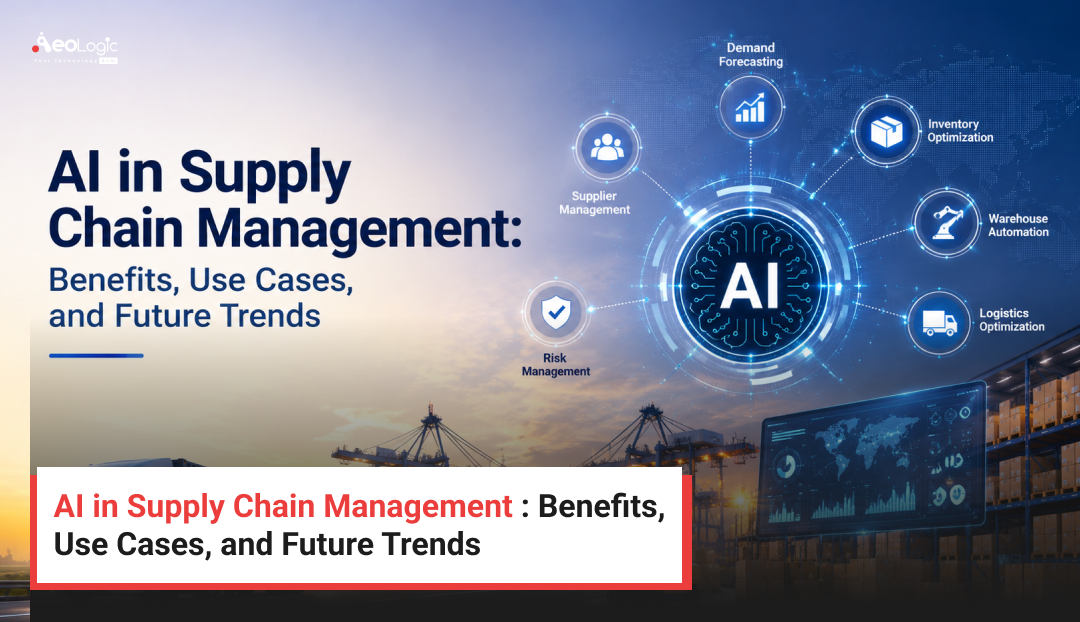
Businesses are constantly confronted with the challenge of optimizing processes, minimizing costs, increasing customer satisfaction, and adapting to market dynamics, all of which are crucial in today’s fast-paced and competitive business landscape. The demands of today’s businesses require a more comprehensive approach to the supply chain than traditional systems with manual processes and historical data analysis could provide. This is where AI in Supply Chain Management is making an impact in the supply chain industry by enabling intelligent automation, predictive analytics, and data-driven decision-making capabilities.
AI has proven to be a transformative tool that empowers businesses to see further into their supply chains, predict demand more accurately and provide more proactive management of disruption, and automate repetitive work. AI is being utilized all the way from procurement and inventory management to logistics and last mile delivery, shaping business supply chain networks to be more resilient, agile, and efficient.
Understanding AI in Supply Chain Management
AI in Supply Chain Management involves the application of AI technologies like machine learning, natural language processing, computer vision, predictive analytics, and intelligent automation to optimize supply chain processes. These technologies empower systems to process vast amounts of data to create patterns, make predictions and aid in the decision-making process with little to no human involvement.
AI-driven supply chains learn from data and adjust to conditions as they go, rather than relying on predetermined rules and past reporting. With this capability, companies will be better able to adapt to demand fluctuations, supplier problems, transportation issues, market shifts and other unforeseen disruptions.
The increasing number of IoT devices, cloud computing platforms, real-time tracking systems, and enterprise resource planning solutions has further propelled AI technologies to be adopted in the supply chain operations. AI’s ability to streamline workflows and boost visibility and efficiency throughout the supply chain lifecycle makes it a powerful asset for organizations.
Why AI is Becoming Essential for Modern Supply Chains
Modern supply chains produce vast quantities of data at various points from suppliers to warehouses, through transportation systems, and to customers and connected devices. But, if data collection fails to generate value, unless organizations are able to analyze and use it for decision making.
AI enables companies to convert raw information in the supply chain into insights that can be acted upon. It can detect inefficiencies, forecast future trends, suggest optimal action, and execute repetitive tasks automatically. With ever increasing expectations from customers and ever wilder market dynamics, organisations need intelligent systems to process information at a speed and scale that is beyond human capacity.
The COVID-19 pandemic showed the world how fragile global supply chains are and how it is important to be resilient and adaptable. Businesses that adopted AI technologies were more likely to proactively respond to disruptions, adjust to stock fluctuations, and ensure business continuity. This has made AI a strategic priority for companies aiming at creating future-ready supply chains.
Key Benefits of AI in Supply Chain Management
AI’s greatest benefit in Supply Chain Management is better demand forecasting. Traditional forecasting techniques may not include all the factors that influence consumer behavior and the external market and these factors change quickly. AI algorithms analyze historical sales data, market trends, seasonal variations, social media activity, and economic indicators to generate highly accurate demand predictions. Forecasting reduces stockouts, lower inventory costs and enhances customer satisfaction.
AI also improves inventory management by constantly keeping an eye on stock levels and forecasting future inventory needs. Intelligent systems can suggest the best reorder levels, pinpoint slow moving stock and avoid overstocking. This means that the inventory turns over better and there are lower carrying costs.
Also, the advantage is increased operational efficiency due to automation. Routine tasks like order processing, supplier assessment, shipment scheduling, and invoice management can be automated using AI-powered systems. This minimizes manual interaction, leading to enhanced productivity, minimized error rates, and employees being able to concentrate on valuable tasks.
Real-time monitoring and predictive analytics give companies increased visibility from supplier to warehouse, transportation, and distribution. This visibility allows businesses to detect potential issues early and take proactive corrective measures.
AI also helps in reducing costs by optimizing logistics routes, optimizing warehouse operations, minimizing waste, and optimizing resource use. Multiple variables can be used to determine the most efficient operational strategies using intelligent algorithms.
AI Use Cases in Supply Chain Management
AI’s potential in the Supply Chain Management sector is gaining momentum in multiple operational areas. AI technologies are helping organizations to solve complex problems and enhance the performance of the whole organization.
Demand Forecasting and Planning
One of the most significant uses of AI in supply chain operations is demand forecasting. By leveraging historical sales data and external factors like weather, economic indicators, promotions, and consumer sentiment, machine learning algorithms can forecast future sales trends and predict demand. These understandings can help businesses make more precise predictions and schedule production accordingly.
Better demand forecasting leads to a better inventory position, lower overstocking and lost sales due to understocking. Business will be able to be more responsive to rapid fluctuations in customer demand, too.
Intelligent Inventory Management
Historically, inventory management has been a tricky balance between having enough product available and costing less to hold the inventory. AI-based inventory management systems constantly monitor stock levels, sales speed, supplier lead times, and demand forecasts to ensure optimal inventory management.
These intelligent systems can automatically recommend replenishment, recognize inventory risks and optimize warehouse utilization. This in turn means that organisations have improved inventory accuracy and improved operating efficiency.
 Supplier Risk Assessment
The reliability of suppliers is a key issue in supply chain performance. AI solutions can analyze supplier performance based on data from various sources, such as delivery records, quality metrics, financial reports, market trends, and news sources.
Through ongoing supply risk assessment, organizations can anticipate risk to suppliers before it makes an impact on operations. AI supplier intelligence is helping companies diversify their sourcing and build resilience into their supply chains.AI supplier intelligence is helping businesses diversify their sourcing and strengthen supply chain resilience.
Logistics and Route Optimization
Transportation is one of the major cost components in the supply chain. By leveraging AI, businesses can optimize their logistics processes by analyzing traffic patterns, weather forecasts, fuel usage, delivery timelines, and other factors that influence their routes.
Smart route optimization systems provide the most efficient delivery routes, optimize transportation expenses and enhance delivery performance. Real-time adjustments can help logistics providers adapt quickly to unforeseen delays and variations.
Warehouse Automation
AI and automation are driving the advancement of warehouses to become smarter than ever. The use of AI-driven systems helps enhance inventory management, order processing, personnel management, and space utilization.
Computer vision technologies can be used to track warehouse operations, detect inefficiencies, and improve inventory management. In addition, automated guided vehicles (AGVs) and robotic systems are increasingly used to automate repetitive tasks and duties in warehouses for greater accuracy and efficiency.
Predictive Maintenance
Equipment failures can cause expensive production downtime and disruption of the supply chain. Predictive maintenance solutions based on AI examine data gathered by sensors and connected devices to spot issues early and warn of a device’s degradation.
This can help organizations avoid potential asset failures, schedule maintenance before they happen, lower repair expenses, and enhance asset reliability. This helps to reduce downtime and increase the useful life of equipment.
Procurement Optimization
AI’s impact on procurement extends beyond efficiency, as it is revolutionizing the way businesses manage supplier selection, contract negotiations, and purchases. Intelligent procurement systems review supplier performance, market pricing and purchasing patterns to find cost savings opportunities.
AI-driven insights can aid in contract negotiations, mitigate procurement risks, and enhance supplier management for organizations. Automated procurement processes also speed up decision-making and efficiency.
Challenges of Implementing AI in Supply Chain Management
While there are several benefits to using AI in Supply Chain Management, there are also some challenges that must be overcome. Data quality is one of the major challenges. The reliability of AI systems is heavily reliant on the quality and correctness of their data. If an organization’s data infrastructure is not fully integrated or not up to date, it may not be able to get the results it seeks.
Integration complexity is another common challenge. There are many businesses running legacy systems, which might not seamlessly integrate with modern AI platforms. Effective implementation may involve significant investments in technology modifications and integration.
AI skills in particular are in short supply, creating challenges for organisations. Developing, deploying, and maintaining AI solutions requires specialized skills in data science, machine learning, and supply chain analytics. To get the most out of AI efforts, companies should invest in employee development and training.
Future Trends of AI in Supply Chain Management
A key trend is the use of autonomous supply chain systems with limited human interaction that make decisions in real time. These systems will continuously monitor operations, detect issues, and automatically take corrective measures.
The combination of AI and Internet of Things technologies will further improve real-time visibility through supply chain networks. A web of sensors, vehicles, equipment, and inventory management systems will provide real-time data that AI models can utilize to enhance decision-making.
Digital twins are also becoming a widely adopted solution for supply chain optimisation. Generative AI will be an ever-more significant enabler for supply chain planning and decision support. With the assistance of advanced AI models, organizations will be able to leverage insights, automate reporting, optimize workflows and enhance strategic planning processes.
Through AI technologies, businesses can keep track of carbon emissions, use resources efficiently, minimize waste, and work towards environmental sustainability goals without compromising operational efficiency.
With the ongoing advancements in AI technologies, businesses can expect to have access to more sophisticated tools and solutions in the future, which will further boost agility, resilience, and competitiveness across their supply chain operations.
Conclusion
AI for Supply Chain Management is transforming the way businesses plan, manage, and optimize their supply chains. Through the use of smart technologies like machine learning, predictive analytics, automation, and computer vision, organizations can gain more accurate forecasts, better inventory management, smoother logistics, cost-saving advantages, and a more resilient supply chain.
In the current complex global supply chain, AI-driven solutions are rapidly gaining traction in various sectors, driven by the rising demands of customers. Data quality, data integration, skill and security challenges are still there, but the future rewards are far greater than the challenges. To implement AI-driven strategies and to reap the measurable benefits of your organization’s business, the right technology partner is essential to modernizing your supply chain operations. Aeologic Technologies enables businesses to use cutting-edge AI, automation, predictive analytics and intelligent supply chain solutions to gain greater visibility, optimize operations and cut costs, while improving supply chain resiliency and preparedness. The implementation of advanced AI technologies today can be a game-changer for businesses aiming to stay competitive and thrive in the evolving global market.
FAQs
Q1. What is AI in Supply Chain Management?
AI in Supply Chain Management refers to the use of artificial intelligence technologies to improve planning, forecasting, and overall supply chain operations through intelligent automation and data-driven decision-making.
Q2. How does AI improve supply chain efficiency?
AI improves efficiency by automating repetitive tasks, optimizing logistics routes, enhancing demand forecasting, improving inventory management, and providing real-time visibility into supply chain activities.
Q3. What industries use AI in Supply Chain Management?
Industries such as manufacturing, retail, healthcare, automotive, logistics, e-commerce, consumer goods, and food distribution are increasingly adopting AI-powered supply chain solutions.
Q4. What are the biggest benefits of AI in supply chains?
The major benefits include improved forecasting accuracy, reduced operational costs, better inventory control, enhanced supply chain visibility, increased productivity, and stronger resilience against disruptions.
Q5. What is the future of AI in Supply Chain Management?
The future includes autonomous supply chains, AI-powered digital twins, predictive decision-making, generative AI applications, enhanced sustainability initiatives, and deeper integration with IoT technologies.