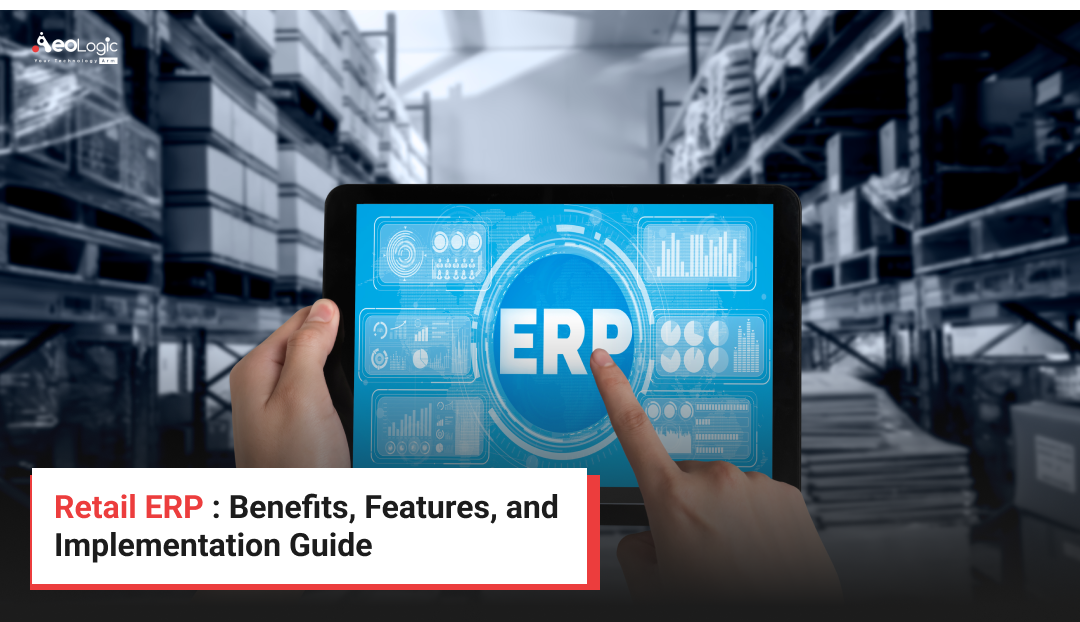
Retail is a rapidly changing sector, with businesses trying to keep up with their customers’ ever-changing expectations, supply chain complexities, and the use of multiple sales channels. Whether in retail stores or through online channels, or across a combination of both (omnichannel retail), retailers are being challenged to remain operationally efficient but also deliver outstanding customer experiences. To overcome these challenges, numerous businesses are adopting Retail ERP solutions which have all the essential business processes integrated into one system.
A Retail ERP system allows retailers to operate in a streamlined manner with regard to inventory management, sales, procurement, finance, customer relationship management, and supply chain activities. Retail ERP’s real-time visibility of business operations assist companies in making better decisions, cutting costs, and satisfying their clients. With the retail industry becoming increasingly competitive, having a strong Retail ERP solution is no longer just a technological upgrade – it is a strategic need.
This comprehensive guide explores what Retail ERP is, its key features, business benefits, implementation strategies, challenges, and best practices for successful deployment.
What is Retail ERP?
Retail Enterprise Resource Planning (Retail ERP) is a specialized ERP solution that integrates and automates core ERP business functions within a single software platform. While a conventional ERP system is suitable for a variety of industries, Retail ERP is uniquely designed to cater to the specific needs of retail operations, such as managing stock, integrating with the point of sale, customer management, merchandising, supply chain management, warehouse management, and finances.
The main goal of a Retail ERP system is to remove data silos and get a single view of retail operations. Retailers don’t need to use different software applications for inventory, accounting, sales, and customer information; they can manage all the important functions in one. This centralized approach increases the visibility of the operations, helps to coordinate different departments, and helps to make decisions based on data in time.
In addition, modern Retail ERP systems can integrate physical stores, online marketplaces, mobile apps, and e-commerce websites, enabling them to operate seamlessly beyond the confines of a single channel. This integration guarantees inventory consistency, pricing accuracy, and customer experiences across all sales channels.
Why Retail Businesses Need ERP Solutions?
The retail world is becoming increasingly complicated, with customers’ needs, stock requirements, and market conditions constantly evolving. These variables are challenging to manage with disjointed systems, resulting in inefficiencies, inaccurate reporting, inventory inaccuracies, and poor customer experiences.
This is where Retail ERP comes in handy and turns the situation around by providing a centralized system that lets information flow across departments. Inventory automatically updates, books are updated and performance metrics are updated on management dashboards when a sale occurs. This is performed in real time, greatly reducing manual effort and the chance of mistakes.
Moreover, retailers need to be agile in adapting to new consumer preferences and market requirements. A Retail ERP solution offers key insights into sales performance, customer preferences, supplier efficiency, and inventory movements, allowing companies to make informed decisions and stay competitive in dynamic markets.
Key Features of a Retail ERP System
In the modern era, a Retail ERP solution must have an extensive range of features that can optimize the retail operation and boost the overall performance of the retail business.
Inventory Management
One of the key functions of a Retail ERP is inventory management. It helps retailers keep track of inventory from store to store, or from warehouse and distribution center. Having accurate inventory records can help to minimise stock outs, overstocking and product availability. Automated stock replenishment and demand forecasting tools also help retailers optimize stock investment and guarantee customer demands are met.
Point-of-Sale (POS) Integration
Retail ERP integrates with the cash registers to track all sales in real-time throughout the business. Sales data and inventory updates are synced in real time, financial records are updated, and customer information is updated—no manual data entry or operational error. With this integration, retailers can gain a full picture of sales performance and business operations.
Customer Relationship Management (CRM)
Customer relationship management feature allows retailers to keep all customer information in one place to strengthen relationships with customers. Retailers can monitor purchase behavior, customer appetites, loyalty program membership, and consumer interaction. With these insights, companies can offer customers a more one-to-one shopping experience, more targeted promotions, and better customer service, and thus enhance the value and retention of customers.
Supply Chain Management
Supply chain management plays a very significant role in ensuring the availability and efficiency of operations. Retail ERP solutions offer visibility of procurement processes, supplier performance, purchase orders and logistics processes. Retailers can benefit from enhancing the collaboration with suppliers, reducing disruptions, optimizing operational costs, and delivering timely products while simplifying demand planning.
Financial Management and Accounting
Financial management skills enable retailers to streamline accounting procedures and improve their financial management. It handles accounts payable, accounts receivable, general ledger functions, budgeting, taxation and financial reporting. The real-time financial visibility will enable you to track your profitability, manage cash flow effectively, and make informed decisions about your strategy.
Warehouse Management
The warehouse management helps retailers optimize picking, packing, and shipping activities as well as optimize storage. Enhanced visibility and operational efficiency in the warehouse will help businesses to shorten order fulfillment times, minimize errors, and boost productivity. Seamless integration with inventory and logistics functions guarantees the smooth flow of products in the supply chain.
 Major Benefits of Implementing Retail ERP
Having a Retail ERP system in place offers many benefits in all areas of retail.
Improved Inventory Management and Stock Visibility
One of the biggest benefits of a Retail ERP solution is that it provides full visibility of inventory at every retail location, warehouse and distribution center. Retailers can view inventory real-time, monitor inventory movements, and get automatic alerts if the stock needs replenishing. This greater visibility can avoid adding to the stock out, overstocking and availability of products to customers.
Enhanced Customer Experience
Today’s consumers want to enjoy a convenient shopping experience without a hitch, whether they are using their computers, telephones, or in physical stores. Retail ERP combines data from customer, sales and inventory sources to create a seamless customer experience. Retailers can make better suggestions, fast delivery, right product information and better customer service, which will increase customer satisfaction and loyalty.
Better Financial Management and Reporting
Retail ERP systems come with built-in financial management features, automating accounting workflows, monitoring spending, managing budgets, and creating precise financial reports. Up-to-the-minute access to financial performance indicators allows business leaders to make informed decisions, optimize cash flow, and ensure compliance with financial regulations.
Data-Driven Decision Making
Retail ERP systems also come with analytics and reporting features that help businesses convert their data into actionable insights. Retail managers can measure the trends of sales, customer buying habits, product performance, and supplier performance. These insights contribute to business strategy and serve as a guide to growth and business efficiencies.
Built to Scale for Business Growth
Today’s retail stores face growing complexity because of the expansion of product lines, expansion of store locations and expanding channels of distribution. The aim of retail ERP systems is to grow along with the organization, supporting companies to deal with growing transaction volumes, bigger stockrooms, and more complex shopping chain connections without compromising efficiency or performance.
How to Successfully Implement a Retail ERP System
Define Clear Business Objectives
The initial step to a successful Retail ERP implementation is to set goals and expectations. The organization should determine its operational problems, such as inventory accuracy, customer service, operational cost reduction, and omnichannel retailing. A clear objective helps to steer the whole process of implementing the project and provides indicators of project success.
Analyze Existing Business Processes
It is important to thoroughly review the existing workflows and existing business processes before choosing and deploying a Retail ERP solution. A clear understanding of the current inefficiencies, bottlenecks, and pain points helps organizations plan their ERP strategy and make sure the new ERP system meets their business needs.
Choose the Right Retail ERP Solution
Choosing an ERP system is a key decision that can influence the success of the implementation. When choosing a solution, retailers need to consider the solution’s functionality, scalability, industry-specific attributes, integration options, customizability, and vendor support.
Create a Detailed Implementation Plan
A roadmap to the structured implementation makes it easier to ensure that the project is delivered on time and within budget. The plan needs to have a timeline, allocation of resources, milestones, risk management strategies and responsibility of all stakeholders involved. Having a clear roadmap helps to minimize uncertainty and enhance project coordination.
Common Challenges During Retail ERP Implementation
Resistance to Organizational Change
Staff may become complacent with their current systems and processes and not want to learn new technologies. People are often reluctant to change, which can hinder implementation and adoption. This can be addressed with effective communication, training, and stakeholder involvement at an organization.
Data Migration Issues
Most retail companies have data throughout various systems and spreadsheets, and frequently in duplicate, incomplete or inconsistent formats. This data can be rather difficult to get into a Retail ERP system and can take a while. Data cleansing and validation procedures are critical for accurate data and efficient systems.
Integration with Existing Systems
Retailers often use several third-party applications like eCommerce systems, payment systems, customer loyalty programs, and warehouse management software.
Unforeseen expenses and budget overruns
However, ERP projects can sometimes go over budget, as they may have to be customized, may take longer to implement, may require more training, or may have unexpected technical problems. Realistic budgets and good project governance can help organizations manage their budgets effectively.
Inadequate User Training
The best of Retail ERP system can be insufficient to meet desired outcomes when employees lack adequate training. Inadequate training can result in minimal adoption, mistakes and inefficiencies. On-going training and post-implementation support are essential for long-term success.
Future Trends in Retail ERP
New technologies including artificial intelligence, machine learning, cloud computing, Internet of Things (IoT), and advanced analytics are helping to drive the future of Retail ERP. AI-driven Retail ERP solutions are powering predictive stock management, smart demand forecasting, and automated decision-making processes.
The popularity of cloud-based Retail ERP systems is still growing because they are flexible, scalability, and require less infrastructure. Retailers have access to business-critical information from anywhere, while receiving automatic updates and added security.
Businesses are benefiting from advanced analytics and real-time reporting features that provide deeper insights into customer behavior, sales trends, and business performance. These abilities help forecast more accurately and strategically plan.
Conclusion
Retail ERP has emerged as a vital tool for retail organizations aiming to boost their efficiency, enrich customer experiences, and foster long-term growth and success. Retail ERP combines inventory management, sales operations, supply chain management, financial management, and customer engagement in a single platform, offering retailers the visibility and control necessary to succeed in the fast-paced retail industry.
For companies aiming to upgrade their retail processes and extract the maximum value from their ERP investments, there are advantages in enlisting the help of seasoned technology providers. At Aeologic Technologies, we can assist you in making use of intelligent ERP solutions that facilitate operations, give real-time access to inventory, offer a better customer knowledge and experience, and assist in long-term business growth. Get in touch with our specialists to learn how the right Retail ERP strategy can make your retail business a great success.
FAQs
Q1. What is Retail ERP?
Retail ERP is a specific type of ERP software tailored to the retail industry for managing everything from inventory, sales, and procurement, to customer management, finance and supply chain activities, from a single platform.
Q2. What are some of the primary advantages of Retail ERP?
The main advantages are increased efficiency, more visibility into inventory, improved customer experiences, accurate financial reporting, effective supply chain management, and data-driven decision making.
Q3. What are the benefits of Retail ERP for Inventory Management?
Retail ERP also offers real-time inventory management, inventory replenishment, demand forecasting, and multi-location inventory visibility to minimize out-of-stock and overstock situations.
Q4. Should small retailers use Retail ERP?
Yes. Some current Retail ERP will provide the flexibility to run it at any scale, enabling small and medium retailers to reap the rewards of integrated business management without the high price tag.
Q5. What is the time frame for implementing Retail ERP?
The time it takes to implement will depend on the size and complexity of the business, customization needs, and the amount of data involved in the migration. For large enterprises, most projects can take a few months to more than a year.