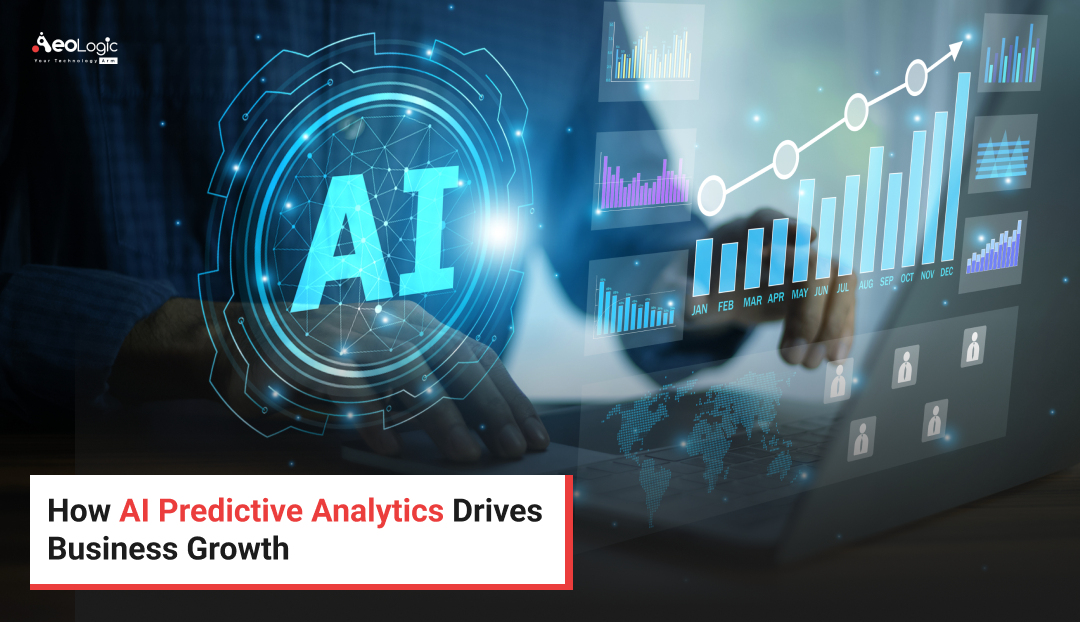
Every business leader eventually faces the same frustrating pattern: the data that would have predicted a problem only becomes obvious after the problem has already happened — a customer who churns, a product that runs out of stock, a quarter that misses its forecast. AI Predictive Analytics exists to close that gap. By combining machine learning with the data companies already collect, it shifts decision-making from reactive to proactive, giving teams a genuine head start instead of a post-mortem.
This guide breaks down what AI Predictive Analytics is, how it works, where it delivers the most value, and how to start using it without getting lost in hype.
What is AI Predictive Analytics?
AI Predictive Analytics is the use of artificial intelligence and machine learning to analyze historical and real-time data in order to forecast future outcomes. Instead of simply reporting what already happened, AI Predictive Analytics identifies patterns in data and uses them to anticipate what is likely to happen next — whether that’s a customer canceling a subscription, a spike in product demand, or a dip in quarterly revenue.
Traditional business intelligence tools tell you what happened. AI Predictive Analytics tells you what’s probably coming, giving leaders a meaningful head start on decisions that would otherwise be reactive.
AI Predictive Analytics combines machine learning algorithms with historical and real-time business data to forecast future trends, customer behavior, and operational outcomes — helping companies make proactive, data-backed decisions instead of relying on guesswork.
 Why Businesses are Turning to AI Predictive Analytics
Markets move faster than they used to, and the businesses that win tend to be the ones that see change coming before it arrives. That’s the core appeal of AI Predictive Analytics: it turns raw, messy data into forward-looking insight that teams can actually act on.
A few forces are driving adoption:
- Data volume has exploded. Companies now collect more customer, operational, and transactional data than any human team could analyze manually. AI Predictive Analytics makes that data usable.
- Customer expectations have risen. Shoppers and clients expect personalized, timely experiences, and predictive models are what make that personalization possible at scale.
- Competitive pressure is constant. When competitors start using AI Predictive Analytics to anticipate demand or churn, companies that rely on gut instinct alone start falling behind.
- Cloud and AI tools are more accessible. Predictive analytics used to require a data science team and a six-figure budget. Today, many AI Predictive Analytics platforms are available as affordable, no-code or low-code tools.
How AI Predictive Analytics Works
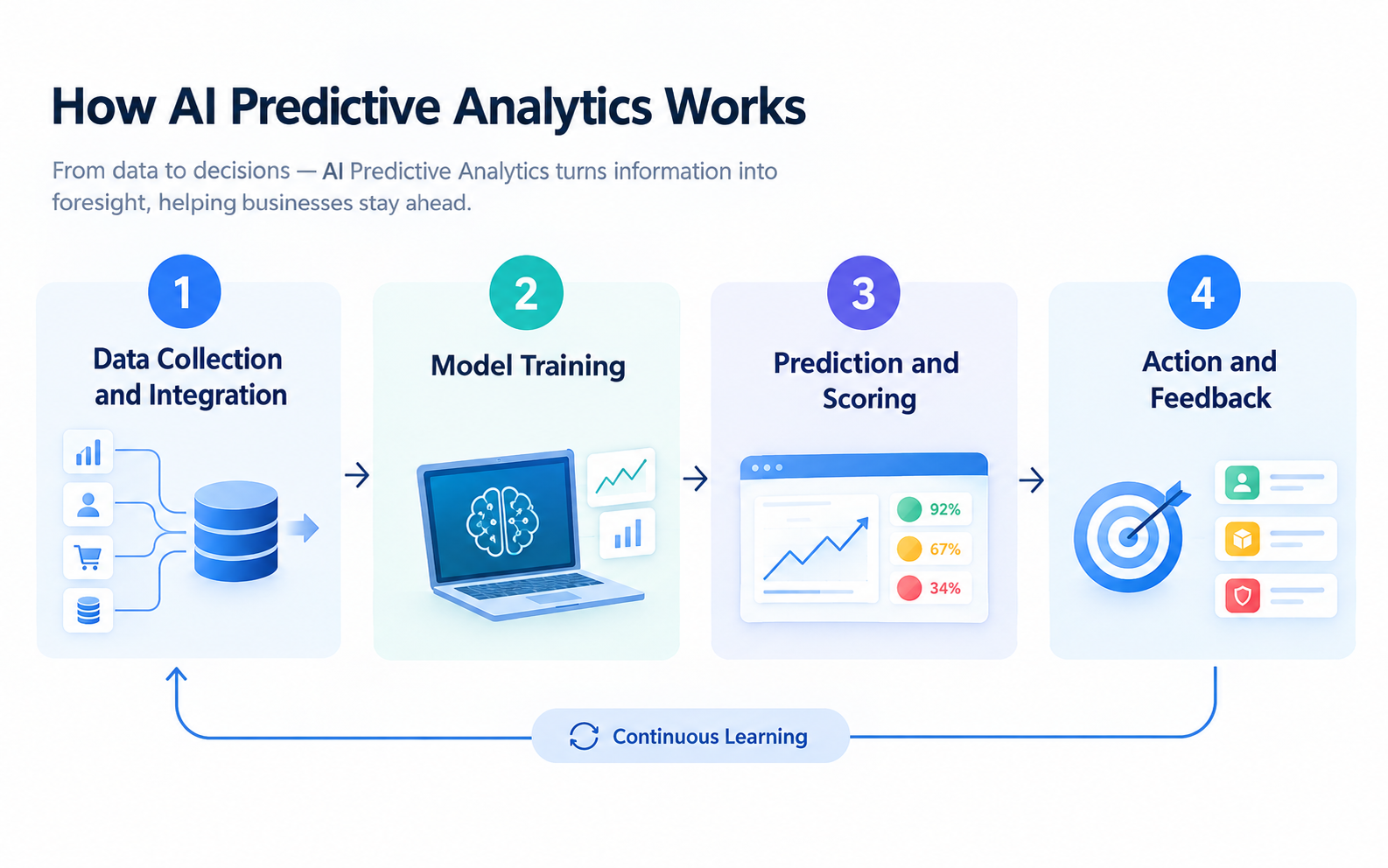
Understanding the mechanics behind AI Predictive Analytics helps businesses set realistic expectations before investing in it. The process generally follows four stages.
1. Data Collection and Integration
Everything starts with data — sales records, website behavior, CRM entries, support tickets, supply chain logs, and more. For AI Predictive Analytics to produce reliable forecasts, this data needs to be collected consistently and integrated from multiple sources into a single, clean dataset.
2. Model Training
Once the data is organized, machine learning models are trained to recognize patterns and relationships within it. This is where AI Predictive Analytics starts to differ from basic statistics: the models can continuously learn and refine their predictions as new data comes in, rather than relying on a single static formula.
3. Prediction and Scoring
The trained model then generates predictions — a likelihood that a customer will churn, a forecasted demand level for next quarter, or a risk score for a transaction. These outputs are typically expressed as probabilities or rankings, which makes them easy for business teams to prioritize and act on.
4. Action and Feedback
The final (and most important) stage is turning predictions into action — triggering a retention offer, adjusting inventory, or flagging a transaction for review. The outcomes of those actions then feed back into the system, helping the AI Predictive Analytics model improve over time.
 Key Business Benefits of AI Predictive Analytics
Smarter, Faster Decision-Making
Instead of waiting for a monthly report to reveal a problem, leaders using AI Predictive Analytics can see issues — and opportunities — forming in real time. This shortens the gap between insight and action, which is often the real competitive advantage.
Improved Customer Retention
AI Predictive Analytics can flag customers who show early warning signs of churn, such as declining engagement or support complaints, long before they cancel. That gives retention teams a window to intervene with personalized offers or outreach.
Optimized Inventory and Supply Chain
Retailers and manufacturers use AI Predictive Analytics to forecast demand more accurately, reducing both stockouts and excess inventory. Better forecasting translates directly into lower holding costs and fewer missed sales.
Reduced Operational Risk
In finance, insurance, and manufacturing, AI Predictive Analytics is used to flag anomalies — a potentially fraudulent transaction, an equipment failure risk, or a compliance issue — before they become costly problems.
Stronger Revenue Growth
By identifying which leads are most likely to convert, which customers are ready to upsell, and which pricing strategies will perform best, AI Predictive Analytics helps sales and marketing teams focus their effort where it will pay off most.
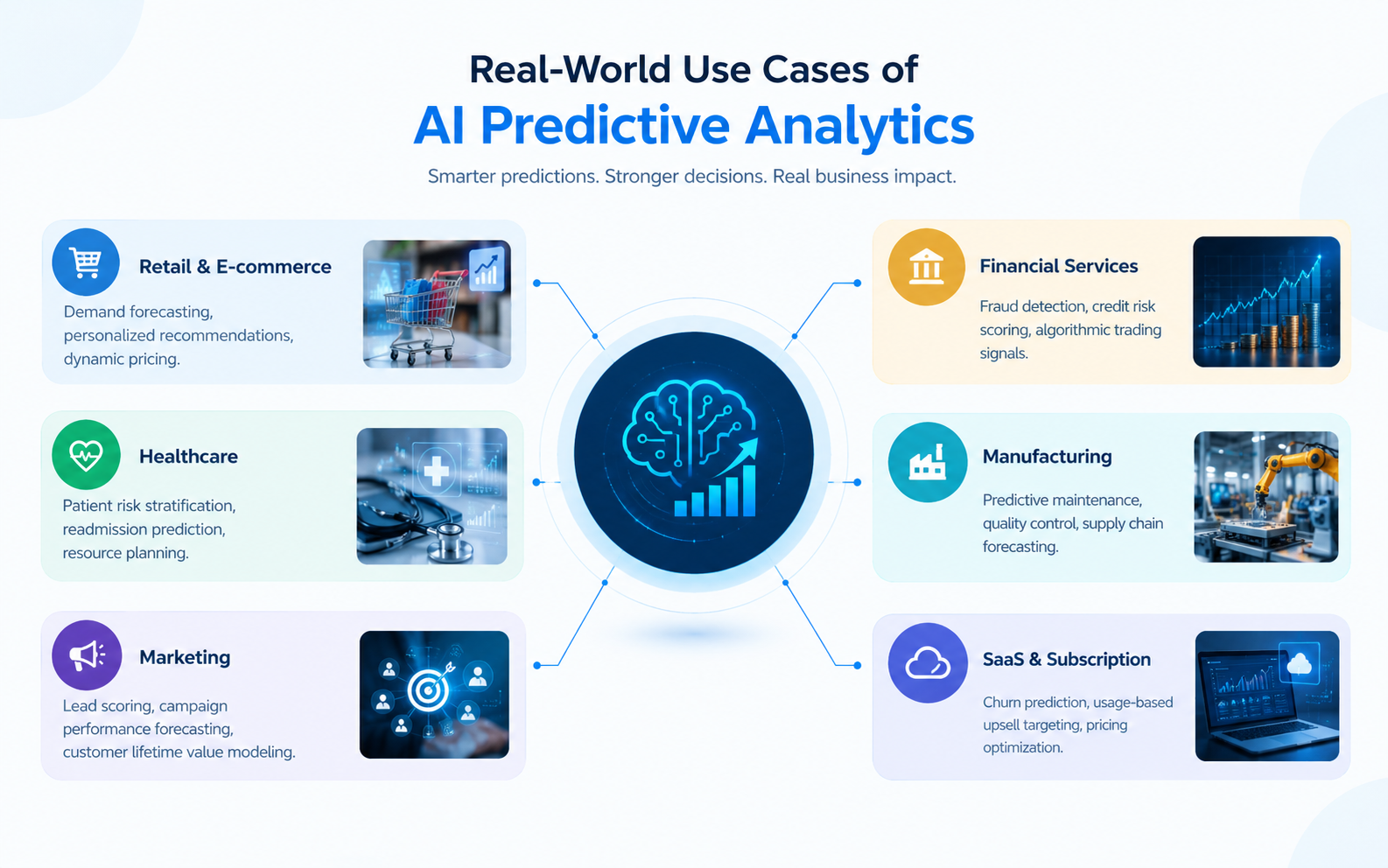
Real-World Use Cases of AI Predictive Analytics by Industry
| Industry | How AI Predictive Analytics Is Used |
|---|---|
| Retail & E-commerce | Demand forecasting, personalized product recommendations, dynamic pricing |
| Financial Services | Fraud detection, credit risk scoring, algorithmic trading signals |
| Healthcare | Patient risk stratification, readmission prediction, resource planning |
| Manufacturing | Predictive maintenance, quality control, supply chain forecasting |
| Marketing | Lead scoring, campaign performance forecasting, customer lifetime value modeling |
| SaaS & Subscription | Churn prediction, usage-based upsell targeting, pricing optimization |
Each of these use cases shares a common thread: AI Predictive Analytics turns historical patterns into forward-looking guidance that teams can act on before an event occurs, not after.
Illustrative example — retail: Imagine an online apparel retailer noticing that sales of winter jackets tend to spike several weeks before regional temperature drops, based on past browsing and purchase patterns. An AI Predictive Analytics model trained on seasonal trends, regional weather signals, and historical sales could flag the right time to increase ad spend and inventory for that category — well before competitors react to the same seasonal shift.
Illustrative example — subscription software: A SaaS company might notice that accounts which stop logging into a key feature for two consecutive weeks are far more likely to cancel. An AI Predictive Analytics model built around product usage data could surface those accounts automatically, letting the customer success team reach out with training or incentives before the account churns rather than after a cancellation request arrives.
These are simplified illustrations of the pattern-based thinking behind AI Predictive Analytics — the specific signals and thresholds would be refined using a company’s own historical data.
 Frequently Overlooked Signals in AI Predictive Analytics Models
Beyond obvious metrics like purchase history or login frequency, well-built AI Predictive Analytics models often incorporate softer signals that add meaningful predictive power: support ticket sentiment, response time to marketing emails, seasonal browsing behavior, and even changes in order frequency relative to a customer’s own historical baseline. The strongest AI Predictive Analytics implementations combine several of these signals rather than relying on any single data point, since real customer and market behavior is rarely explained by one variable alone.
Challenges of Implementing AI Predictive Analytics
Adopting AI Predictive Analytics isn’t automatically a smooth process. Common obstacles include:
- Data quality issues. Predictive models are only as good as the data behind them; incomplete or inconsistent data leads to unreliable forecasts.
- Siloed systems. When customer, sales, and operational data live in separate, disconnected tools, it’s harder to build a complete picture for AI Predictive Analytics to work with.
- Skill gaps. Interpreting and acting on predictive outputs requires some data literacy across teams, not just within a data science department.
- Change management. Even accurate predictions are useless if teams don’t trust them or don’t change their workflows to act on them.
- Cost and integration complexity. Connecting an AI Predictive Analytics platform to existing business systems can take real planning and budget, especially for larger organizations.
Best Practices for AI Predictive Analytics Success
- Start with a specific business question. Rather than “let’s use AI,” aim for something concrete, like “which customers are most likely to churn in the next 30 days?”
- Clean and centralize your data first. AI Predictive Analytics performs far better on consistent, well-structured data than on scattered spreadsheets.
- Choose tools that fit your team’s skill level. Some AI Predictive Analytics platforms require data science expertise; others are built for business users.
- Validate predictions against real outcomes. Regularly check forecasts against what actually happened, and retrain models when accuracy drifts.
- Build a feedback loop into workflows. The real value of AI Predictive Analytics comes from acting on predictions, not just viewing dashboards.
- Get buy-in across departments. Marketing, sales, operations, and finance all benefit from predictive insight — involve them early so adoption sticks.
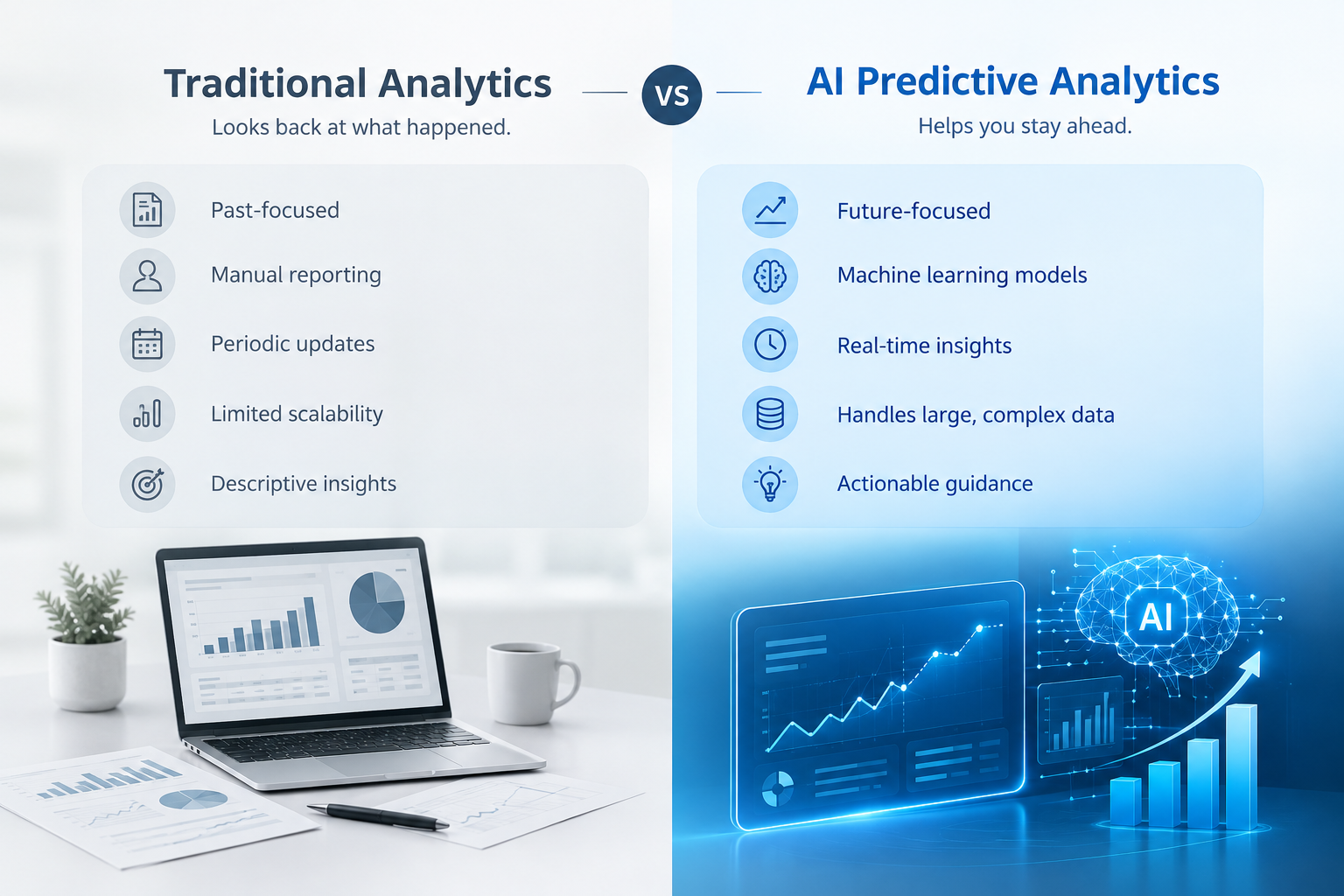
AI Predictive Analytics vs. Traditional Analytics
| Aspect | Traditional Analytics | AI Predictive Analytics |
|---|---|---|
| Focus | What happened in the past | What is likely to happen next |
| Method | Manual reporting, static dashboards | Machine learning models that adapt over time |
| Speed | Periodic (weekly/monthly reports) | Continuous, near real-time |
| Scalability | Limited by analyst bandwidth | Scales across large, complex datasets |
| Business Value | Descriptive insight | Forward-looking, actionable guidance |
 Common Mistakes Businesses Make with AI Predictive Analytics
Even well-funded AI Predictive Analytics initiatives can underdeliver when a few avoidable mistakes creep in:
- Treating it as a one-time project. AI Predictive Analytics isn’t a dashboard you set up once and forget — models need regular retraining as business conditions change.
- Ignoring the “last mile.” Generating an accurate prediction is only half the job; if nobody owns the follow-up action, the prediction never turns into value.
- Overcomplicating the first use case. Teams that try to predict everything at once often stall out. Starting narrow — one churn model, one demand forecast — builds momentum and trust.
- Underestimating data prep time. Most of the effort in any AI Predictive Analytics project goes into cleaning and connecting data, not building the model itself.
- Skipping stakeholder education. If sales, marketing, or operations teams don’t understand how to read a prediction score, they won’t use it — no matter how accurate the model is.
How to Choose the Right AI Predictive Analytics Tool
With dozens of platforms on the market, picking the right fit matters as much as the technology itself. When evaluating an AI Predictive Analytics tool, consider:
- Integration compatibility — does it connect natively with your CRM, e-commerce platform, or ERP, or will it require custom development work?
- Ease of use — can business users interpret and act on predictions, or does every insight require a data analyst to translate it?
- Transparency — does the platform explain why it made a prediction, or is it a black box? Explainability builds trust and makes adoption easier.
- Scalability — can the tool handle growing data volumes and additional use cases as your AI Predictive Analytics program matures?
- Security and compliance — especially for industries like healthcare and finance, make sure the platform meets relevant data protection standards.
A short pilot project — applying AI Predictive Analytics to a single, well-defined problem — is usually the fastest way to evaluate a tool before committing to a wider rollout. It also gives internal stakeholders a tangible result to point to, which makes it far easier to secure budget and buy-in for expanding AI Predictive Analytics into other parts of the business afterward.
Measuring the ROI of AI Predictive Analytics
Because AI Predictive Analytics is still viewed by some leadership teams as experimental, proving return on investment early matters. A practical way to do this is to compare outcomes for a group where predictions were acted on against a group where they weren’t — for example, customers flagged as churn-risks who received a retention offer versus those who didn’t. Tracking metrics like retention rate, forecast accuracy, inventory turnover, or fraud losses before and after adoption gives a concrete, defensible picture of what AI Predictive Analytics is actually contributing, rather than relying on anecdotal impressions.
The Future of AI Predictive Analytics
As AI models become more accessible and easier to integrate, AI Predictive Analytics is shifting from a specialized data-science function to a standard part of everyday business tooling.
Expect to see deeper integration with everyday platforms like CRMs and e-commerce systems, more natural-language interfaces for exploring predictions, and a growing shift toward “prescriptive” analytics — tools that don’t just predict an outcome but recommend the best next action to take.
Key Takeaways
- AI Predictive Analytics uses machine learning to forecast future outcomes from historical and real-time data.
- It helps businesses make proactive decisions around customer retention, inventory, risk, and revenue.
- Success depends heavily on data quality, clear business questions, and cross-team buy-in.
- Industries from retail to healthcare to finance are already using AI Predictive Analytics to gain a competitive edge.
- The field is moving toward prescriptive analytics, where predictions come paired with recommended actions.
Conclusion
AI Predictive Analytics is no longer a futuristic concept reserved for data science teams — it’s becoming a practical, accessible tool for businesses of every size that want to move from reactive decision-making to proactive growth. Whether the goal is reducing churn, forecasting demand, or minimizing risk, AI Predictive Analytics gives teams the forward-looking insight needed to act before problems happen, not after.
Companies that invest in clean data, the right tools, and a culture of acting on predictions are best positioned to turn AI Predictive Analytics into measurable business growth. Aeologic Technologies helps businesses leverage data-driven insights to improve decision-making, optimize operations, and identify new growth opportunities.
Detailed FAQ Section
Q1. What is AI Predictive Analytics used for in business?
AI Predictive Analytics is used to forecast outcomes like customer churn, product demand, sales performance, and operational risk. Businesses apply it across marketing, sales, finance, and operations to move from reactive reporting toward proactive, data-driven decision-making.
Q2. How is AI Predictive Analytics different from traditional analytics?
Traditional analytics describes what already happened using static reports. AI Predictive Analytics uses machine learning models that continuously learn from new data to forecast what is likely to happen next, making it inherently forward-looking rather than historical.
Q3. What data do you need for AI Predictive Analytics?
You typically need clean, consistent historical data relevant to the outcome you’re predicting — such as past sales, customer behavior, support interactions, or operational logs. Data quality matters more than data volume for reliable AI Predictive Analytics results.
Q4. Is AI Predictive Analytics only for large enterprises?
No. While early predictive analytics required large data science teams, many modern AI Predictive Analytics platforms are built for small and mid-sized businesses, offering no-code or low-code tools that don’t require an in-house data scientist.
Q5. How accurate is AI Predictive Analytics?
Accuracy varies by use case, data quality, and model design, so there’s no universal figure. Businesses typically validate AI Predictive Analytics models against real outcomes over time and retrain them as accuracy drifts or business conditions change.
Q6. What industries benefit most from AI Predictive Analytics?
Retail, financial services, healthcare, manufacturing, and SaaS businesses are among the heaviest users of AI Predictive Analytics today, applying it to demand forecasting, fraud detection, patient risk scoring, predictive maintenance, and churn prediction respectively.
Q7. How much does AI Predictive Analytics cost to implement?
Costs vary widely depending on the platform, data complexity, and integration needs — ranging from affordable subscription-based tools for small teams to larger custom implementations for enterprises. A focused pilot project is a practical way to estimate cost before a full rollout.

With a strong foundation in software and a growing expertise in AI, I specialize in building smart, scalable solutions that drive digital transformation