

Walk into almost any hospital today and you’ll notice something that would have looked like science fiction twenty years ago: robots delivering medication trays, software flagging a patient’s deteriorating vital signs before a nurse even checks the monitor, and chatbots scheduling appointments at 2 a.m. without a single human involved. This is Automation in Healthcare in action, and it’s reshaping how care is delivered, how hospitals run, and how patients experience the system.
Automation in Healthcare isn’t a single tool or a futuristic promise anymore — it’s a practical, growing part of daily operations across hospitals, clinics, pharmacies, and insurance companies. This article breaks down what Automation in Healthcare actually means, why it’s gaining so much momentum, where it’s already working, what challenges it brings, and how organizations can approach it thoughtfully.
What is Automation in Healthcare?
Automation in Healthcare refers to the use of technology — software, robotics, and artificial intelligence — to perform repetitive, rules-based, or data-heavy tasks that were traditionally done manually by healthcare staff. This spans everything from administrative work like appointment scheduling and insurance claims to clinical support like diagnostic imaging analysis and medication dispensing.
At its core, Automation in Healthcare is about freeing up human time and attention for the things machines can’t do: empathy, complex judgment, and hands-on care. The technology doesn’t replace clinicians; it removes friction from the processes around them.
Healthcare automation generally falls into three broad categories:
- Administrative automation — scheduling, billing, insurance verification, and records management.
- Clinical automation — diagnostic support, robotic surgery assistance, medication management, and remote patient monitoring.
- Operational automation — supply chain management, inventory tracking, and facility logistics.
 Why Automation in Healthcare Is Gaining Momentum
A few converging forces have pushed Automation in Healthcare from a “nice to have” to something hospitals actively budget for.
1. Rising Administrative Burden
Studies and industry reports consistently point to administrative work — not direct patient care — as one of the biggest drains on clinician time. Paperwork, documentation, and billing eat into hours that could otherwise go toward patients. Automation in Healthcare directly targets this problem by handling repetitive documentation and claims work in the background.
2. Workforce Shortages
Many regions face a shortage of nurses, physicians, and specialized technicians. Automation in Healthcare helps stretch limited staff further by taking over routine tasks, allowing existing teams to focus on higher-value clinical work rather than administrative overhead.
3. Pressure to Reduce Costs
Healthcare spending continues to climb in most developed economies. Automation in Healthcare offers a way to control costs without necessarily cutting services — by streamlining workflows, reducing billing errors, and minimizing waste in supply chains.
4. Growing Patient Expectations
Patients increasingly expect the same convenience from healthcare that they get from banking or retail apps — online scheduling, instant appointment reminders, and quick answers to simple questions. Automation in Healthcare makes these self-service experiences possible at scale.
Key Benefits of Automation in Healthcare
Improved Accuracy and Reduced Errors
Manual data entry is a leading source of mistakes in medical records, prescriptions, and billing codes. Automated systems apply consistent rules every time, which significantly lowers the risk of transcription errors, duplicate records, and miscoded claims.
Faster Administrative Processes
Tasks like insurance verification, which might take a staff member 15–20 minutes per patient, can often be completed by automated systems in seconds. This speeds up everything from check-in to discharge.
Better Resource Allocation
When routine tasks are automated, clinical and administrative staff can be redeployed to work that actually requires human judgment — patient counseling, complex case management, or quality improvement initiatives.
Enhanced Patient Experience
Automated appointment reminders, online scheduling portals, and automated follow-up messages reduce no-show rates and keep patients engaged in their own care journey without adding to staff workload.
Data-Driven Decision Making
Automation in Healthcare often comes paired with analytics dashboards that surface trends — bed occupancy, readmission risk, or supply usage — that would be difficult to track manually across a large organization.
Cost Savings Over Time
While the upfront investment in automation tools can be significant, the long-term savings from reduced errors, faster processing, and better resource use typically outweigh the initial cost for most mid-to-large healthcare organizations.
Real-World Use Cases of Automation in Healthcare
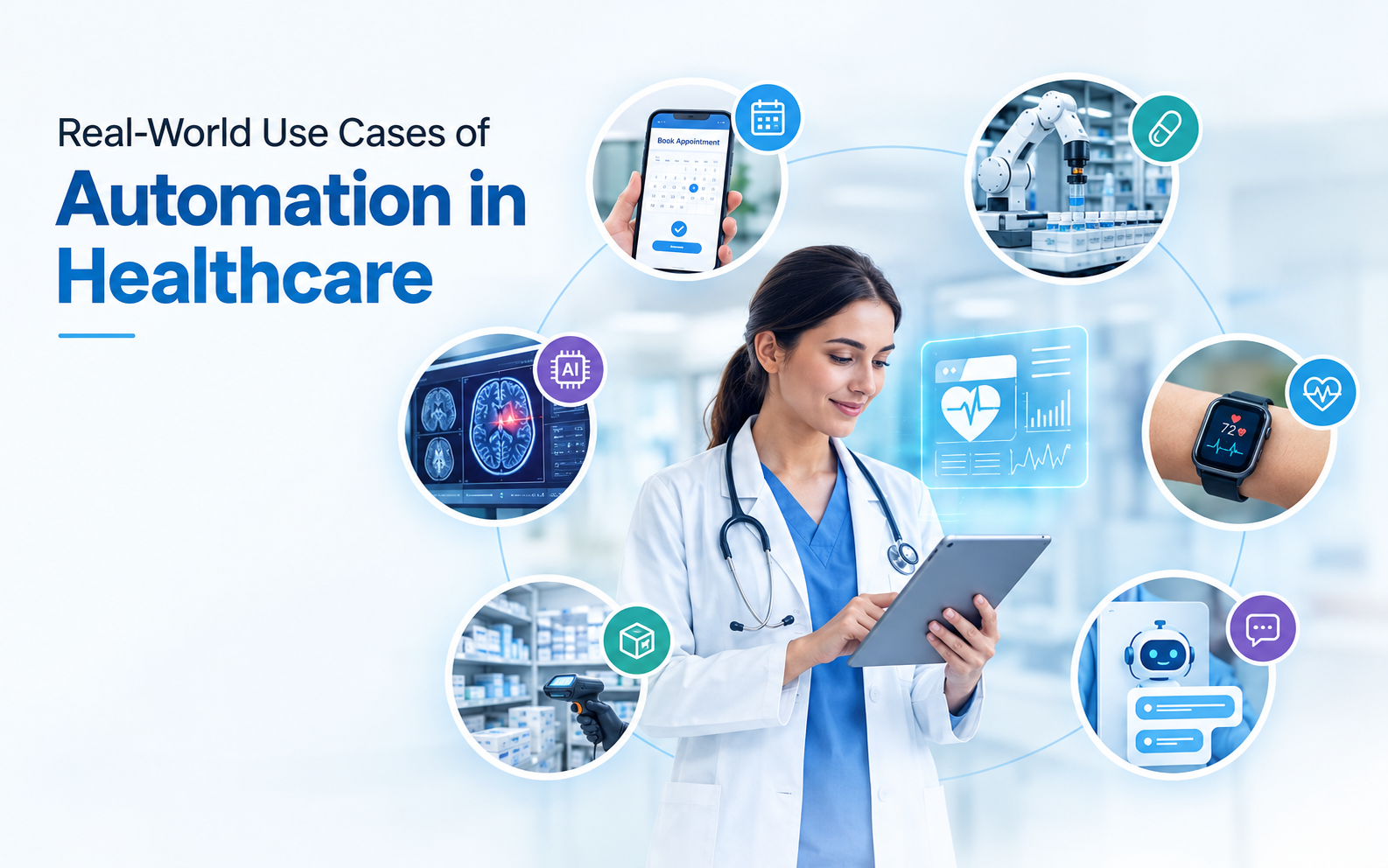
Automated Patient Scheduling
Instead of patients calling a front desk during business hours, automated scheduling tools let them book, reschedule, or cancel appointments online at any time. The system checks provider availability, sends confirmations, and triggers reminder texts automatically.
Robotic Process Automation (RPA) in Billing and Claims
RPA bots can extract data from intake forms, cross-check it against insurance databases, and submit claims without a human manually re-typing information between systems. This is one of the most mature and widely adopted forms of Automation in Healthcare because it touches a high-volume, rules-based process.
Automated Medication Dispensing
Pharmacy automation systems count, package, and label medications with far greater precision than manual dispensing, reducing the risk of dosage errors — a meaningful patient-safety improvement.
Remote Patient Monitoring
Wearable devices and connected sensors now continuously track vitals like heart rate, blood oxygen, and glucose levels, automatically alerting care teams when readings fall outside safe ranges. This is especially valuable for managing chronic conditions outside the hospital.
AI-Assisted Diagnostic Imaging
Machine learning models can pre-screen X-rays, MRIs, and CT scans, flagging areas of concern for radiologists to review first. This doesn’t replace the radiologist’s judgment, but it helps prioritize cases and catch subtle patterns faster.
Supply Chain and Inventory Automation
Hospitals use automated inventory systems to track medical supplies in real time, automatically triggering reorders before stock runs critically low — something that became especially important after supply shortages exposed gaps in manual tracking.
Chatbots and Virtual Health Assistants
Many healthcare organizations now deploy chatbots to handle common patient questions, symptom triage, and appointment-related requests, reducing call-center volume while giving patients instant responses.
 Challenges and Considerations in Automation in Healthcare
Automation in Healthcare isn’t a plug-and-play fix, and organizations that treat it that way often run into trouble. A few recurring challenges deserve attention.
Data Privacy and Security
Healthcare data is among the most sensitive information that exists, and automated systems that move or process this data must meet strict regulatory standards (such as HIPAA in the United States or GDPR in Europe). Any automation initiative needs a clear security and compliance plan from day one.
Integration with Legacy Systems
Many hospitals still run on electronic health record (EHR) systems that are decades old. Connecting new automation tools to these legacy platforms can be technically complex and sometimes requires custom integration work.
Staff Resistance and Training Gaps
Clinicians and administrative staff may be wary of new technology, especially if they fear it threatens their jobs or adds a learning curve during already busy shifts. Successful rollouts usually involve staff early, communicate clearly about what automation will and won’t change, and provide hands-on training.
Risk of Over-Automation
Not every process should be automated. Decisions involving nuanced clinical judgment, emotional sensitivity, or ethical weighing still require a human in the loop. Over-automating can erode trust and, in worst cases, introduce patient-safety risks if edge cases aren’t handled well.
Upfront Investment
Smaller clinics and independent practices may find the initial cost of automation tools — software licensing, hardware, implementation, and training — harder to justify than large hospital systems that can spread the cost across more patients and departments.
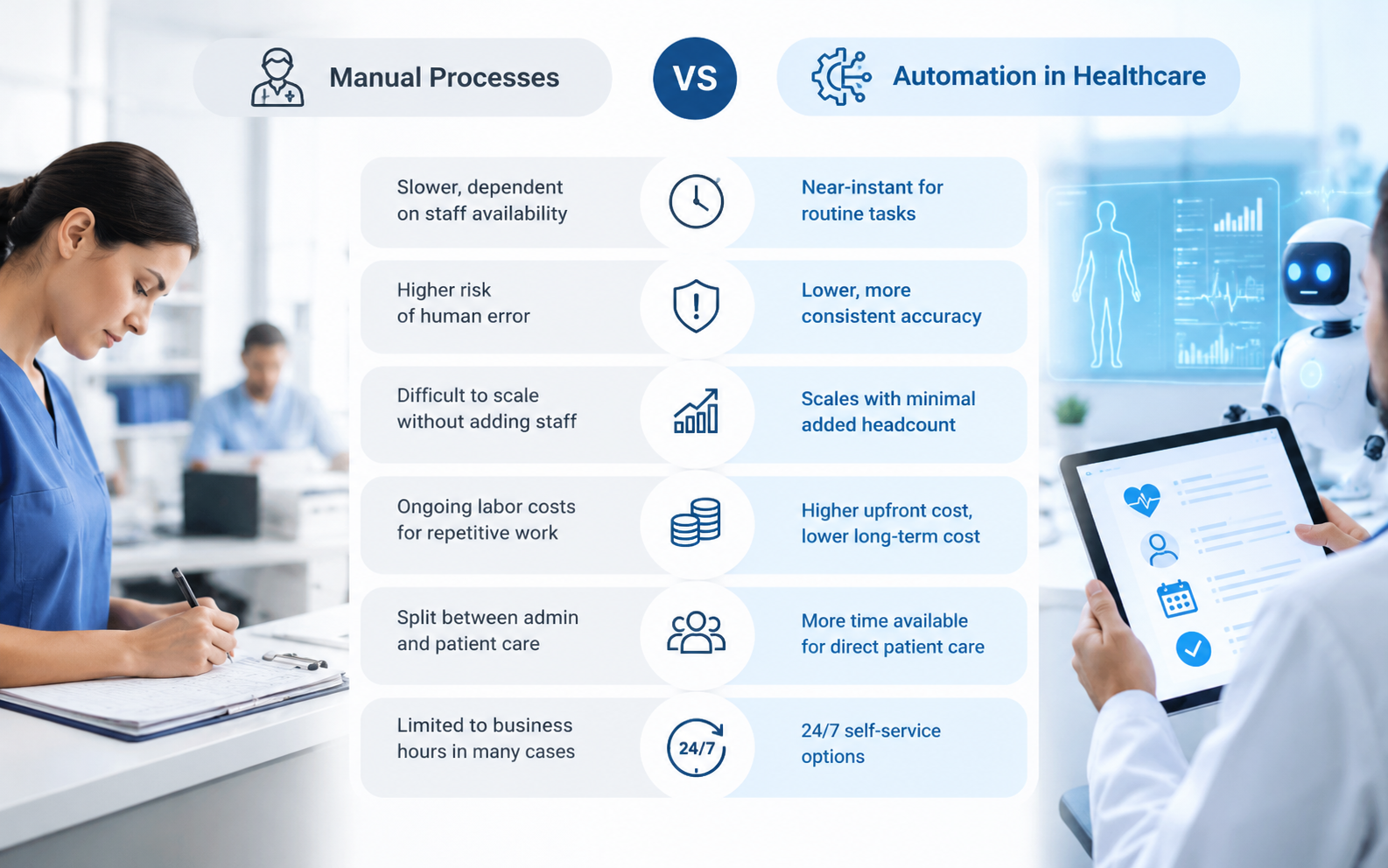
Automation in Healthcare vs. Traditional Manual Processes
| Factor | Manual Processes | Automation in Healthcare |
|---|---|---|
| Speed | Slower, dependent on staff availability | Near-instant for routine tasks |
| Error Rate | Higher risk of human error | Lower, more consistent accuracy |
| Scalability | Difficult to scale without adding staff | Scales with minimal added headcount |
| Cost Over Time | Ongoing labor costs for repetitive work | Higher upfront cost, lower long-term cost |
| Staff Focus | Split between admin and patient care | More time available for direct patient care |
| Patient Experience | Limited to business hours in many cases | 24/7 self-service options |
 Best Practices for Implementing Automation in Healthcare
- Start with high-volume, rules-based processes. Scheduling, billing, and claims processing are usually the easiest and safest places to begin.
- Involve clinical and administrative staff early. Their frontline insight helps identify which tasks genuinely need automation and which don’t.
- Prioritize data security and compliance from the design stage, not as an afterthought.
- Pilot before scaling. Test automation tools in one department or location before a full rollout.
- Measure outcomes continuously — error rates, processing time, patient satisfaction — to confirm the automation is actually delivering value.
- Keep a human in the loop for anything involving clinical judgment or sensitive patient interactions.
- Plan for ongoing maintenance, since automated systems need updates as regulations, insurance rules, and clinical guidelines evolve.
The Future of Automation in Healthcare
Looking ahead, Automation in Healthcare is expected to deepen rather than slow down. A few directions stand out:
- More predictive, AI-driven automation that doesn’t just execute tasks but anticipates needs — like predicting which patients are at high risk of readmission before symptoms worsen.
- Greater interoperability between automation tools and EHR systems, reducing the integration headaches that slow adoption today.
- Expansion into mental health and chronic care management, where automated check-ins and monitoring can extend care beyond clinic walls.
- Increased regulatory clarity around AI-driven clinical tools, which should make adoption more straightforward for smaller providers.
The organizations that benefit most from Automation in Healthcare will likely be the ones that treat it as an ongoing capability to build, rather than a one-time project to finish.
Key Takeaways
- Automation in Healthcare uses software, robotics, and AI to handle repetitive administrative, clinical, and operational tasks.
- It’s driven by rising administrative burden, workforce shortages, cost pressure, and patient expectations for convenience.
- Common use cases include scheduling, billing (RPA), medication dispensing, remote monitoring, and diagnostic imaging support.
- Benefits include fewer errors, faster processes, better resource allocation, and improved patient experience.
- Challenges include data privacy, legacy system integration, staff training, and avoiding over-automation.
- Successful implementation starts small, involves staff, prioritizes security, and keeps humans in the loop for judgment-heavy decisions.
Conclusion
Automation in Healthcare has moved well beyond buzzword status — it’s an operational reality reshaping how hospitals, clinics, and healthcare companies function day to day. From cutting down administrative busywork to supporting faster, more accurate clinical decisions, the technology is helping healthcare organizations do more with the resources they have, without losing the human touch that patient care depends on.
That said, Automation in Healthcare works best as a thoughtful, staged process rather than a rushed overhaul. Organizations that start with clear-cut, rules-based tasks, involve their staff from the beginning, and keep patient safety and data privacy at the center tend to see the strongest, most sustainable results.
If your organization is exploring where to begin, start by mapping your most repetitive, time-consuming processes — that’s usually where Automation in Healthcare delivers the fastest, most visible results. Aeologic Technologies helps businesses identify opportunities for automation and build more efficient, patient-focused operations. Connect with your IT and clinical leadership teams to identify a pilot project and take the first step toward smarter healthcare delivery.
FAQs
Q1. What does Automation in Healthcare actually include?
It includes any technology-driven process — software, robotics, or AI — that performs tasks previously done manually, such as scheduling, billing, claims processing, medication dispensing, remote monitoring, and diagnostic image analysis.
Q2. How does Automation in Healthcare improve patient safety?
By reducing manual data entry and standardizing repetitive steps, automation lowers the risk of medication errors, miscommunication, and documentation mistakes, which are common sources of preventable harm in healthcare settings.
Q3. What is the difference between RPA and AI in healthcare automation?
RPA (robotic process automation) follows fixed rules to complete structured tasks like data entry, while AI-based automation can analyze patterns and make predictions, such as flagging abnormal scans or predicting readmission risk.
Q4. Is healthcare automation expensive to implement?
Initial costs vary widely depending on the scope — from affordable scheduling software to large-scale RPA or AI systems. Most organizations see cost savings over time through reduced errors, faster processing, and lower administrative labor needs.
Q5. Which healthcare processes are easiest to automate first?
High-volume, rules-based processes such as appointment scheduling, insurance eligibility checks, and claims submission are typically the easiest and lowest-risk starting points for automation projects.
Q6. Does Automation in Healthcare require changing existing EHR systems?
Not always. Many automation tools are built to integrate with existing electronic health record systems through APIs or middleware, though older legacy systems may require additional customization work.
Q7. What are the biggest risks of healthcare automation?
Key risks include data privacy breaches, integration failures with legacy systems, staff resistance due to inadequate training, and over-automating processes that genuinely require human clinical judgment.
Q8. How is patient data kept secure during automation?
Reputable automation systems use encryption, access controls, and audit trails, and are built to comply with healthcare data regulations such as HIPAA or GDPR, protecting patient information throughout automated workflows.