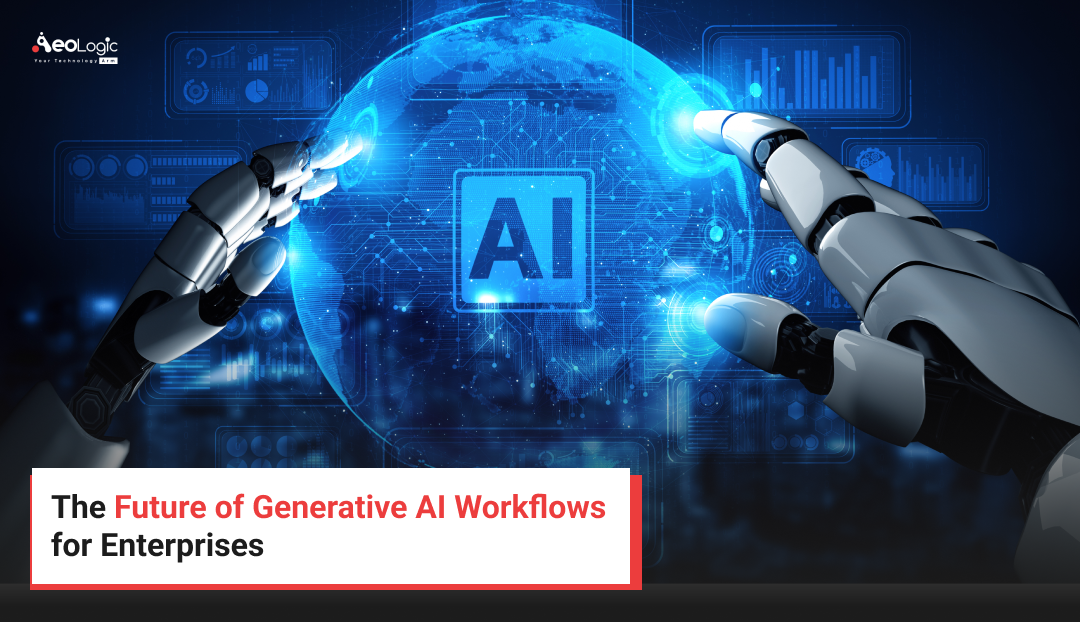
The Future of Generative AI Workflows is reshaping how modern enterprises operate, innovate, and compete in an increasingly digital world. Businesses are moving beyond experimenting with artificial intelligence and are now integrating Generative AI into everyday workflows to improve productivity, automate repetitive tasks, enhance decision-making, and create personalized customer experiences. From generating reports and marketing content to assisting software developers and streamlining customer support, Generative AI is becoming an essential part of enterprise operations.
As organizations continue their digital transformation journey, the focus is shifting from isolated AI tools to connected AI-powered workflows that seamlessly integrate across departments and business systems. These intelligent workflows enable teams to work faster, reduce operational costs, and unlock new opportunities for innovation. However, building enterprise-ready AI workflows requires careful planning, strong governance, and the right technology strategy.
This article explores the Future of Generative AI Workflows, how they are transforming enterprise operations, the technologies driving their evolution, the challenges organizations must address, and the best practices for successful implementation.
Understanding Generative AI Workflows
Generative AI workflows combine artificial intelligence with business processes to automate tasks that traditionally required human creativity and decision-making. Unlike conventional automation, which follows predefined rules, Generative AI can understand natural language, generate content, summarize information, analyze documents, write code, answer customer queries, and support employees with contextual recommendations.
A workflow may begin with a customer inquiry, continue through document analysis, generate a personalized response, update enterprise systems, notify relevant teams, and produce analytical insights—all with minimal human intervention. These workflows become even more powerful when integrated with enterprise applications such as CRM platforms, ERP systems, document management solutions, collaboration tools, and cloud services.
The future lies in creating intelligent ecosystems where Generative AI becomes an active participant in business operations rather than simply acting as a supporting tool.
Why enterprises are investing in Generative AI workflows?
Organizations across industries recognize that AI is no longer a competitive advantage reserved for technology companies. Instead, it has become a strategic necessity for businesses seeking operational efficiency and long-term growth.
Generative AI significantly reduces the time employees spend on repetitive and information-heavy tasks. Instead of manually preparing reports, drafting emails, reviewing contracts, or searching through thousands of documents, employees can rely on AI assistants to complete these activities within minutes. This allows teams to dedicate more time to strategic initiatives, customer engagement, and innovation.
Another major driver is the growing demand for personalized customer experiences. Businesses can use Generative AI to create customized recommendations, marketing campaigns, support responses, and product descriptions tailored to individual customer preferences. As customer expectations continue to rise, personalized engagement becomes a key differentiator.
Enterprises are also investing in AI workflows to improve collaboration between departments. Information flows more efficiently across sales, marketing, finance, HR, and operations when AI automatically processes, summarizes, and distributes relevant insights to the right stakeholders.
The Evolution of Enterprise AI Workflows
From Rule-Based Automation to Intelligent Decision Making
Earlier automation systems relied on fixed rules and predefined instructions. While effective for repetitive tasks, these systems lacked flexibility and required manual updates whenever business requirements changed.
Generative AI introduces adaptability into workflows. Instead of following static rules, AI models understand context, interpret user intent, and generate relevant outputs. This makes enterprise workflows more dynamic, responsive, and capable of handling complex scenarios.
For example, rather than routing every customer support ticket using predefined keywords, AI can analyze the complete conversation, identify urgency, understand customer sentiment, recommend appropriate solutions, and even generate draft responses for support teams.
Integration with Enterprise Knowledge
One of the most significant developments in the Future of Generative AI Workflows is the integration of enterprise knowledge bases. AI systems can securely access company documents, policies, product manuals, technical documentation, and internal databases to generate accurate, context-aware responses.
This enables employees to retrieve information quickly without searching through multiple systems. New employees can also onboard faster by interacting with AI-powered assistants that provide instant access to organizational knowledge.
Autonomous Workflow Execution
Future enterprise workflows will involve AI agents capable of executing multi-step business processes independently. Instead of generating only content or recommendations, these intelligent agents will perform tasks across multiple applications.
For instance, an AI agent could receive a purchase request, validate budgets, obtain approvals, communicate with suppliers, generate purchase orders, update inventory systems, and notify finance teams—all within a single automated workflow.
This level of autonomy represents the next generation of enterprise process automation.
 Key Technologies Driving the Future of Generative AI Workflows
Large Language Models
Large Language Models form the foundation of modern Generative AI. These models understand human language, generate meaningful responses, summarize documents, write code, and support intelligent conversations. As enterprise-grade language models continue improving, businesses will gain access to more reliable and specialized AI capabilities.
Retrieval-Augmented Generation (RAG)
Retrieval-Augmented Generation enhances AI accuracy by allowing models to retrieve information from trusted enterprise data sources before generating responses. Instead of relying only on pre-trained knowledge, AI uses real-time company information to produce more relevant and factual outputs.
This technology is becoming essential for organizations that require accurate responses based on internal documentation.
AI Agents
AI agents are expected to become the backbone of enterprise automation. Unlike chatbots that respond only to prompts, AI agents understand goals, make decisions, coordinate multiple tasks, and interact with various business applications.
These autonomous systems will significantly reduce manual effort while improving workflow efficiency across departments.
Multi-Modal AI
Future enterprise workflows will not rely solely on text. Multi-modal AI can process images, videos, voice recordings, spreadsheets, scanned documents, and structured data simultaneously.
This capability enables organizations to automate complex business operations involving multiple content formats.
Enterprise Use Cases of Generative AI Workflows
Customer Service
AI-powered customer support workflows can analyze customer inquiries, generate personalized responses, retrieve information from internal knowledge bases, and escalate complex issues to human representatives when necessary. This reduces response times while maintaining service quality.
Human Resources
HR teams are using Generative AI to streamline recruitment, employee onboarding, policy management, training content creation, and performance evaluation support. AI assists HR professionals while ensuring employees receive timely and consistent information.
Software Development
Developers increasingly rely on AI-assisted workflows for code generation, debugging, documentation, testing, and software maintenance. Development teams can accelerate project delivery without compromising code quality.
Marketing
Marketing departments use AI workflows to generate blogs, social media content, email campaigns, product descriptions, advertising copy, customer segmentation insights, and campaign performance summaries. AI helps maintain content consistency while improving production speed.
Finance
Finance professionals benefit from AI-generated financial reports, invoice processing, compliance documentation, fraud detection support, forecasting, and budget analysis. Intelligent workflows reduce manual processing while improving data accuracy.
Legal Operations
Legal teams leverage Generative AI to review contracts, summarize legal documents, identify compliance risks, generate draft agreements, and assist with document management. This significantly reduces administrative workload.
Benefits of Future Generative AI Workflows
Enhanced Productivity
Employees spend less time performing repetitive administrative work and more time focusing on strategic business initiatives. AI handles routine processes while humans contribute expertise, creativity, and decision-making.
Faster Business Decisions
AI analyzes large datasets within seconds, providing executives with valuable insights for informed decision-making. Real-time intelligence enables organizations to respond quickly to market changes.
Improved Customer Experience
Personalized communication, faster responses, and consistent service quality improve customer satisfaction and strengthen brand loyalty.
Operational Cost Reduction
By automating labor-intensive tasks, enterprises reduce operational expenses while improving workflow efficiency across departments.
Better Knowledge Management
AI organizes enterprise information, making institutional knowledge accessible to employees whenever required. This improves collaboration and reduces knowledge silos.
Challenges Enterprises Must Address
While the opportunities are significant, implementing enterprise AI workflows also presents several challenges.
Data privacy remains a primary concern. Organizations must ensure sensitive business information is protected through secure AI deployment, encryption, access controls, and compliance with regulatory requirements.
Model accuracy is equally important. AI-generated outputs require validation mechanisms to minimize errors, misinformation, and hallucinations, particularly in regulated industries.
Integration complexity can slow adoption. Many enterprises operate multiple legacy systems that require seamless AI connectivity. Selecting scalable integration platforms becomes essential for long-term success.
Governance and ethical AI practices also require attention. Organizations need clear policies regarding AI usage, transparency, accountability, and human oversight to maintain trust among employees and customers.
Employee adoption represents another critical factor. Successful AI implementation depends not only on technology but also on workforce training, change management, and organizational readiness.
Best Practices for Building Enterprise Generative AI Workflows
Organizations should begin with clearly defined business objectives rather than adopting AI simply because it is trending. Identifying measurable outcomes such as reducing response times, improving productivity, or enhancing customer satisfaction provides a strong foundation for implementation.
Selecting high-value workflows for initial deployment allows businesses to demonstrate tangible benefits before expanding AI across additional departments. Early successes also encourage employee adoption and executive support.
Data quality should remain a priority throughout implementation. AI systems perform best when trained and connected to accurate, structured, and well-governed enterprise data.
Human oversight remains essential even as AI capabilities continue advancing. Enterprises should design workflows where AI assists employees instead of replacing critical business decisions entirely.
Continuous monitoring and optimization ensure workflows evolve alongside changing business requirements, customer expectations, and technological advancements.
What the future holds?
The next phase of enterprise AI will move beyond content generation toward intelligent business orchestration. AI agents will collaborate with one another, manage end-to-end workflows, coordinate cross-functional operations, and make autonomous decisions within predefined governance frameworks.
Organizations will increasingly adopt AI-first operating models where intelligent assistants become embedded into every business application. Employees will interact with AI naturally through conversational interfaces while complex processes execute seamlessly in the background.
Future enterprise workflows will also become highly personalized. AI will adapt recommendations based on employee roles, customer preferences, organizational policies, and business objectives, creating more efficient and context-aware operations.
As advancements in reasoning models, autonomous AI agents, multimodal intelligence, and enterprise integrations continue, businesses that invest strategically today will be better positioned to lead tomorrow’s digital economy.
Conclusion
The Future of Generative AI Workflows represents a significant transformation in how enterprises operate, collaborate, and innovate. Rather than simply automating repetitive tasks, modern AI workflows enable organizations to create intelligent systems capable of understanding context, generating valuable insights, supporting employees, and orchestrating complex business processes.
As Generative AI continues to evolve, enterprises that embrace secure, scalable, and well-governed AI workflows will achieve greater operational efficiency, improved customer experiences, faster innovation, and stronger competitive advantages. By combining advanced AI technologies with thoughtful implementation strategies, businesses can build resilient digital enterprises prepared for the future of intelligent work. Organizations looking to accelerate this transformation can partner with Aeologic Technologies to implement customized AI solutions that align with their business goals and drive long-term success.
FAQs
Q1. What are Generative AI workflows in enterprises?
Generative AI workflows are AI-powered business processes that automate tasks such as content creation, document analysis, customer support, software development, and decision-making. They integrate with enterprise systems to improve efficiency, reduce manual work, and enhance productivity across departments.
Q2. Why is the Future of Generative AI Workflows important for businesses?
The Future of Generative AI Workflows is important because it enables organizations to streamline operations, improve employee productivity, deliver personalized customer experiences, reduce operational costs, and accelerate innovation through intelligent automation.
Q3. Which industries benefit the most from Generative AI workflows?
Industries such as healthcare, finance, manufacturing, retail, logistics, legal services, education, and information technology benefit significantly from Generative AI workflows. These solutions help automate repetitive tasks, improve decision-making, and optimize business processes across diverse sectors.
Q4. What challenges should enterprises consider before implementing Generative AI workflows?
Enterprises should address challenges related to data security, privacy, AI model accuracy, integration with existing systems, regulatory compliance, governance, and employee adoption. Establishing clear AI policies and maintaining human oversight are essential for successful implementation.
Q5. How can organizations prepare for the Future of Generative AI Workflows?
Organizations can prepare by identifying high-value business processes for automation, investing in quality data management, integrating AI with existing enterprise applications, training employees on AI tools, and implementing strong governance practices to ensure secure and responsible AI adoption.

With a strong foundation in software and a growing expertise in AI, I specialize in building smart, scalable solutions that drive digital transformation