Consulting has always sold judgment. Clients pay for a point of view — someone who has seen the problem before, who can pattern-match across industries, and who can turn a messy situation into a clear plan. For decades, the raw material behind that judgment was built the same way: junior analysts spent long nights building market sizing models, synthesizing interview notes, and formatting slide after slide, while partners distilled it all into a recommendation.
That production line is being rewritten. Generative AI in Consulting is no longer a side experiment running in an innovation lab; it has moved into the daily workflow of research, benchmarking, drafting, and even early-stage strategy formation. Firms that once measured productivity in analyst-hours are now measuring it in prompts, and the shift is forcing a genuine rethink of what consulting work actually looks like.
This article breaks down what’s really changing, where the technology adds value today, where it falls short, and what firms and individual consultants need to do to stay relevant as Generative AI in Consulting becomes a baseline expectation rather than a competitive edge.
What does Generative AI in Consulting Actually Mean?
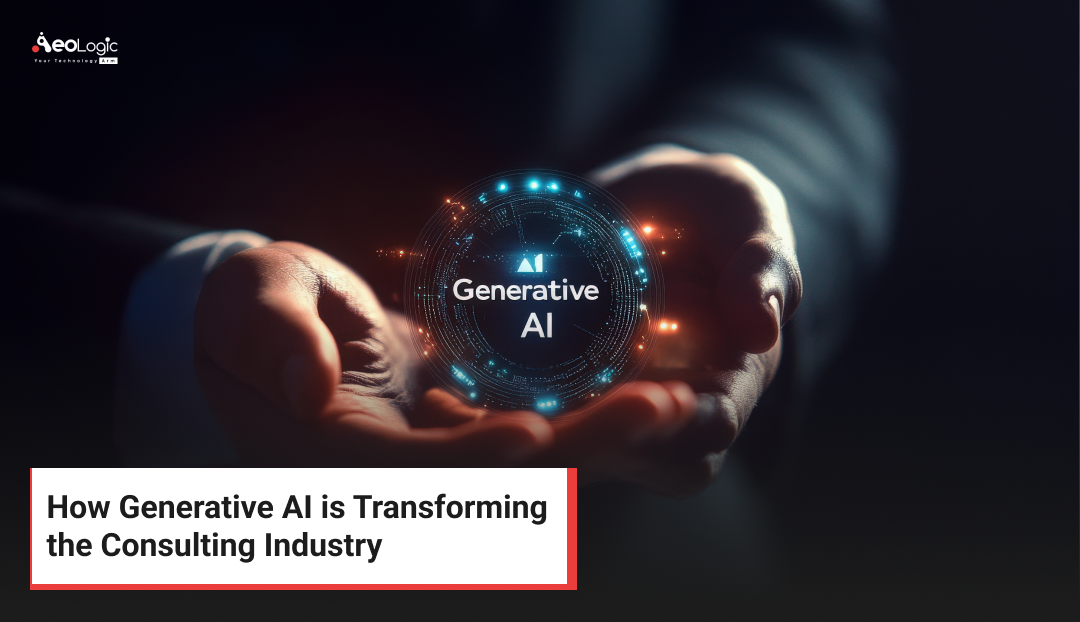
Generative AI in Consulting refers to the use of large language models and related generative tools — text, image, code, and data generators — inside the core activities of advisory work: research synthesis, document drafting, data analysis, scenario modeling, and client communication.
Unlike earlier “AI in consulting” efforts, which mostly meant predictive analytics or dashboarding tools bolted onto a project, generative AI sits much closer to the actual thinking work. It can read hundreds of pages of interview transcripts and pull out themes. It can draft a first-cut strategy memo from a set of bullet points. That’s the core distinction: this wave of AI doesn’t just analyze information, it produces usable drafts of consulting deliverables. It can generate code to clean a messy client dataset in minutes instead of days.
Why This Shift Matters Now
Three forces are converging to make Generative AI in Consulting a priority rather than an experiment:
- Model quality crossed a usability threshold. Current-generation models can hold long documents in context, reason across multiple sources, and produce coherent, well-structured prose — good enough to serve as a legitimate first draft rather than a novelty.
- Client expectations have shifted. Clients who use these tools internally expect their consultants to move faster and charge accordingly. A firm that still bills for three weeks of manual research synthesis looks slow by comparison.
- Competitive pressure inside the industry. The large strategy and technology consultancies have publicly committed significant investment to internal AI tools, training, and AI-focused practice areas, pushing mid-size and boutique firms to respond or risk losing ground on price and speed.
 Where Generative AI Is Actually Being Used in Consulting Today
It helps to separate the hype from the day-to-day reality. Here’s where Generative AI in Consulting is delivering real, measurable value right now.
1. Research and Market Intelligence
Instead of manually scanning dozens of industry reports, analysts can use generative tools to summarize market trends, competitor positioning, and regulatory shifts in a fraction of the time. The AI doesn’t replace judgment about what matters — it compresses the time spent gathering raw material so consultants can spend more time interpreting it.
2. Data Analysis and Cleaning
A large share of analyst time historically went into unglamorous data wrangling: reconciling spreadsheets, writing one-off scripts, fixing formatting inconsistencies. Generative AI tools that can write and explain code are now handling much of this groundwork, with a human reviewing the output rather than building it line by line.
3. Drafting Client Deliverables
Slide outlines, executive summaries, project charters, and status reports are prime candidates for AI-assisted drafting. A consultant feeds in the key findings and structure, and the model produces a workable first draft that gets refined rather than written from a blank page.
4. Interview and Workshop Synthesis
Client engagements generate huge volumes of qualitative input — stakeholder interviews, workshop notes, survey responses. Generative AI in Consulting is increasingly used to transcribe, cluster, and summarize this material, surfacing themes that might otherwise take a team days to triangulate manually.
5. Scenario Modeling and What-If Analysis
Strategy consultants are using generative tools to quickly sketch multiple scenarios — different market conditions, pricing strategies, or operating models — and stress-test assumptions before committing analyst time to detailed modeling.
6. Internal Knowledge Management
Large firms sit on decades of prior project work. Generative AI, paired with retrieval systems, helps consultants search that internal knowledge base in natural language, surfacing relevant past frameworks, case studies, and benchmarks instead of relying on institutional memory or informal networks.
The Business Impact: Speed, Cost, and Scope
The practical effect of Generative AI in Consulting shows up in three areas that matter to both consulting firms and their clients.
| Impact Area | What Changes | Why It Matters |
|---|---|---|
| Speed | Research and drafting cycles shrink from days to hours | Faster time-to-insight for clients facing urgent decisions |
| Cost structure | Less junior-analyst time per deliverable | Pressure on traditional hourly and staffing-based pricing models |
| Scope of work | Consultants can take on more ambiguous, judgment-heavy problems | Shift from “produce the analysis” to “interpret and advise” |
This is also changing how firms price engagements. When a research phase that used to take two weeks can be substantially accelerated, firms are experimenting with value-based and outcome-based pricing instead of pure time-and-materials billing — a structural shift that touches everything from staffing models to partner compensation.
Challenges and Risks Firms Need to Manage
Adopting Generative AI in Consulting isn’t without friction, and firms that skip over the risks tend to run into trouble quickly.
- Accuracy and hallucination risk. Generative models can produce confident, well-formatted answers that are factually wrong. In a field where recommendations drive real business decisions, unverified AI output is a serious liability.
- Client confidentiality. Consulting runs on sensitive client data. Firms need clear policies — and often dedicated, secured environments — before feeding proprietary information into any AI tool.
- Over-reliance and skill erosion. If junior consultants lean on AI for synthesis and drafting too early in their careers, they risk never developing the judgment that senior partners rely on. Firms need to be deliberate about which tasks stay human-led for training purposes.
- Intellectual property and sourcing. When AI tools pull from broad training data, firms must be careful about attribution, originality, and whether generated content inadvertently resembles another organization’s proprietary frameworks.
- Change management. Rolling out new tools across a partnership-based organization, where incentives and habits run deep, is as much a people challenge as a technology one.
Best Practices for Adopting Generative AI in Consulting
Firms that are getting real value from Generative AI in Consulting tend to follow a similar pattern:
- Start with low-risk, high-volume tasks. Research summarization and first-draft document generation are safer starting points than client-facing strategic recommendations.
- Keep a human in the loop on every deliverable. AI output should always be reviewed, verified, and owned by a consultant before it reaches a client.
- Invest in prompt and tool training. Treat AI fluency as a core consulting skill, not an optional extra — the same way Excel or PowerPoint proficiency has always been assumed.
- Build or adopt secure, firm-specific environments. Generic public tools are rarely appropriate for confidential client work; many firms are standing up private instances with stronger data controls.
- Redefine junior roles intentionally. Rather than eliminating entry-level positions, forward-looking firms are redesigning them around review, verification, and judgment-building rather than pure production.
- Measure outcomes, not just adoption. Track whether AI use is actually improving project timelines, quality, and client satisfaction — not just how many people are logging into a tool.
What This Means for Consultants’ Careers
A common fear is that Generative AI in Consulting will simply replace junior analysts. The more accurate picture is a redistribution of time rather than outright elimination of roles. Tasks that were purely mechanical — formatting, first-pass summarization, basic data cleanup — are shrinking. Tasks that require judgment, client relationship management, creative problem framing, and the ability to challenge an AI-generated draft are becoming more valuable, not less.
Consultants who thrive in this environment share a few traits: they’re comfortable treating AI output as a draft to interrogate rather than a finished answer, they understand enough about how these models work to spot likely errors, and they still invest in the foundational research and analysis skills that let them catch a wrong answer before a client sees it.
How Clients Are Responding to AI-Powered Consulting
Clients are not passive observers in this shift. Many are asking consulting firms directly how generative AI is used on their engagements, what safeguards exist around their data, and whether faster delivery timelines translate into lower fees. Sophisticated buyers increasingly expect:
- Transparency about which parts of a deliverable involved AI assistance.
- Evidence that findings were human-reviewed and validated, not just AI-generated.
- Faster turnaround on research-heavy phases of a project.
- A clear point of view on how the firm uses AI responsibly, especially in regulated industries like finance and healthcare.
This has turned a firm’s AI approach into a genuine differentiator in the sales process, not just an internal efficiency play.
Generative AI in Consulting Across Different Practice Areas
The impact of Generative AI in Consulting isn’t uniform — it plays out differently depending on the type of advisory work involved.
Strategy consulting. Here, generative AI mainly accelerates the groundwork: market scans, competitive teardown, and scenario drafting. The actual strategic choice — which path a client should take — still rests firmly with experienced consultants, since it depends on judgment about risk, culture, and execution capability that AI can’t assess on its own.
Technology and digital transformation consulting. This is where generative AI shows up most visibly, since many engagements now involve helping clients design and implement AI systems themselves. Consultants in this space need to be fluent both in using generative AI internally and in advising clients on their own AI roadmaps, which has created a fast-growing sub-specialty within the broader field.
Operations and process consulting. Generative AI in Consulting is proving useful for mapping current-state processes from interview transcripts and documentation, then drafting future-state recommendations that human consultants refine. It speeds up the unglamorous but essential documentation work that process improvement projects depend on.
Financial and risk advisory. Adoption here tends to be more cautious, given the regulatory scrutiny around financial recommendations. Generative AI is mostly used for internal research and drafting support, with heavier human review before anything reaches a client, rather than for generating client-facing financial conclusions directly.
Across all of these areas, the common thread is that Generative AI in Consulting works best as an accelerant for the research and drafting layer of a project, while the interpretive, relationship-driven, and accountability-carrying parts of the job stay firmly in human hands. Firms that understand this distinction tend to get far more sustainable value from the technology than those chasing automation for its own sake.
The Road Ahead
Looking forward, the trajectory of Generative AI in Consulting points toward deeper integration rather than a plateau. Expect more consulting firms to build proprietary AI tools trained on their own methodologies and past engagements, more specialized AI-focused consulting practices advising clients on their own AI adoption, and a continued blurring of the line between “consulting” and “building software for the client.”
The firms and individual consultants who treat this as a fundamental shift in how advisory work gets done — rather than a temporary trend — are the ones positioning themselves to lead the next decade of the industry.
Key Takeaways
- Generative AI in Consulting is already embedded in research, drafting, data cleaning, and knowledge management workflows at most major firms.
- The technology compresses production time, which is reshaping both project timelines and pricing models.
- Real risks around accuracy, confidentiality, and skill development require deliberate governance, not just enthusiastic adoption.
- Career paths are shifting toward judgment, verification, and client relationship skills rather than disappearing altogether.
- Clients increasingly expect transparency about how AI is used on their engagements.
Conclusion
Generative AI in Consulting has moved past the pilot-project stage and is now shaping how research gets done, how deliverables get drafted, and how firms price and staff their engagements. The consultancies gaining ground are the ones treating AI as a tool that amplifies human judgment rather than a shortcut around it — pairing faster research and drafting with rigorous human review, clear data governance, and deliberate investment in the skills that still can’t be automated. For firms and individual consultants alike, the question is no longer whether to adopt Generative AI in Consulting, but how quickly they can do it responsibly.
If you’re evaluating how AI fits into your consulting practice or vendor selection process, Aeologic Technologies can help you explore AI-driven strategies and solutions. Now is the time to build your AI strategy rather than wait for the rest of the market to move first.
Frequently Asked Questions
Q1. Is generative AI replacing consultants?
No. Generative AI in Consulting is automating repetitive research and drafting tasks, but it still requires human judgment to verify accuracy, interpret findings, and manage client relationships. Firms are redesigning roles rather than eliminating them outright, shifting junior work toward review and validation.
Q2. What skills do consultants need to work with generative AI?
Consultants need strong prompt-writing ability, a working understanding of how AI models can fail or hallucinate, and the underlying analytical skills to catch errors in AI-generated output. Traditional skills like structured problem-solving and client communication remain essential and are arguably more valuable now.
Q3. Is it safe to use generative AI with confidential client data?
Only within properly secured, firm-approved environments. Public consumer AI tools are generally unsuitable for sensitive client information. Most firms adopting Generative AI in Consulting use private or enterprise-grade instances with strict data handling and confidentiality controls.
Q4. How are consulting firms pricing AI-assisted projects?
Many firms are moving away from pure time-and-materials billing toward value-based or outcome-based pricing, since AI can significantly compress research and drafting timelines. Pricing models are still evolving across the industry.
Q5. Which consulting tasks benefit most from generative AI?
Research synthesis, document drafting, data cleaning, interview and workshop analysis, and internal knowledge search see the clearest benefits. High-stakes strategic recommendations still require significant human oversight.
Q6. Will junior consulting roles disappear because of AI?
Entry-level roles are evolving rather than vanishing. Firms are redesigning junior positions around reviewing and verifying AI output, building analytical judgment, and handling tasks that still require human interpretation, rather than eliminating these roles outright.
Q7. What risks should consulting firms watch for with generative AI?
Key risks include AI hallucinations producing inaccurate recommendations, client confidentiality breaches from using unsecured tools, and erosion of junior consultants’ analytical skills if AI is relied on too heavily before foundational skills are developed.