
A customer calls about a defective unit, and your team can’t tell which production run it came from, let alone which batch of raw material, which shift, or which machine touched it. That blind spot is exactly what individual product traceability is built to close. Instead of tracking a whole lot or batch as one blurry unit, you give every single item its own identity, so you can trace it from raw material to the shelf and back again, one unit at a time.
This guide walks through what individual product traceability actually means, why it’s become non-negotiable in regulated and high-value industries, and — most importantly — how to implement individual product traceability in your own operation without blowing up your existing workflows. You’ll find a practical rollout plan, the technology choices that matter, the pitfalls teams hit most often, and answers to the questions that come up again and again when companies start this project.
What is Individual Product Traceability?
Individual product traceability is the practice of assigning a unique identifier to every single unit of a product so its origin, movement, and status can be tracked across the entire supply chain — from raw materials through manufacturing, distribution, and final sale. It’s the difference between knowing “this came from Batch 4521” and knowing “this exact unit, serial #AX19284, was made on Line 2 at 3:14 PM on March 4th, using components from Supplier B.”
Individual vs. Batch Traceability
Most manufacturers start with batch (or lot) traceability, which groups many units together under one shared code. Individual product traceability goes a level deeper, giving each unit its own identity within that batch.
| Aspect | Batch Traceability | Individual Product Traceability |
|---|---|---|
| Tracking unit | A production lot or batch | A single serialized item |
| Recall scope | Entire batch, often thousands of units | Only the specific affected units |
| Data granularity | Shared across the batch | Unique per item (timestamps, machine, operator) |
| Counterfeit protection | Limited | Strong — each unit can be authenticated |
| Implementation complexity | Lower | Higher, but far more precise |
Why “Individual” Matters
When traceability only works at the batch level, a single defect can force a recall of an entire production run — most of which may be perfectly fine. Individual product traceability narrows that net dramatically. It also underpins capabilities batch-level systems simply can’t offer: unit-level warranty tracking, serialized anti-counterfeiting checks, and precise chain-of-custody records for regulated goods like pharmaceuticals, medical devices, and firearms.
 Why Individual Product Traceability Matters
Faster, Narrower Recalls
When something goes wrong, speed and precision save money and reputation. With individual product traceability, you can identify exactly which units are affected, where they are in the supply chain, and who received them — instead of pulling an entire lot off shelves worldwide.
Regulatory Compliance
Industries like pharmaceuticals (DSCSA in the U.S., the EU Falsified Medicines Directive), medical devices (UDI requirements), food safety (FSMA 204), and aerospace increasingly require serialized, unit-level tracking by law. Implementing individual product traceability early means you’re not scrambling to retrofit compliance later.
Counterfeit and Gray Market Protection
A unique identifier on every unit lets customers, retailers, and customs officials verify authenticity instantly — something a shared batch code can’t do. Serialized products are far harder to clone convincingly at scale.
Better Quality and Root-Cause Analysis
When defects are tied to specific units, you can trace them back to the exact machine, shift, operator, or supplier batch involved. That turns vague quality complaints into actionable engineering data.
Warranty and Lifecycle Management
Each serialized unit can carry its own warranty start date, service history, and ownership record, which improves customer support and reduces fraudulent warranty claims.
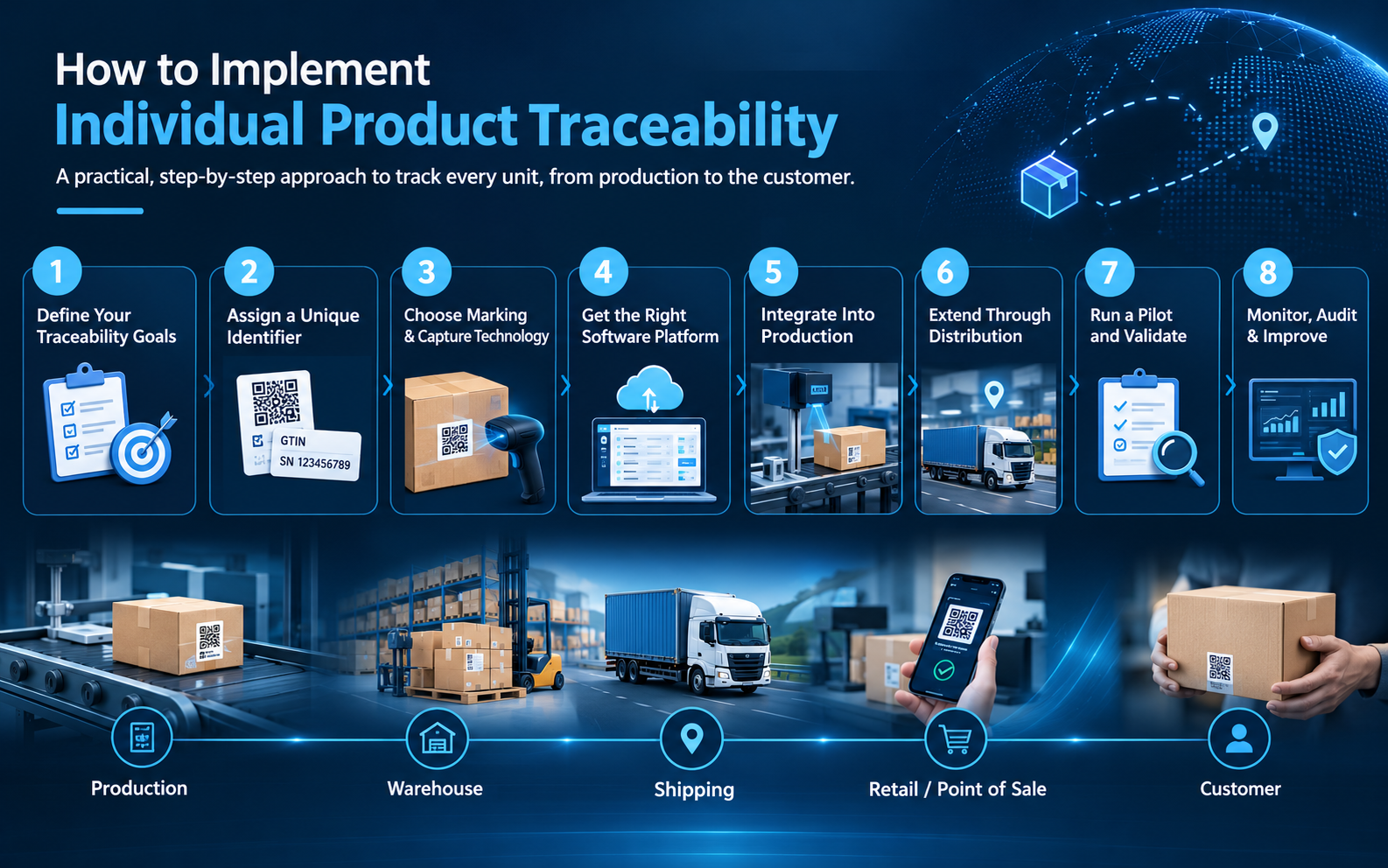
How to Implement Individual Product Traceability: Step by Step
Implementing individual product traceability is less about buying one piece of software and more about redesigning how data flows alongside your physical product. Here’s a practical, order-of-operations roadmap.
Step 1: Define What “Traceable” Means for Your Product
Before choosing any technology, decide what you actually need to trace. Ask:
- Do you need full genealogy (every component and sub-assembly), or just origin-to-sale tracking?
- Which regulations apply to your industry, and what data do they require you to capture?
- What events matter — production, inspection, packaging, shipping, point of sale, returns?
Writing this down first prevents the common mistake of building a system that captures too little (useless for recalls) or too much (expensive and slow).
Step 2: Choose a Unique Identifier Scheme
Every unit needs an identifier that is genuinely unique and never reused. Common approaches include:
- Sequential serial numbers — simple, human-readable, easy to audit.
- GS1 Serialized Global Trade Item Numbers (SGTIN) — industry-standard, interoperable with retail and logistics partners.
- Cryptographically random IDs — harder to guess or forge, useful for anti-counterfeiting.
- Composite IDs (batch + sequence number) — retains batch-level grouping while still identifying individual units.
For most companies, a GS1-compliant serialized identifier strikes the best balance of standardization and flexibility, especially if you sell through retail partners or across borders.
Step 3: Select Your Marking and Capture Technology
The identifier has to physically travel with the product. Typical options:
| Technology | Best For | Trade-offs |
|---|---|---|
| 1D/2D barcodes (Code 128, Data Matrix) | High-volume, low-cost goods | Requires line-of-sight scanning |
| QR codes | Consumer-facing products, engagement + traceability combined | Easily photographed and shared, good for verification |
| RFID tags | High-value items, bulk scanning without line-of-sight | Higher per-unit cost |
| NFC chips | Luxury goods, tap-to-verify authentication | Higher cost, shorter read range |
| Direct Part Marking (laser etch) | Durable goods, harsh environments | Equipment investment required |
Many implementations combine two technologies — for example, a Data Matrix code for internal scanning plus an NFC tag for consumer-facing authentication.
Step 4: Build or Select the Traceability Software Platform
This is the system of record that ties every unique identifier to its full history. Look for a platform that can:
- Generate and assign unique IDs at the point of production
- Capture scan events across every stage (manufacturing, warehouse, shipping, point of sale)
- Integrate with your existing ERP, MES, and WMS systems via API
- Support offline capture at sites with unreliable connectivity
- Provide audit-ready reporting for regulators
Teams with strict compliance requirements often lean toward established track-and-trace platforms rather than building in-house, since certification and validation work is already done.
Step 5: Integrate Traceability Into Production Workflows
Serialization has to happen at or near the production line, which usually means:
- Installing label printers or marking equipment at the right point in the line
- Training line operators on scan-and-verify procedures
- Adding automated checks that reject units with missing or duplicate IDs before they leave the line
- Syncing production data (machine, shift, operator, material lot) to each unit’s record in real time
Step 6: Extend Traceability Through Distribution
Individual product traceability only delivers full value if tracking continues after the product leaves the factory. Set up scan checkpoints at:
- Warehouse receiving and shipping
- Distribution center transfers
- Retail or point-of-sale systems
- Returns and service centers
Each checkpoint should log a timestamp, location, and status update against the unit’s unique ID.
Step 7: Test With a Pilot Before Full Rollout
Run the system on a single product line or SKU first. Validate that:
- Every unit actually receives a unique, scannable identifier
- Data flows correctly into your central system
- Reports can answer real recall-style questions (“show me every unit shipped to Region X between these dates”)
Fix gaps here before scaling to your full catalog — mistakes are far cheaper to correct on a pilot line than across an entire plant.
Step 8: Monitor, Audit, and Continuously Improve
Once live, build in regular audits: spot-check that physical units match their digital records, monitor scan failure rates, and review whether new regulations or customer requirements call for capturing additional data points.
 Standards and Technologies That Support Individual Product Traceability
GS1 Standards
GS1 is the most widely adopted global standard for product identification. Its Serialized Global Trade Item Number (SGTIN) framework is purpose-built for individual product traceability, letting a single barcode or RFID tag encode both the product type and its unique serial number in a format recognized across retail, logistics, and healthcare systems worldwide.
Blockchain for Traceability (Where It Actually Helps)
Blockchain is sometimes pitched as a traceability silver bullet. Its real value is narrower: it can provide a tamper-evident, shared ledger of custody events across multiple companies (e.g., a supplier, manufacturer, and distributor who don’t fully trust each other’s systems). For traceability within a single company’s four walls, a well-designed database usually does the job with far less overhead.
Cloud Platforms vs. On-Premise Systems
Cloud-based traceability platforms are easier to scale across multiple facilities and give distributors or retail partners controlled access to relevant data. On-premise systems can make sense for highly regulated environments with strict data residency requirements, but they shift more integration and maintenance work onto your internal IT team.
IoT Sensors and Environmental Monitoring
For products sensitive to temperature, humidity, or shock (pharmaceuticals, fresh food, electronics), pairing individual product traceability with IoT sensors adds a condition history to each unit’s record — not just where it went, but what it experienced along the way.
Common Challenges in Implementing Individual Product Traceability (and How to Handle Them)
Challenge 1: Line Speed vs. Data Capture
High-speed production lines can make it hard to print, apply, and scan a unique identifier on every single unit without slowing throughput.
Best practice: pilot marking and scanning equipment at full production speed before committing, and build in automated reject stations for unreadable codes rather than manual intervention.
Challenge 2: Legacy System Integration
Older ERP, MES, and WMS systems weren’t built with unit-level data in mind.
Best practice: use middleware or an API layer that can translate traceability events into formats your legacy systems already understand, rather than forcing a disruptive rip-and-replace.
Challenge 3: Data Volume
Tracking every unit individually, rather than by batch, multiplies your data volume significantly.
Best practice: design your database schema around the events and queries you’ll actually need (recall lookups, warranty checks, compliance reports) rather than storing everything “just in case.”
Challenge 4: Supply Chain Partner Adoption
Traceability breaks down if your suppliers, distributors, or retail partners can’t or won’t scan and report events.
Best practice: start with your own four walls, prove the value internally, then phase in partner requirements with clear onboarding support and, where possible, GS1-standard formats partners likely already use.
Challenge 5: Cost Justification
Serialization hardware, software licensing, and process redesign all cost money, and the ROI (avoided recall costs, reduced counterfeiting, compliance readiness) can be hard to quantify upfront.
Best practice: frame the business case around specific, quantifiable risks your company already faces — a past recall, known counterfeiting losses, or an approaching regulatory deadline — rather than traceability as a generic improvement.
Conclusion
Getting individual product traceability right isn’t a single purchase — it’s a redesign of how your product and its data move together, from the first component through the final customer. Start by defining exactly what you need to trace, choose a unique identifier scheme that fits your industry (GS1 serialization is the safest default), pick marking technology suited to your volume and product value, and build the software backbone that ties it all together. Pilot before you scale, expect a few integration headaches along the way, and treat partner adoption as its own project.
Done well, individual product traceability pays for itself the first time it turns a company-wide recall into a narrow, surgical one — or the first time it stops a counterfeit from reaching a customer. If your team is weighing how to implement individual product traceability this year, Aeologic Technologies can help you start with a single high-risk product line, prove the value, and expand from there.
Frequently Asked Questions
Q1. Is individual product traceability required by law?
It depends on your industry. Pharmaceuticals (DSCSA, FMD), medical devices (UDI), and certain food categories (FSMA 204) have specific regulatory serialization requirements. Many other industries adopt individual product traceability voluntarily for recall precision, counterfeit protection, and customer trust rather than legal mandate.
Q2. How much does it cost to implement individual product traceability?
Costs vary widely based on production volume, marking technology (barcodes are cheapest, RFID and NFC cost more per unit), and whether you build custom software or license an existing platform. Most companies start with a pilot on one product line to estimate realistic costs before scaling company-wide.
Q3. Can small manufacturers implement individual product traceability affordably?
Yes. Cloud-based traceability platforms with pay-as-you-go pricing and standard barcode printers let small manufacturers start without major capital investment. Starting with one high-risk or high-value product line keeps initial costs manageable.
Q4. What data should each traceable unit record?
At minimum: unique identifier, production date/time, production line or machine, raw material or component batch, quality inspection results, and each subsequent location or custody change through distribution and sale.
Q5. Does individual product traceability slow down production?
It can, if marking and scanning aren’t properly integrated into line speed. Well-designed systems use automated printing and scanning synchronized to line speed, so the impact on throughput is minimal once tuned.
Q6. How does individual product traceability help with anti-counterfeiting?
Each unit’s unique identifier can be checked against the manufacturer’s database in real time, letting retailers, customs officials, or even end customers confirm a specific item is genuine — something a shared batch code cannot provide.
Q7. What’s the difference between traceability and track-and-trace?
The terms overlap significantly. “Traceability” usually refers to the overall capability to trace a product’s history, while “track-and-trace” often emphasizes the real-time monitoring of a product’s current location and movement. Individual product traceability typically includes both.

I’m a Software Developer with 9 years of experience building scalable web and mobile applications. Currently focused on React.js and React Native, I specialize in creating high-performance, user-friendly interfaces that drive business outcomes.
My background spans cross-platform development using Flutter, and native Android development, giving me a strong understanding of the entire mobile ecosystem. I’ve contributed to products in EdTech, Healthcare, and Enterprise SaaS—helping scale apps to 100K+ users and improving performance, reliability, and user engagement.
I’m passionate about clean architecture, modular design, and seamless user experiences. Whether it’s setting up robust state management with Redux Toolkit, optimizing API integrations with GraphQL/REST, or automating workflows with CI/CD pipelines (GitHub Actions)—I focus on writing maintainable code and delivering value to both users and stakeholders.