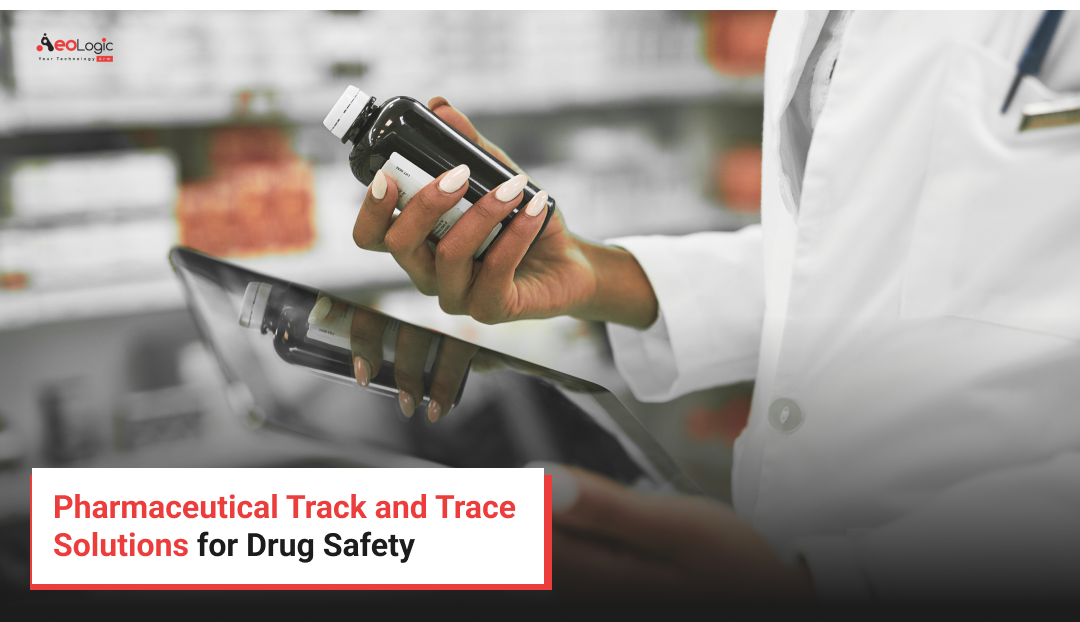
Every year, counterfeit and diverted medicines slip into legitimate pharmacies, hospitals, and online stores, putting patients at real risk. That’s the exact problem pharmaceutical track and trace solutions were built to solve. These systems follow a drug’s journey from the manufacturing line to the patient’s hand, flagging anything that looks tampered, diverted, or fake before it ever reaches someone who needs that medicine to work as intended.
If you’re researching this topic, you’re probably trying to answer one of two questions: what exactly do pharmaceutical track and trace solutions do, or which one is right for your company. This guide answers both. We’ll walk through how these systems work, why regulators around the world now require them, what to expect during implementation, and how to pick a platform that fits your supply chain instead of fighting it.
What are Pharmaceutical Track and Trace Solutions?
Pharmaceutical track and trace solutions are software and hardware systems that assign a unique serial number to every drug package, then record and verify that package’s movement across manufacturers, wholesalers, pharmacies, and patients. They help companies meet drug safety laws, spot counterfeit or diverted products, and recall affected batches quickly when something goes wrong.
At a practical level, these platforms combine a few core pieces: serialization hardware that prints unique codes on packaging, data systems that store every scan and handoff, and verification tools that let anyone in the supply chain confirm a product is genuine before it moves forward. Think of it as a digital chain of custody for medicine — every box, bottle, and carton carries a traceable identity from the moment it’s made.
The term “track and trace” actually describes two connected capabilities:
- Tracking follows a product forward through the supply chain, confirming where it is right now and where it’s headed next.
- Tracing works backward, reconstructing where a specific unit has been, who handled it, and when, which is essential during a recall or an investigation into suspected counterfeits.
Together, these capabilities are what make pharmaceutical track and trace solutions so central to modern drug safety programs. Without them, a single contaminated or counterfeit batch could circulate for weeks before anyone noticed the pattern.
 Why Drug Safety Depends on Pharmaceutical Track and Trace Solutions
Counterfeit medicine isn’t a rare, far-off problem — the World Health Organization estimates that substandard and falsified medical products circulate widely in low- and middle-income countries, and incidents have surfaced in developed markets too, from fake cancer drugs to diluted insulin. Patients have no way to visually tell a counterfeit pill from a genuine one. That gap is exactly what pharmaceutical track and trace solutions close.
Here’s what’s at stake when a supply chain lacks reliable traceability:
- Patient harm. Fake or degraded medicine can fail to treat a condition, or actively cause injury.
- Slow, inaccurate recalls. Without serialized data, a manufacturer may need to pull entire lots instead of the specific affected units, which is costly and disruptive.
- Regulatory exposure. Most major markets now require serialization and verification by law, and gaps in compliance can mean fines or loss of market access.
- Brand and trust damage. A single counterfeit incident tied to a brand name can take years to recover from in the public’s eye.
By contrast, a strong pharmaceutical track and trace program turns drug safety from a reactive scramble into a proactive, data-driven discipline. Companies can isolate a problem to a specific lot or even a specific package, notify only the affected pharmacies, and keep the rest of their inventory moving. That precision is the whole point.
How Pharmaceutical Track and Trace Solutions Work
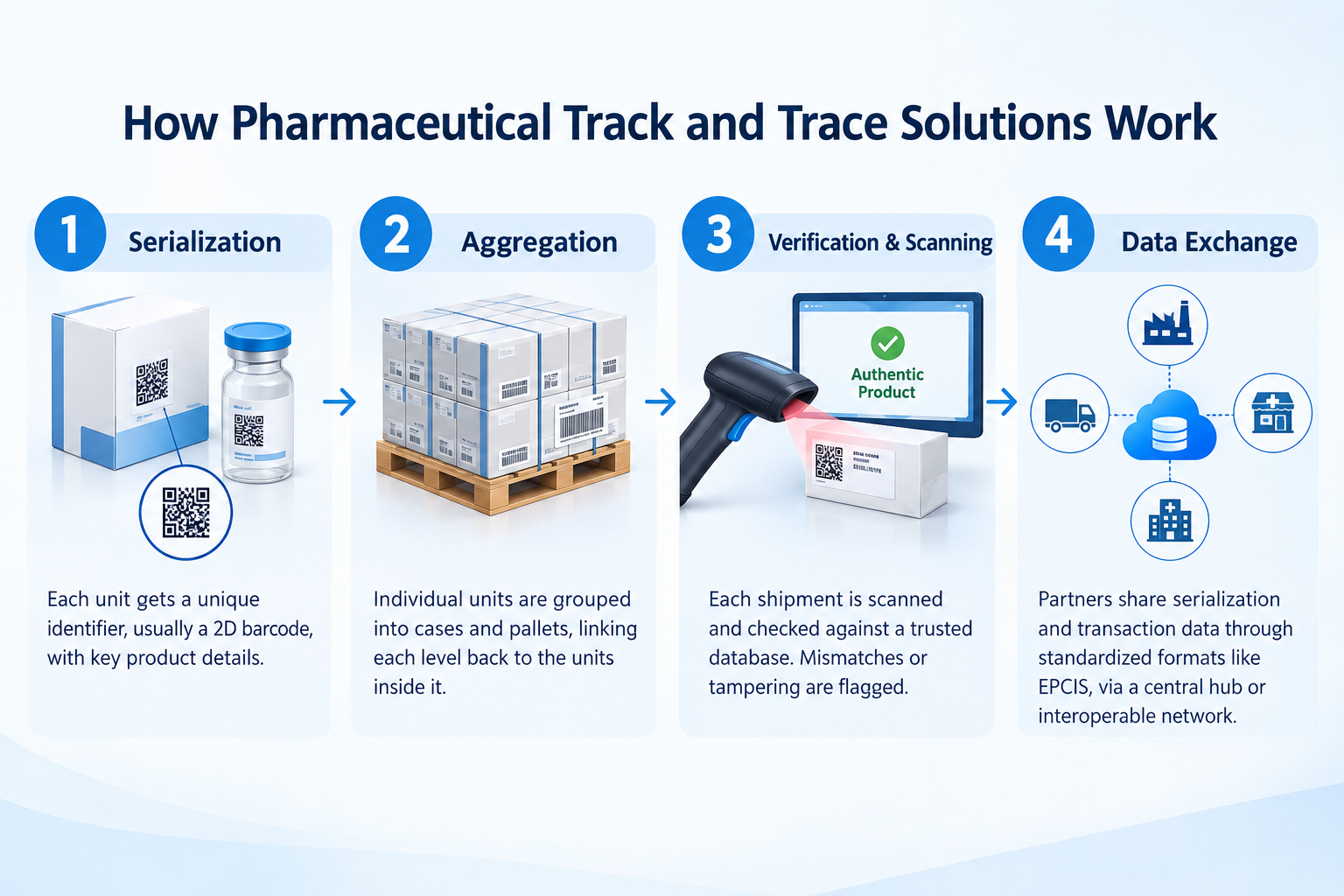
Most platforms follow the same four-stage workflow, even though the underlying technology varies by vendor.
1. Serialization
Each saleable unit — a bottle, box, or blister pack — gets a unique identifier, usually a 2D barcode (GS1 Data Matrix) encoding a product code, batch number, expiration date, and a random or sequential serial number. This happens on the manufacturing line, often right after packaging.
2. Aggregation
Individual units are grouped into cases, and cases into pallets, with each level of packaging linked back to the units inside it. Aggregation means a scan of one pallet barcode can tell you every serial number riding inside it, which saves enormous time during receiving and shipping.
3. Verification and Scanning
As product moves through distributors, wholesalers, and pharmacies, each party scans incoming shipments and checks the serial numbers against a trusted database. If a code doesn’t match, has already been sold, or shows signs of tampering, the system flags it before the product reaches a patient.
4. Data Exchange
Trading partners share serialization and transaction data through standardized formats like EPCIS (Electronic Product Code Information Services), often routed through a central repository or a network of interoperable hubs. This is what lets a hospital verify a drug’s origin even though it never directly interacted with the original manufacturer.
Taken together, these four stages are what separate modern pharmaceutical track and trace solutions from older, paper-based lot tracking — every handoff is recorded, timestamped, and verifiable in near real time.
 Key Benefits of Pharmaceutical Track and Trace Solutions
- Faster, more targeted recalls. Pinpoint the exact lots and locations affected instead of pulling broad inventory.
- Stronger counterfeit and diversion detection. Unexpected scan patterns — a code used twice, or one that never shows up in the system — surface problems early.
- Regulatory compliance. Meet serialization and reporting requirements in the markets where a company sells product.
- Supply chain visibility. Real-time data on where inventory sits helps teams plan production and avoid shortages.
- Improved patient trust. Verification at the pharmacy counter reassures patients that what they’re taking is genuine.
- Operational efficiency. Automated scanning and aggregation cut down on manual data entry and shipping errors.
For manufacturers weighing the cost of implementation, it helps to see these as risk-reduction investments rather than pure compliance overhead. A single prevented recall or counterfeit incident can offset years of platform costs.
Regulatory Landscape for Pharmaceutical Track and Trace Solutions
Governments worldwide have moved from recommending serialization to mandating it. Here’s how the major frameworks compare:
| Regulation | Region | Core Requirement |
|---|---|---|
| DSCSA (Drug Supply Chain Security Act) | United States | Unit-level serialization, interoperable electronic tracing of products at the package level across the supply chain |
| EU FMD (Falsified Medicines Directive) | European Union | Unique identifier and tamper-evident feature on packaging, verified at the point of dispensing |
| GS1 Standards | Global | Common barcode and data-sharing standards (GTIN, EPCIS) that most national regulations are built on |
| China NMPA Track and Trace | China | Mandatory drug identification codes managed through a national regulatory platform |
Even where requirements differ in detail, they share a common goal: making it possible to verify, at any point in the supply chain, that a specific unit of medicine is authentic and hasn’t been tampered with. Companies operating across multiple regions typically need a platform flexible enough to meet each jurisdiction’s specific data format and reporting cadence, rather than a one-size-fits-all approach to pharmaceutical track and trace solutions.
Common Implementation Challenges and Best Practices
Rolling out serialization and traceability isn’t just a software install — it touches manufacturing lines, warehouse operations, and partner relationships. Common hurdles include:
- Legacy equipment. Older packaging lines may need hardware retrofits to print and scan serialized codes reliably.
- Data silos. Manufacturers, distributors, and pharmacies often run different systems that don’t talk to each other out of the box.
- Partner onboarding. Every trading partner in the chain needs to scan and share data consistently, or the chain of custody breaks.
- Cost and timeline pressure. Full rollouts can take 12–24 months, and rushing increases the risk of line downtime.
A few best practices consistently show up at companies that implement smoothly:
- Start with a pilot line before a full facility rollout, so issues surface on a smaller scale.
- Choose standards-based technology (GS1, EPCIS) so the system can connect with partners and regulators without custom integration work for every relationship.
- Involve quality and IT early, not just operations, since serialization data often feeds compliance reporting.
- Build in redundancy for scanning and verification so a single hardware failure doesn’t halt packaging.
- Train frontline staff on exception handling — what to do when a scan fails or a code doesn’t verify — since real-world edge cases happen daily.
Companies that treat pharmaceutical track and trace solutions as an ongoing operational capability, rather than a one-time compliance project, tend to adapt faster when regulations evolve.
Choosing the Right Pharmaceutical Track and Trace Solution
Not every platform fits every company. Before comparing vendors, it helps to score candidates against a short, practical checklist:
- Regulatory coverage: Does it support the specific markets a company ships to (DSCSA, EU FMD, NMPA, etc.)?
- Standards compatibility: Is it built on GS1/EPCIS, or will it require custom integration with every partner?
- Scalability: Can it handle growth in SKUs, production lines, and new markets without a full re-implementation?
- Integration: Does it connect cleanly with existing ERP, warehouse management, and manufacturing execution systems?
- Partner network: Does the vendor already connect to major distributors and pharmacy networks, or will each connection be built from scratch?
- Support and uptime guarantees: Serialization lines can’t tolerate long outages — what’s the vendor’s track record?
Smaller manufacturers often start with cloud-based, subscription-priced platforms that bundle hardware integration support, while larger enterprises with multiple facilities tend to invest in more customizable, on-premise or hybrid deployments. Either path can deliver strong results — the right choice depends on production volume, number of markets served, and in-house IT capacity.
Conclusion
Counterfeit medicine, slow recalls, and fragmented supply chains are solvable problems — and pharmaceutical track and trace solutions are the tool built specifically to solve them. From serialization on the packaging line to verification at the pharmacy counter, these systems give every stakeholder in the chain a reliable way to confirm that the medicine in front of them is genuine, safe, and exactly where it’s supposed to be.
Whether a company is just starting to evaluate serialization requirements or looking to upgrade an aging system, the goal stays the same: protect patients, stay compliant, and keep products moving without unnecessary disruption. If your organization hasn’t yet mapped its current traceability gaps, now is the time to act. Aeologic Technologies can help you assess your supply chain requirements, identify compliance gaps, and plan a track and trace rollout aligned with your production volume and target markets.
Frequently Asked Questions
Q1. What is the main purpose of pharmaceutical track and trace solutions?
Their main purpose is to prevent counterfeit and diverted medicine from reaching patients by giving every package a traceable identity. This lets manufacturers, distributors, and pharmacies verify authenticity and quickly isolate affected product during a recall.
Q2. Are pharmaceutical track and trace solutions legally required?
In most major markets, yes. The U.S. DSCSA, the EU Falsified Medicines Directive, and similar laws in countries like China and Brazil require serialization and verification. Requirements and deadlines vary by region, so companies should confirm obligations for each market they sell in.
Q3. How much does a pharmaceutical track and trace system cost?
Costs vary widely based on production volume, number of facilities, and whether hardware retrofits are needed. Smaller operations may pay a monthly subscription fee, while large multi-site manufacturers often invest significantly more in equipment and integration work.
Q4. What’s the difference between serialization and aggregation?
Serialization assigns a unique code to each individual unit, like a bottle or box. Aggregation links those unit-level codes to the cases and pallets they’re packed into, so scanning one case barcode reveals every unit inside it.
Q5. Can small and mid-size pharmaceutical companies afford track and trace technology?
Yes. Cloud-based platforms have made serialization more accessible, with subscription pricing and managed services that reduce the need for large upfront IT investment. Many vendors specifically target smaller manufacturers with scaled-down implementations.
Q6. How long does implementation typically take?
Most full rollouts take 12 to 24 months, depending on the number of production lines, facilities, and markets involved. Pilot programs on a single line can go live faster, often within a few months.
Q7. What happens if a product fails verification?
The scanning party — a pharmacy, distributor, or wholesaler — receives an alert that the code doesn’t match, has already been used, or shows signs of tampering. The product is then quarantined and reported through the appropriate regulatory channel rather than dispensed.