
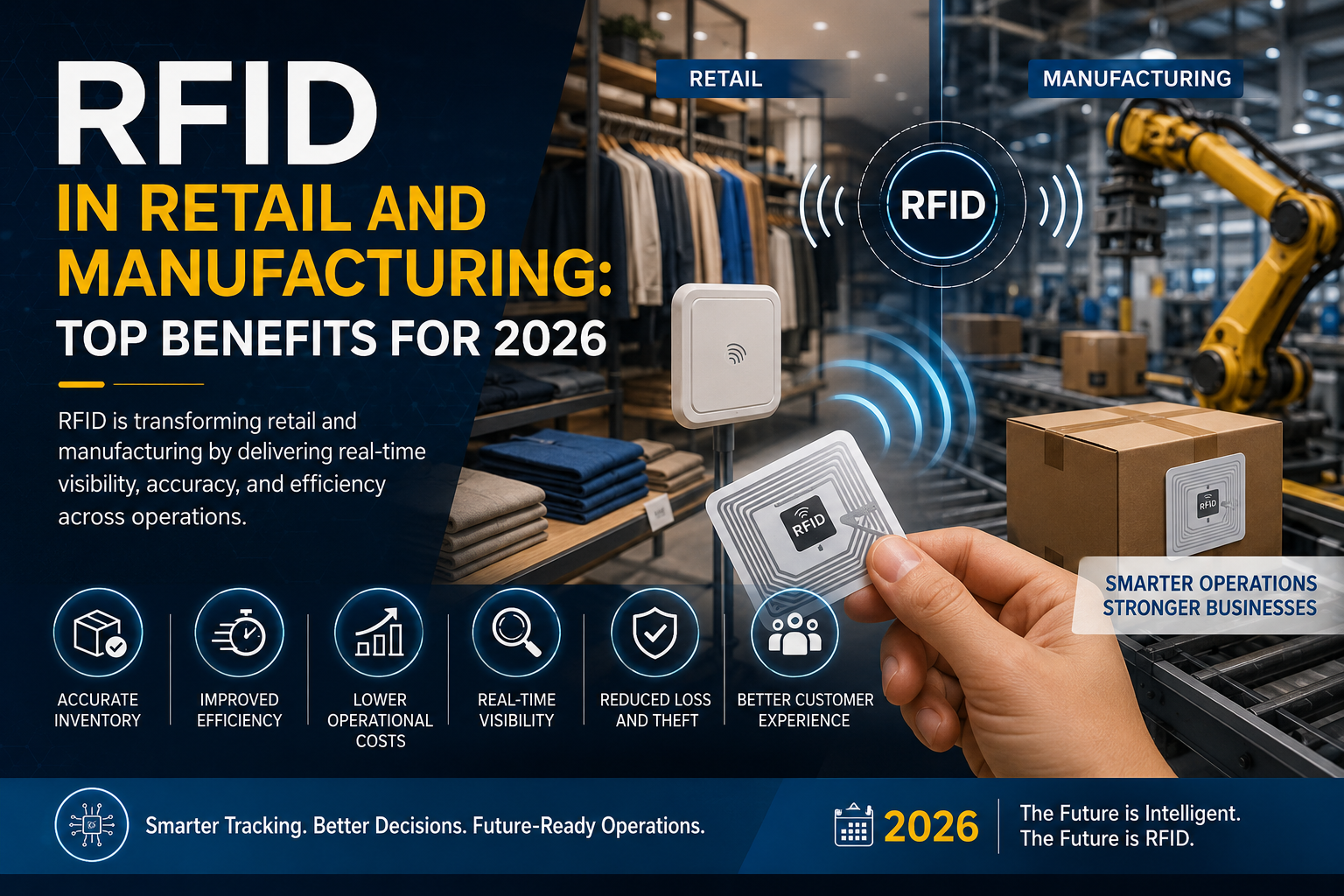
The Radio Frequency Identification (RFID) is no longer just a tracking technology but has become an essential business solution that has emerged in recent years in many industries. With the ongoing push towards digital transformation, retail and manufacturing are increasingly adopting these technologies, and RFID is playing a vital role in enhancing operational efficiency and customer experience. In 2026, organizations are increasingly focusing on developing RFID-based systems, with the aim of creating an advantage, cutting down on the expense of operations, optimizing production processes, and managing inventories. No longer is RFID in Retail and Manufacturing restricted to inventory tracking.
This now facilitates smart supply chains, greater visibility in the warehouse, predictive operations and data-informed decision-making. Companies with RFID in place can better meet customer evolving needs, deal with complex supply chain, and track inventories at different sites.
What is RFID Technology?
Radio Frequency Identification (RFID), an automated identification technology, captures and transmits information stored on Radio Frequency Identification (RFID) Tags. In general, an RFID system comprises of the RFID tags, an RFID reader, an antenna, and software that serves as the interface for processing the data obtained from the reader. Unlike barcodes, an RFID system does not require a line of sight for scanning and thus enables real-time tracking of products at high speeds.
With the rising use of Industry 4.0 technologies, RFID fits in perfectly with cloud platforms, IoT devices, enterprise resource planning (ERP) platforms and warehouse management software. This integration allows companies to automate processes and gain end-to-end visibility across their supply chain.
Why RFID adoption is accelerating in 2026?
Industries have been moving towards RFID adoption at a tremendous rate, mainly because of the requirements for faster deliveries, accurate inventory, warehouse automation, and improved customer experiences. The retailer should be able to oversee all channels and ensure that the inventory level is accurate in both stores and warehouses as well as on the eCommerce sites. Likewise, manufacturers need to have a real-time view of raw materials, work-in-progress (WIP) goods, finished goods, and production equipment.
Growing labor shortages, increasing operational costs, and rising consumer expectations are encouraging businesses to invest in technologies that improve efficiency without significantly increasing workforce requirements. RFID addresses these challenges by providing accurate, automated, and scalable asset tracking.
RFID in Retail: Transforming modern shopping experiences
Improving inventory accuracy
Inventory accuracy remains one of the biggest challenges for retailers. Manual inventory counting often leads to stock discrepancies, misplaced products, and inaccurate replenishment decisions. RFID automates inventory tracking by allowing multiple tagged products to be scanned simultaneously without manual intervention.
Retailers gain real-time visibility into stock levels, helping ensure shelves remain properly stocked while minimizing stockouts and overstock situations. This level of accuracy directly improves customer satisfaction and operational efficiency.
Enabling faster checkout experiences
Long checkout queues continue to affect customer experience. RFID technology enables rapid product identification during billing, significantly reducing checkout times. Self-checkout systems powered by RFID also allow customers to complete purchases quickly while reducing dependency on manual scanning.
The result is a smoother shopping experience that encourages repeat visits and improves customer loyalty.
Supporting omnichannel retail operations
Modern consumers frequently shop across multiple channels, including physical stores, mobile applications, and online marketplaces. RFID provides synchronized inventory visibility across all sales channels, allowing retailers to confidently offer services such as Buy Online Pick Up In Store (BOPIS), ship-from-store, and same-day delivery.
With accurate inventory information available in real time, retailers can fulfill customer orders more efficiently while reducing canceled orders caused by inaccurate stock data.
Reducing theft and product loss
Retail shrinkage caused by theft, misplaced inventory, and administrative errors continues to impact profitability. RFID enables continuous monitoring of high-value merchandise and instantly identifies unauthorized product movement.
Retailers can quickly locate missing inventory while strengthening overall loss prevention strategies.
Enhancing customer experience
Consumers increasingly expect personalized and efficient shopping experiences. RFID enables smart fitting rooms, interactive product displays, and automated inventory availability checks that help customers find products quickly. Staff members spend less time searching for inventory and more time assisting customers, improving both service quality and sales opportunities.
 RFID in Manufacturing: Driving Smart Factory Operations
Real-time production visibility
Manufacturers need complete visibility into production processes to improve efficiency and maintain product quality. RFID allows every component, raw material, and finished product to be tracked throughout the production lifecycle.
Production managers gain instant insights into work-in-progress status, helping identify bottlenecks before they impact manufacturing schedules.
Streamlining material tracking
Manufacturing facilities handle thousands of materials moving between storage areas, production lines, and assembly stations. RFID automates material tracking, reducing delays caused by manual documentation and misplaced inventory.
Accurate material availability ensures production schedules remain uninterrupted while minimizing downtime.
Improving asset management
Manufacturing organizations invest heavily in expensive machinery, tools, and equipment. RFID enables continuous monitoring of these assets, helping businesses track equipment location, maintenance schedules, and utilization rates.
This improves equipment availability while reducing unnecessary replacement costs and minimizing operational disruptions.
Strengthening quality control
Quality assurance becomes significantly more efficient when every product and component carries a unique RFID identity. Manufacturers can trace products back to specific production batches, suppliers, and manufacturing stages.
In the event of product recalls or quality concerns, RFID enables rapid identification of affected items, minimizing financial losses and protecting brand reputation.
Supporting predictive manufacturing
RFID generates valuable operational data that can be combined with Artificial Intelligence and IoT platforms to support predictive analytics. Manufacturers gain insights into equipment performance, inventory movement, production efficiency, and maintenance requirements.
Predictive manufacturing reduces unexpected equipment failures while improving production planning and operational reliability.
Key Benefits of RFID in Retail and Manufacturing
Increased operational efficiency
Automation eliminates repetitive manual tasks, allowing employees to focus on higher-value activities. Inventory counting, asset tracking, product identification, and warehouse management become significantly faster and more accurate.
Better inventory visibility
Real-time inventory visibility helps organizations make informed purchasing, replenishment, and production decisions. Businesses can accurately monitor stock across warehouses, retail stores, and manufacturing facilities without relying on manual updates.
Lower operational costs
Although RFID requires an initial investment, long-term savings are substantial. Reduced labor requirements, fewer inventory errors, minimized product loss, and improved operational efficiency contribute to a strong return on investment.
Enhanced supply chain transparency
RFID enables complete product traceability from supplier to customer. Businesses gain better visibility into inventory movement, shipment status, warehouse operations, and production processes, allowing them to respond quickly to disruptions.
Faster decision-making
Accurate real-time data enables management teams to identify trends, monitor operational performance, and make proactive business decisions based on reliable information rather than manual reports.
Emerging RFID Trends for 2026
AI-Powered RFID analytics
Artificial Intelligence is enhancing RFID by transforming collected data into predictive business insights. Companies can forecast inventory demand, optimize warehouse operations, and identify process inefficiencies before they affect business performance.
RFID and IoT integration
The combination of RFID with Internet of Things technologies creates connected ecosystems where products, equipment, vehicles, and facilities continuously communicate operational data. This integration enables intelligent automation across retail stores and manufacturing plants.
Cloud-based RFID platforms
Cloud computing makes RFID systems more scalable and accessible. Organizations can monitor operations across multiple facilities through centralized dashboards while reducing infrastructure costs and simplifying system management.
Sustainability through RFID
Sustainability has become a strategic priority for businesses worldwide. RFID supports environmentally responsible operations by reducing waste, improving inventory planning, minimizing excess production, and optimizing transportation routes.
Challenges Businesses should consider
While RFID offers substantial benefits, successful implementation requires careful planning. Organizations should evaluate infrastructure readiness, system integration requirements, data security, employee training, and long-term scalability before deployment.
Selecting appropriate RFID tags, readers, and software based on industry requirements is equally important. A well-designed implementation strategy ensures businesses maximize return on investment while minimizing operational disruption.
How to successfully implement RFID
Successful RFID deployment begins with identifying clear business objectives. Organizations should determine whether the primary goal is inventory optimization, production visibility, asset tracking, or supply chain automation. Pilot implementations allow businesses to validate system performance before expanding across multiple facilities.
Integration with existing ERP, warehouse management, manufacturing execution, and supply chain systems ensures seamless data flow across the organization. Continuous monitoring and employee training further improve adoption and long-term success.
The Future of RFID in Retail and Manufacturing
The future of RFID extends far beyond simple tracking. Advances in Artificial Intelligence, machine learning, robotics, digital twins, and autonomous supply chains are transforming RFID into a core technology for intelligent business operations.
Retailers will increasingly rely on RFID to deliver personalized shopping experiences, while manufacturers will use it to power autonomous factories capable of self-monitoring production, optimizing workflows, and predicting maintenance requirements.
As digital transformation accelerates throughout 2026 and beyond, RFID will continue serving as the foundation for smarter, faster, and more connected business environments.
Conclusion
RFID in Retail and Manufacturing is becoming an essential technology for organizations seeking greater efficiency, real-time visibility, and long-term operational excellence. From improving inventory accuracy and enhancing customer experiences in retail to optimizing production, asset management, and quality control in manufacturing, RFID delivers measurable business value across every stage of the supply chain.
As businesses embrace Industry 4.0 and intelligent automation, RFID will play an increasingly important role in building resilient, data-driven operations. Organizations that invest in RFID today will be better positioned to improve productivity, reduce operational costs, and stay competitive in an increasingly connected global marketplace. Aeologic Technologies helps businesses accelerate this transformation by delivering customized RFID solutions that improve operational visibility, automate critical processes, and support long-term digital growth.
FAQs
Q1. What is RFID in Retail and Manufacturing?
RFID in Retail and Manufacturing refers to the use of Radio Frequency Identification technology to automatically identify, track, and manage products, inventory, assets, and materials. It helps businesses improve operational efficiency, inventory accuracy, and supply chain visibility.
Q2. How does RFID improve inventory management in retail?
RFID enables retailers to track inventory in real time without manual scanning. This improves stock accuracy, reduces stockouts and overstocking, speeds up inventory audits, and ensures products are always available for customers across physical stores and online channels.
Q3. What are the benefits of RFID in manufacturing?
In manufacturing, RFID enhances material tracking, monitors work-in-progress, improves asset utilization, supports quality control, and provides real-time production visibility. It also helps reduce downtime and increases overall production efficiency.
Q4. Is RFID better than barcode technology?
RFID offers several advantages over traditional barcode systems. It can scan multiple items simultaneously, does not require a direct line of sight, stores more data, and provides real-time tracking, making it a more efficient solution for large-scale retail and manufacturing operations.
Q5. Can RFID be integrated with ERP and warehouse management systems?
Yes. Modern RFID solutions can be integrated with ERP, Warehouse Management Systems (WMS), Manufacturing Execution Systems (MES), and IoT platforms. This integration enables seamless data sharing, automated workflows, and better decision-making across business operations.
Q6. What industries benefit the most from RFID technology?
While retail and manufacturing are among the largest adopters, RFID is also widely used in healthcare, logistics, warehousing, automotive, pharmaceuticals, aviation, hospitality, and supply chain management to improve tracking, security, and operational efficiency.
Q7. Why is RFID becoming more important in 2026?
In 2026, businesses are focusing on automation, real-time visibility, and digital transformation. RFID supports these goals by improving inventory accuracy, reducing operational costs, enhancing supply chain transparency, and enabling smarter, data-driven business decisions.

I’m a Software Developer with 9 years of experience building scalable web and mobile applications. Currently focused on React.js and React Native, I specialize in creating high-performance, user-friendly interfaces that drive business outcomes.
My background spans cross-platform development using Flutter, and native Android development, giving me a strong understanding of the entire mobile ecosystem. I’ve contributed to products in EdTech, Healthcare, and Enterprise SaaS—helping scale apps to 100K+ users and improving performance, reliability, and user engagement.
I’m passionate about clean architecture, modular design, and seamless user experiences. Whether it’s setting up robust state management with Redux Toolkit, optimizing API integrations with GraphQL/REST, or automating workflows with CI/CD pipelines (GitHub Actions)—I focus on writing maintainable code and delivering value to both users and stakeholders.