
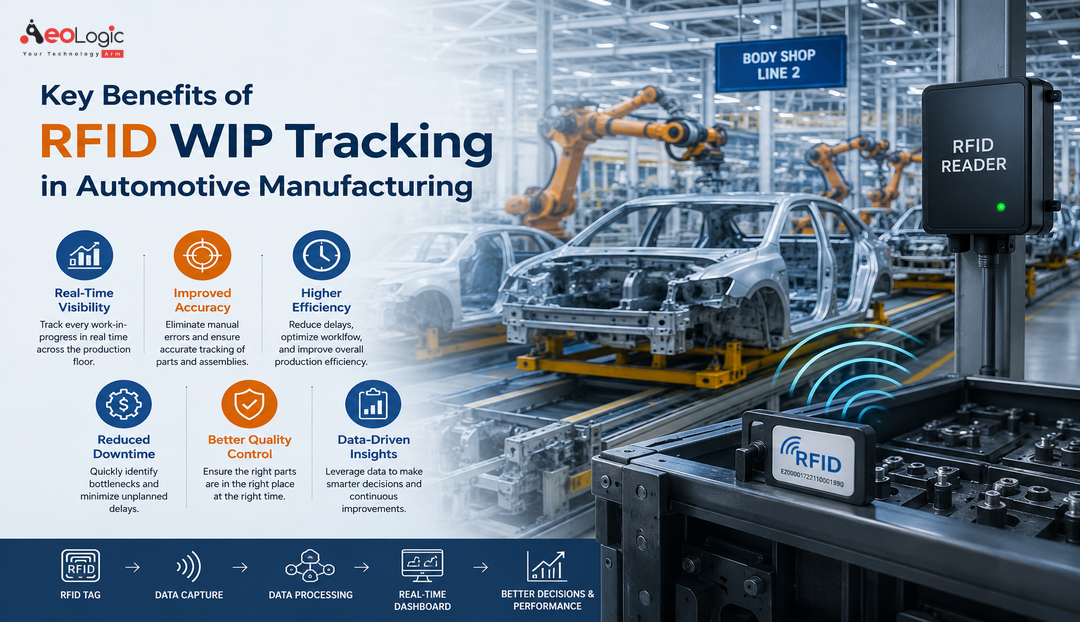
Walk onto almost any automotive production floor and you’ll see the same quiet problem repeating itself: nobody can say, with full confidence, exactly where every part or subassembly is at this exact moment. Multiply that by thousands of parts moving through dozens of stations every shift, and small tracking gaps turn into real money — in scrap, in overtime, in missed ship dates.
This is the exact problem RFID WIP tracking was built to solve. Instead of relying on manual scans, paper travelers, or periodic cycle counts, RFID work-in-process tracking gives manufacturers a continuous, automated record of where every tagged part, container, or subassembly is on the plant floor, in real time.
In this guide, we’ll break down what RFID WIP tracking actually is, why it matters specifically in automotive manufacturing, the concrete benefits plants see after adopting it, how it compares to barcode-based tracking, and what to consider before implementing it on your own line.
What is RFID WIP Tracking?
RFID WIP tracking (Radio Frequency Identification work-in-process tracking) is a method of monitoring parts, subassemblies, and containers as they move through a production process using RFID tags and readers instead of manual data entry or barcode scanning.
Fixed or handheld RFID readers positioned at key points along the line — station entrances, conveyor junctions, paint booths, staging areas — automatically detect the tag as it passes, no line-of-sight or manual scan required.
The result is a live map of everything moving through the plant, updated automatically rather than reconstructed after the fact.
Key Takeaway
RFID WIP tracking replaces manual, point-in-time inventory checks with continuous, automatic location and status updates — giving manufacturers real-time visibility into every part on the production floor without added labor.
Why Automotive Manufacturers Need RFID WIP Tracking
Automotive manufacturing is uniquely suited to RFID WIP tracking for a few structural reasons that other industries don’t share to the same degree.
First, the sheer part count. A single vehicle can involve 5,000–30,000 individual components, many of which move through multiple stations, suppliers, and sub-assembly lines before reaching final assembly. Tracking that volume manually is simply not sustainable at scale.
Second, traceability requirements. Automotive OEMs and Tier 1 suppliers operate under strict quality standards (such as IATF 16949) that require the ability to trace a part’s history — where it was made, which line it passed through, and when — often years after the vehicle has shipped.
Third, the mixed-model reality of modern plants. Most automotive lines no longer build one vehicle configuration repeatedly; they build several trims, engine variants, and option packages on the same line, often in a nearly random sequence. Keeping the right part paired with the right vehicle at the right station is far harder without automated tracking.
RFID WIP tracking directly addresses all three pressures: it scales to high part volumes without added labor, it creates a built-in traceability record, and it reduces the risk of the wrong part reaching the wrong vehicle on a mixed-model line.
Key Benefits of RFID WIP Tracking in Automotive Manufacturing
Below are the benefits manufacturers most consistently report after implementing RFID WIP tracking on the plant floor.
1. Real-Time Production Visibility
The most immediate benefit of RFID WIP tracking is knowing where everything is, right now, without walking the floor or calling a supervisor. Because readers capture location data automatically as tagged parts move, plant managers get a live, always-current view of work-in-process instead of a snapshot from the last manual count.
This matters most when something goes wrong. If a station goes down, managers can immediately see how much WIP is sitting upstream and downstream, and make faster decisions about rerouting or reallocating labor — instead of losing time figuring out where the backlog actually is.
2. Improved Inventory Accuracy
Manual WIP counts are prone to human error: missed scans, duplicate entries, mislabeled bins. Because RFID WIP tracking captures reads automatically as tagged items pass a reader, it removes most of the manual data-entry steps where errors typically creep in.
3. Reduced Labor Costs and Manual Errors
Every manual scan, count, or paper traveler update is a task that pulls a person away from higher-value work. RFID WIP tracking automates the data capture itself, which means operators spend less time on administrative tracking tasks and more time on actual production and quality work.
Over a full shift, and across an entire plant, that adds up. Fewer manual touchpoints also means fewer opportunities for transcription errors, mislabeling, or missed updates — all of which otherwise require rework to correct.
4. Enhanced Quality Control and Traceability
Because every RFID read is time-stamped and tied to a specific part or container, RFID WIP tracking effectively builds a digital paper trail as parts move through the plant. If a quality issue is discovered downstream — or after the vehicle has shipped — that history makes it possible to trace exactly which stations, shifts, and process parameters a specific part passed through.
This is particularly valuable for automotive suppliers operating under IATF 16949 or customer-specific quality requirements, where documented traceability isn’t optional. Instead of reconstructing a timeline from paper logs, quality teams can query the tracking system directly.
5. Faster Cycle Times and Throughput
When managers can see WIP levels and bottlenecks in real time, they can react faster — rebalancing labor, adjusting sequencing, or flagging a stalled station before it cascades into a larger delay. Some plants also use RFID data to analyze historical cycle times by station, identifying which steps consistently run behind and where process improvements would have the biggest impact.
6. Better Compliance and Recall Management
If a component defect is identified after vehicles have shipped, automotive manufacturers need to know precisely which vehicles contain the affected part — not just approximately. RFID WIP tracking supports this by linking specific tagged components to the vehicles they were installed on, station by station.
7. Data-Driven Decision Making
Plant leaders can use this data to spot recurring bottlenecks, compare shift performance, evaluate the impact of process changes, and support capacity planning decisions with actual movement data instead of estimates.
8. Seamless Integration with MES and ERP Systems
RFID WIP tracking is rarely a standalone system in practice — it’s most valuable when it feeds directly into a manufacturing execution system (MES) or enterprise resource planning (ERP) platform. This integration lets WIP location data automatically update production schedules, trigger material replenishment, and feed quality records, without someone manually re-entering the same information across multiple systems.
Summary Table: Core Benefits at a Glance
| Benefit | What It Solves |
| Real-time visibility | Eliminates guesswork about WIP location |
| Improved inventory accuracy | Reduces manual counting errors |
| Lower labor costs | Frees operators from manual data entry |
| Quality traceability | Creates an automatic, queryable part history |
| Faster cycle times | Surfaces bottlenecks before they cascade |
| Recall precision | Narrows recalls to actually-affected vehicles |
| Data-driven decisions | Supports planning with real movement data |
| System integration | Connects WIP data to MES/ERP automatically |
RFID WIP Tracking vs. Barcode Tracking
Many plants currently rely on barcode scanning for WIP tracking, so it’s worth comparing the two directly.
| Factor | RFID WIP Tracking | Barcode Tracking |
| Scan method | Automatic, no line-of-sight needed | Requires direct line-of-sight scan |
| Read speed | Multiple tags read simultaneously | One barcode scanned at a time |
| Labor requirement | Minimal — passive reads | Requires an operator to scan |
| Durability | Tags withstand heat, paint, dirt (with proper housing) | Labels can be damaged, smudged, or torn |
| Real-time data | Continuous, automatic updates | Data only as current as the last scan |
| Upfront cost | Higher initial investment | Lower initial investment |
| Best fit | High-volume, mixed-model lines | Lower-volume or simpler tracking needs |
Barcode tracking still has a place, particularly in lower-volume operations or where budget constraints are significant. But for high-mix, high-volume automotive environments, the labor savings and real-time accuracy of RFID WIP tracking typically outweigh the higher upfront cost over time.
 What are the Challenges of Implementing RFID WIP Tracking?
RFID WIP tracking is not a plug-and-play upgrade, and it’s worth being clear-eyed about the challenges before committing to a rollout.
- Upfront investment. Tags, readers, middleware, and system integration require real capital, and the payback period varies by plant size and complexity.
- Metal and liquid interference. Automotive environments are full of metal surfaces and painted parts, both of which can interfere with RFID signal reads if tags and readers aren’t positioned and specified correctly.
- Tag durability in harsh conditions. Paint booths, welding stations, and high-heat processes can degrade standard tags; industrial-grade tags rated for the specific environment are usually necessary.
- System integration complexity. Connecting RFID data to existing MES, ERP, or quality systems takes planning and, often, custom integration work.
None of these challenges are unusual for a manufacturing technology rollout, but they do mean RFID WIP tracking works best as a planned, phased implementation rather than a plant-wide switch flipped overnight.
Best Practices for RFID WIP Tracking Implementation
- Start with a pilot area. Choose one line or station cluster with a clear, measurable pain point — such as a bottleneck or a high-error area — and prove the concept before scaling plant-wide.
- Map read points to actual decision points. Place readers where the data will actually change a decision (station entry/exit, quality checkpoints) rather than everywhere physically possible.
- Specify tags for the environment. Match tag type and housing to the conditions they’ll face — heat-resistant tags near paint and weld stations, metal-mount tags on metal containers.
- Train for the new workflow, not just the new hardware. Operators need to understand what changes in their daily process, not just how the reader works.
- Validate data accuracy before scaling. Confirm read rates and data quality in the pilot area before expanding, since interference issues are easier to fix on a small scale.
How to Choose the Right RFID WIP Tracking System
When evaluating vendors or systems, automotive manufacturers should weigh:
- Compatibility with existing MES/ERP — can the system integrate without a full replatform?
- Read range and accuracy — has the vendor tested performance in environments with similar metal density and line speed?
- Scalability — can the system expand from a pilot area to the full plant without a redesign?
- Support and implementation experience — does the vendor have documented experience in automotive manufacturing specifically, not just general industrial settings?
Choosing a system that fits your existing infrastructure and quality requirements — rather than the system with the most features on paper — tends to produce the smoothest implementation.
Conclusion
RFID WIP tracking has moved from a “nice to have” pilot project to a practical necessity for automotive manufacturers dealing with high part volumes, mixed-model production, and strict traceability requirements. The core value is straightforward: instead of reconstructing where parts are after the fact, plant teams know in real time — which translates into fewer errors, faster response to bottlenecks, more accurate inventory, and a traceability record that holds up when quality or compliance questions come up.
Implementing RFID WIP tracking does require careful planning—from choosing the right tags for harsh plant conditions to integrating the system with existing MES and ERP platforms and training teams on the new workflow. With solutions from Aeologic Technologies, manufacturers can approach this transition with the right technology and implementation strategy. For manufacturers evaluating their next process improvement investment, RFID WIP tracking stands out as a practical solution with clear and measurable benefits on the plant floor.
Frequently Asked Questions
Q1. What does WIP stand for in manufacturing?
WIP stands for work-in-process (or work-in-progress) — the parts, subassemblies, or products that have entered the production process but haven’t yet been completed. Tracking WIP accurately is essential for scheduling, inventory accuracy, and identifying bottlenecks on the production floor.
Q2. How is RFID WIP tracking different from RFID inventory tracking?
RFID inventory tracking generally refers to tracking finished goods or raw materials in storage, while RFID WIP tracking focuses specifically on items actively moving through the production process. The core RFID technology is the same, but WIP tracking is tied more closely to real-time process visibility and station-level data.
Q3. Does RFID work reliably around metal parts in automotive plants?
Yes, but it requires careful planning. Standard RFID tags can have reduced read range near metal surfaces, so automotive plants typically use metal-mount tags and position readers to account for interference, which is a standard part of a proper RFID WIP tracking implementation.
Q4. How much does an RFID WIP tracking system cost?
Costs vary significantly based on plant size, number of read points, tag volume, and integration complexity. Rather than a fixed number, most manufacturers evaluate cost against expected labor savings, error reduction, and traceability benefits during a pilot phase before committing to a full rollout.
Q5. How long does it take to implement RFID WIP tracking?
Implementation timelines depend on scope, but most manufacturers start with a pilot on one line or area, which can typically be running within a few weeks to a couple of months, before planning a phased rollout to the rest of the plant.

With a strong foundation in software and a growing expertise in AI, I specialize in building smart, scalable solutions that drive digital transformation