
The pharmaceutical industry is the industry that produces drugs by deep research. So in this manner, this is one of the most important industries for mankind. There are a lot of pharmaceutical companies across the world and this industry has established a well-developed global market. It grew from $1199.86 billion in 2023 to $1267.05 billion in 2024 at a compound annual growth rate (CAGR) of 5.6%. The pharmaceutical drugs market size is expected to see rapid growth in the next few years. It will grow to $2092.95 billion in 2028 at a compound annual growth rate (CAGR) of 13.4%.
However, there are many problems in the pharmaceutical industry due to the lack of any specific tool or technology. The pharmaceutical industry suffers from a lack of transparency, difficulty tracking products, lack of trust, and the shipment of expired products. This results in a severe loss for the pharmaceutical industry. Traceability is one of the major issues among the all issues that need to be solved to enhance the efficiency of this industry.
In the pharmaceutical sector, traceability is essential for ensuring the efficacy, safety, and quality of products. It helps avoid product recalls by making it possible to identify and remove potentially dangerous products from the market. These problems can be cured with a specific technology which is blockchain technology. Blockchain technology can provide a secure, transparent, and tamper-proof record of every drug transaction, reducing counterfeit risks and enabling quick tracing of products.
The global blockchain market size is projected to grow from USD 20.1 billion in 2024 to USD 248.9 billion by 2029 at a Compound Annual Growth Rate (CAGR) of 65.5% during the forecast period. This technology has been in use for many years and provides positive results for its users. This technology could bring an evolution for the pharmaceutical industry in the aspect of traceability.
Even a few pharmaceutical industries have implemented this technology.
Here are a few companies mentioned that are using blockchain technology.
- Pfizer. Pfizer uses the MediLedger blockchain project to create a closed ecosystem and track drugs to every last detail.
- Roche.
- United Healthcare.
In this article, we will see the role of blockchain technology in the pharmaceutical industry. We will also see the top key benefits of blockchain technology in the pharmaceutical industry to enhance traceability. In the end, we will conclude our vision on this topic.
Overview: Blockchain For Pharmaceutical Traceability
Blockchain technology is a sophisticated database system that makes it possible for information to be shared transparently inside a company network. Data is kept in blocks that are connected in a chain within a blockchain database. Blockchain technology in healthcare can enhance the various aspects as products may be tracked, traced, and recalled. Pharmaceutical supply chain management based on blockchain makes it possible to track medicine transactions from suppliers of raw ingredients to final users. Overall, it can change the face of the pharmaceutical industry in various ways.
In pharmaceutical traceability, blockchain enables:
- End-to-end visibility of drug movement
- Real-time data sharing across stakeholders
- Immutable record of transactions
- Improved recall management
- Enhanced regulatory compliance
From raw material sourcing to final delivery to patients, blockchain ensures that every step is recorded and verifiable.
Blockchain + Cold Chain Monitoring in Pharma
Temperature-sensitive drugs such as vaccines and biologics require strict environmental control.
Challenges:
- Temperature fluctuations
- Data manipulation
- Lack of real-time monitoring
Solution: Blockchain + IoT Integration
- IoT sensors monitor temperature, humidity, and location
- Blockchain stores tamper-proof data
- Real-time alerts for deviations
Benefits:
- Reduced product spoilage
- Improved compliance
- Enhanced patient safety
- Audit-ready data
Regulatory Compliance Driving Traceability Adoption
1. DSCSA (Drug Supply Chain Security Act – USA)
The Drug Supply Chain Security Act (DSCSA) mandates full traceability of prescription drugs across the United States supply chain.
Key Requirements:
- Product serialization
- Electronic interoperable systems
- Verification of drug authenticity
- End-to-end traceability by 2024–2025
Blockchain aligns perfectly with DSCSA requirements by providing:
- Secure data exchange
- Immutable transaction records
- Real-time verification of drug movement
2. EU FMD (Falsified Medicines Directive – Europe)
The EU Falsified Medicines Directive (EU FMD) aims to eliminate counterfeit medicines from the European market.
Key Features:
- Unique identifier (2D barcode) on each pack
- Tamper-evident packaging
- Centralized verification system
Blockchain enhances EU FMD compliance by:
- Providing decentralized verification
- Ensuring data integrity
- Enabling real-time authentication
3. India Drug Traceability Regulations
India, being one of the largest pharmaceutical exporters, has implemented several traceability measures.
Key Initiatives:
- Barcode-based drug tracking
- Track and Trace system for exports
- GS1 standards adoption
- Integration with government portals
Blockchain can significantly strengthen India’s traceability framework by:
- Eliminating data silos
- Ensuring real-time visibility
- Preventing counterfeit drug exports
- Enhancing global compliance standards
Serialization in Pharmaceutical Traceability
Serialization involves assigning a unique identifier to each drug unit, enabling precise tracking throughout the supply chain.
Blockchain + Serialization Workflow:
- Manufacturer assigns a unique serial number
- Data is recorded on blockchain
- Product moves through distributors and wholesalers
- Each transaction is logged in real-time
- Final verification occurs at the pharmacy level
Benefits:
- Eliminates duplication
- Prevents counterfeit drugs
- Enables instant authentication
- Improves recall accuracy
How Blockchain Could Be Beneficial For Pharmaceutical Traceability?
Blockchain technology can enhance data security with traceability solutions in the pharmaceutical industry by various means as by guaranteeing medication validity, traceability, and transparency, this technology helps to improve the pharmaceutical supply chain. In addition to facilitating regulatory compliance and enabling real-time monitoring, it also lowers the danger of counterfeiting, gives stakeholders secure access to verified data, and promotes patient safety.
There are many other benefits of this technology that we will see later in the upcoming paragraph.

Benefits Of Blockchain For Pharmaceutical Traceability
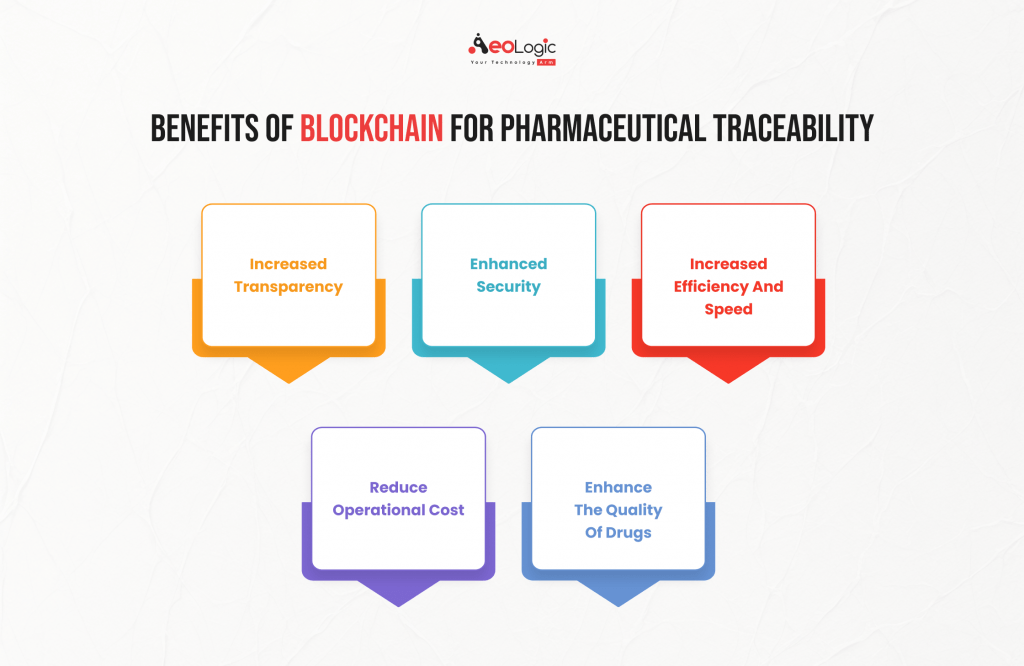
Blockchain technology offers a variety of benefits to pharmaceutical traceability as here are a few key benefits mentioned below.
1. Increased Transparency
Transparency is one of the important aspects in any industry that builds trust between the employees and also for the customers. With the blockchain-powered traceability system in the pharmaceutical industry, the transparency factor is enhanced by properly providing data on every process in the supply chain. Each procedure can be easily tracked with details. This results in overall increases in transparency.
2. Enhanced Security
Security of sensitive data is also critical in the pharmaceutical industry. With blockchain technology, security can be enhanced as this technology adds an extra layer of protection that cannot easily be breached. Overall, this technology is also a great tool for security for traceability.
Also Read: Challenges and Opportunities in the Traceability of Medicinal Products
3. Increased Efficiency and Speed
With the blockchain technology-powered traceability system in the pharmaceutical industry, you can constantly look out for the factors that can enhance the speed of the supply chain. With the proper information about every aspect, you can escape the interruption that slows down the processes. This overall increases the speed and efficiency of the supply chain in the pharmaceutical industry
4. Reduce Operational Cost
Many unnecessary expenditures occur in a company due to the lack of a proper traceability system. With blockchain-powered traceability, automation can also be achieved with the integration of other technologies like AI. Automatic tracing can reduce the manual operational cost in the industry. This also reduces the error rate than humans so overall this results in an increase in revenue generation.
5. Enhance the Quality of Drugs
The quality of drugs matters the most as any mistake could lead to harm to patients. With blockchain technology-based traceability, every minute process can be monitored it does not prevent any degradation in quality. This overall enhances the quality of drugs and also a big boost to the company’s reputation.
Also Read: Improving Patient Care with RFID Technology in Healthcare
Real-World Use Cases of Blockchain in Pharma
Several global companies have already started adopting blockchain technology.
1. Pfizer
Uses the MediLedger network to track and verify drug authenticity.
2. Roche
Explores blockchain for clinical trials and supply chain transparency.
3. UnitedHealthcare
Implements blockchain for secure healthcare data exchange.
Blockchain vs Traditional Traceability Systems
| Feature | Blockchain | RFID | ERP |
|---|---|---|---|
| Transparency | High | Medium | Low |
| Data Security | Very High | Medium | Medium |
| Tamper-proof | Yes | No | No |
| Real-time Tracking | Yes | Yes | Limited |
| Cost | High | Medium | Medium |
Challenges With Blockchain For The Pharmaceutical Industry
We have seen a bundle of benefits of blockchain-powered traceability systems in the pharmaceutical industry. But there are a few challenges too as there are a few challenges mentioned below.
- Initial implementation cost is too high for blockchain technology as this is one of the new technologies that have been introduced in recent times.
- It is very hard to find a good engineer or company to implement blockchain technology as there is not too much development in the study of this technology. But definitely, soon this is going to change the face of the world.
- Complex integration with the existing system can be a challenge with blockchain technology as it takes too much labor and time to adapt the existing system resulting in downtime for the company.
Do you know? Role RFID Traceability in Medical Device Industry
Future of Blockchain in Pharmaceutical Traceability
The future of blockchain in pharma looks promising due to:
- Increasing regulatory pressure
- Growing demand for transparency
- Rising counterfeit drug concerns
- Integration with AI, IoT, and analytics
Blockchain will evolve into a core infrastructure layer for pharmaceutical supply chains, enabling:
- Fully digital ecosystems
- Autonomous compliance systems
- Predictive analytics for supply chain optimization
Final Words
The utilization of blockchain technology in the pharmaceutical industry for traceability presents noteworthy advantages in terms of augmenting transparency, fostering confidence, and optimizing quality assurance and compliance procedures. We have also seen a lot of benefits that should be enough to decide the fate of this technology in the pharmaceutical industry’s traceability for the future.
FAQs
Q1. How does blockchain prevent counterfeit drugs?
Blockchain prevents counterfeit drugs by creating a secure, immutable record of every transaction in the supply chain. Each drug unit is serialized and tracked from manufacturer to end user.
Q2. What is DSCSA compliance and how does blockchain help?
DSCSA (Drug Supply Chain Security Act) requires end-to-end traceability of prescription drugs in the U.S. Blockchain helps by enabling secure, real-time data sharing, immutable transaction records, and product verification. It ensures compliance through transparent tracking, reducing fraud and improving supply chain visibility across stakeholders.
Q3. Is blockchain used in Indian pharma?
Yes, blockchain is gradually being adopted in Indian pharma, especially for drug traceability and export compliance. Companies are exploring pilot projects to enhance transparency and meet global standards. Government initiatives like track-and-trace systems can further benefit from blockchain integration for secure and real-time monitoring.
Q4. What are alternatives to blockchain for drug traceability?
Alternatives to blockchain include RFID, barcoding systems, centralized databases, and IoT-based tracking solutions. Technologies like ERP systems and cloud-based platforms also support traceability. However, unlike blockchain, these systems may lack decentralization and immutability, making them less secure against data tampering and fraud.

I’m Deepika Pandey, an SEO strategist and content writer with 6+ years of experience. I create SEO-friendly content that drives traffic and engages readers. I combine data insights with creativity to help businesses grow their online presence effectively.