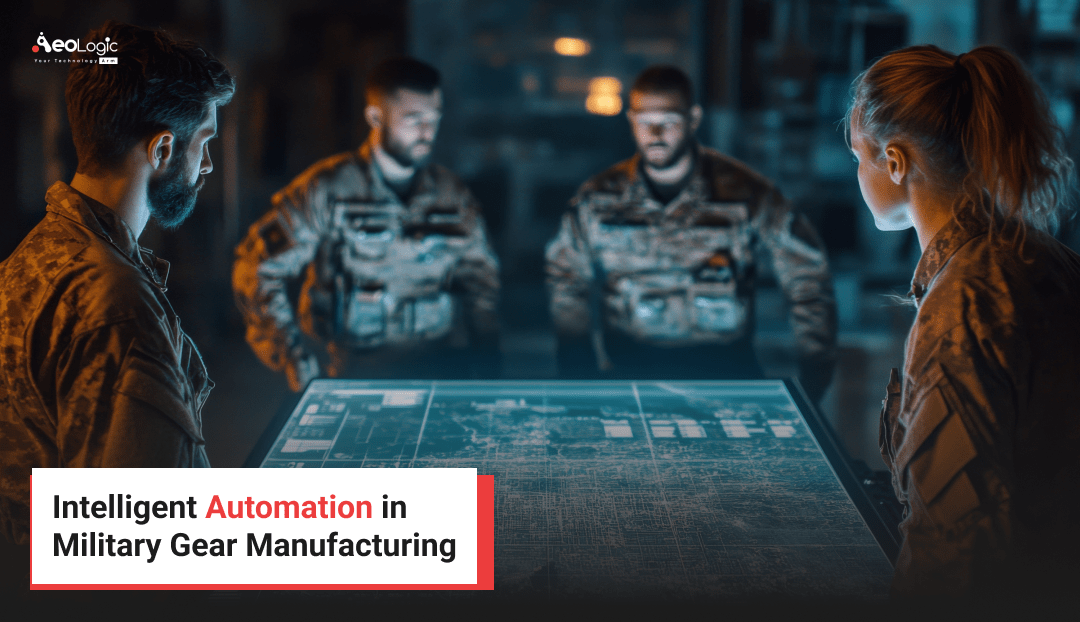
The military gear manufacturing industry is undergoing a deep change, powered by the power of military equipment AI. Imagine production features where the agent AI agency autonomously optimize assembly lines, predicts maintenance needs, and designs advanced military gear – such as strategic waste, drones, and communication devices – with unmatched accurate. The military equipment is redefinously defining how gear is produced, ensuring efficiency, durability and innovation. According to the 2025 Deloite report, 82% of the manufacturer AI, who adopted military equipment, reported an increase of 28% in production efficiency. AI-operated manufacturing, intelligent automation system, and AI-Enhanced gear design, military equipment reduces the cost and accelerates distribution. This blog discovers the influence of military equipment , its benefits, real -world applications, challenges, solutions and emerging trends. Whether you are shaping the future of a defense contractor, engineer, or military strategist, Military Equipment AI safe, efficient gear production.
Why military equipment is the future of AI gear building?
The military equipment is bringing revolution in the defense industry by enabling AI, smart, faster and more reliable manufacturing processes. The modern military gear demands accurate, scalability and adaptability to meet the needs of the battleground, and the military equipment distributes through the AI agent AI Agency. These solutions integrate machine learning, predictable analytics and autonomous systems from design to deployment to make each stage of production effective.
The 2025 McKinse report estimated that military equipment can save the global defense sector through customized workflows by 2030 by 2030. For example, military equipment AI analyzes giant datasets- physical specifications, supply chain logistics and performance matrix to increase AI efficiency. This device predicts failures, reduces downtime, and rapidly supports rapid prototypeings for designs recurrence. Agent AI agency autonomously adjusts the production parameters to ensure frequent quality under high demand. By incorporating intelligent automation systems, military equipment AI meets strict standards of modern war, making it an essential tool for the future.
Image Placeholder: AI-Powered Gear Production Line
Caption: A intelligent automation system adaptation of military gear production with military equipment AI.
Precision Manufacturing & AI Quality Control
One of the most critical advancements in military equipment AI is precision manufacturing combined with AI-driven quality control.
What is Precision Manufacturing in Defense?
Precision manufacturing ensures that complex military components—such as:
- Missile guidance systems
- Communication devices
- Body armor
- Radar modules
…are produced with micron-level accuracy.
AI-Powered Quality Control
AI enhances this through:
- Computer vision systems for defect detection
- Real-time inspection during assembly
- Automated error correction
Instead of relying on manual inspection, AI systems continuously monitor production lines and instantly identify:
- Structural defects
- Material inconsistencies
- Assembly misalignments
This ensures near-zero defect rates, which is critical in mission-critical defense applications.
 Predictive Maintenance for Military Equipment
Another major innovation is predictive maintenance powered by AI.
Traditional maintenance models are:
- Reactive (fix after failure)
- Time-based (scheduled checks)
AI introduces a smarter approach.
How It Works:
- Sensors collect real-time machine data
- AI models analyze wear patterns
- Systems predict failures before they occur
Key Benefits:
- Reduces downtime by up to 40%
- Extends machinery lifespan
- Prevents costly production interruptions
For example, AI systems can predict when a robotic arm in an assembly line is likely to fail—allowing preemptive servicing without halting production.
Major benefits of military equipment AI
The military operated by the Agent AI Agency provides transformational benefits to the defense industry. Here are the main benefits:
- Presiguation Manufacturing: Military equipment ensures high accuracy in complex gear production, such as body armor or navigation system, reduces errors.
- Cost Efficiency: AI-AI-manufacturing manufacturing 2024 According to Gartner study, materials with savings up to 27%reduces waste and labor costs.
- Scalability: Agent AI agency manages large -scale production demands, meeting immediate military needs without compromising quality
- Future -staging maintenance: forecast military equipment AI equipment maintenance, prevent failures and expand machinery lifespan
- Promoted cyber security: intelligent automation system protects sensitive production data against cyber threats, important in defense applications.
- Rapid Innovation: AI-anhansed gear design accelerates the prototype, enabling rapid deployment of state-of-the-art technologies.
- Stability: Military tools adapt to AI resource use, align with global stability goals and reduce environmental impact.
- Supply chain optimization: AI-operated manufacturing forecasts, ensuring spontaneous logistics and timely delivery.
These benefits are placed as the cornerstone of modern military gear production, driving efficiency and innovation.
Image Placeholder: AI-Powered Manufacturing Dashboard
Caption: A dashboard showcasting military equipment optimize gear production workflow in real time.
How agent AI agency works in military gear construction
Military equipment depends on the sophisticated agent AI agency to revolutionize AI manufacturing processes. These systems integrate advanced technologies to provide spontaneous, efficient and accurate production. Here’s how they work:
- Data Integration: Military equipment collects data from AI sensors, supply chain systems, design software and IOT devices, creating a broad dataset.
- Real Time Analysis: Agent AI agency uses machine learning to process the data to identify the incompetence or defects in production lines.
- Autonomous adaptation: intelligent automation system adjusts parameters such as material flow or assembly speed to maximize efficiency and quality.
- Quality Assurance: Military equipment employs computer vision to detect defects in real time, ensuring that gear meets rigid standards.
- Predictive Insights: Ai-operated manufacturing forecast supplies or tool failures, enabling active solutions.
- Continuous education: Agent AI Agency refines the processes based on ongoing data, improving performance over time.
For example, Northrop Grumman used military equipment to adapt to drone production, to reduce the assembly time by 16%, according to its 2024 report. Similarly, the BAE system takes advantage of the agent AI agency for quality control, cutting the defects up to 18%. This progress highlights how military equipment AI ensures accurate and reliability.
Image Placeholder: AI Quality Control System
Caption: Military equipment AI ensure accuracy in gear production through real -time quality check.
Role of AI-Inaculated Manufacturing In Military Gear
AI-driven manufacturing, powered by AI, is redefining military gear production. Agentic AI agency automates complex tasks like material allocation, assembly line scheduling, and resource optimization. By integrating intelligent automation systems, military equipment AI enables seamless coordination between robotics, IoT devices, and human operators. A 2025 RAND study found that manufacturers using AI reduced production timelines by 22%, critical for rapid deployment in mission-critical scenarios.
Agent AI agency also increases cyber security, protects sensitive design data from cyber threats, a growing concern in defense. Additionally, the AI-manufacturing manufacturing manufacturing supports autonomous gear production, which enables fully automated lines to strategic gear or communication devices. This increases automation efficiency and ensures stability in high pressure environment. Military equipment AI thus is an important force in modernizing gear production, which ensures readiness to develop the challenges of the battlefield.
Image Placeholder: Autonomous Gear Production
Caption: Agent AI agency strengthens autonomous military gear production for rapid deployment.
AI in Drone Manufacturing
Drone technology is one of the fastest-growing segments in defense—and AI is at its core.
How AI Transforms Drone Manufacturing:
- Autonomous assembly lines
- AI-assisted aerodynamic design
- Simulation-based testing
- Real-time performance optimization
Benefits:
- Faster production cycles
- Improved flight accuracy
- Enhanced payload optimization
- Reduced manufacturing costs
AI also enables swarm drone technology, where multiple drones operate collaboratively using real-time data sharing.
This is critical for:
- Surveillance missions
- Border security
- Tactical operations
Military equipment AI’s real -world use cases
Military equipment AI is making significant progress throughout the industry. Here are seven compelling examples
- Northrop Gramman: Military equipment uses AI to optimize drone production, reduces the cost by 17%according to their 2024 data.
- General Dynamics: The assembly cuts up to 20%of the assembly time to streamline the armored vehicle manufacturing to employ agentic AI agency.
- BAE System: Military equipment for quality control in strategic gear avails AI, reducing defects by 18%.
- Raytheon Technologies: Missile system uses AI-operated manufacturing to accelerate production, improves efficiency up to 19%.
- Thales Group: Intelligent applies to the automation system to increase communication equipment production, increasing the output by 21%.
Agent AI agency also increases cyber security, protects sensitive design data from cyber threats, a growing concern in defense. Additionally, the AI-manufacturing manufacturing manufacturing supports autonomous gear production, which enables fully automated lines to strategic gear or communication devices. This increases automation efficiency and ensures stability in high pressure environment. Military equipment thus is an important force in modernizing gear production, which ensures readiness to develop the challenges of the battlefield.
Image Placeholder: Autonomous Gear Production
Caption: Agent AI agency strengthens autonomous military gear production for rapid deployment.
Challenges in implementing military equipment AI
Despite its transformative ability, military equipment faces many challenges
- Data Safety concerns: A 2025 PWC study notes that 72% of defense contractors worry about cyber hazards for sensitive production data.
- High Implementation Cost: Small manufacturers are challenged to deploy agent AI agency.
- Heritage System Integration: Many existing system military equipment are inconsistent with AI, which requires expensive upgrades.
- Workforce Upscilling: Employees require training to effectively manage AI-manufacturing manufacturing, which may be resource-intensive.
- Elgorithm bias: The sub -production production may take decisions, affecting the quality of incomplete data gear.
- Regulatory compliance: Military equipment must follow strict rules such as Itar, complicate implementation.
Solution to cross challenges:
- Provide comprehensive training programs to Upskil Staff at Agent AI Agency.
- Use APIs to integrate military equipment with heritage systems, reducing heritage.
- Regular audit algorithms to ensure fairness, accuracy and regulatory compliance.
Image Placeholder: AI Security Interface
Caption: Preference to cyber security in military systems for safety of sensitive data.
How to adopt milietary gear manufacturer AI
To apply military equipment, manufacturers can follow this roadmap:
- Pilot AI Equipment: Test the AI-operated manufacturing or intelligent automation system on a small scale to evaluate the effect
- Train Workforce: Employs employees with skills to manage agent AI agency through targeted training programs.
- Monitor Performance: To measure ROI, track cost savings, production speed and defect rates such as KPI.
This empowers roadmap manufacturers to take advantage of AI for operational excellence and competitive advantage.
Conclusion
Military equipment AI is changing the defense industry, providing accurate, efficiency and innovation through the agent AI agency. From customizing production lines to enabling autonomous gear production, military equipment empowers AI manufacturers to meet modern war demands. The evidence is clear: Companies adopting AI achieve significant costs saving, rapid production deadline and increased quality. As the industry develops, the agent AI agency will continue to carry forward progress, making the manufacturers agile and competitive.
Are military equipment ready to change your military gear production with AI? Contact Aeologic Technologies to detect AI solutions for your business and build manufacturing operations prepared for the future.
FAQs
Q1. How is automation used in military manufacturing?
Automation in military manufacturing is used to streamline production processes, improve accuracy, and reduce human intervention in critical operations. Technologies such as robotic assembly lines, AI-driven monitoring systems, and IoT-enabled machinery help in manufacturing complex defense equipment like missiles, armored vehicles, and communication systems. Automation ensures faster production, consistent quality, and the ability to scale operations during high-demand scenarios.
Q2. What is intelligent automation in defence?
Intelligent automation in defence refers to the combination of artificial intelligence (AI), machine learning, and robotic process automation (RPA) to create self-optimizing manufacturing systems. Unlike traditional automation, intelligent automation can analyze data, make decisions, and adapt processes in real time. In defense manufacturing, it is used for predictive maintenance, autonomous production lines, quality inspection, and supply chain optimization.
Q3. How does AI improve quality control in manufacturing?
AI enhances quality control by using computer vision and machine learning algorithms to detect defects in real time. These systems can identify inconsistencies, structural issues, or assembly errors with high precision—often beyond human capability. AI-driven quality control reduces defects, minimizes rework, and ensures that military equipment meets strict safety and performance standards required for mission-critical operations.
Q4. What is the role of robotics in defence manufacturing?
Robotics plays a crucial role in defense manufacturing by performing repetitive, hazardous, and high-precision tasks. Industrial robots are used for welding, assembly, material handling, and testing of military equipment. They improve efficiency, reduce human error, and enhance worker safety, especially when dealing with sensitive or dangerous materials. When integrated with AI, robotics can operate autonomously and adapt to changing production requirements.
Q5. How does Make in India relate to defence automation?
The Make in India initiative promotes domestic manufacturing and technological advancement in the defense sector. Defence automation, powered by AI and intelligent systems, supports this initiative by enabling Indian manufacturers to produce high-quality military equipment efficiently and at scale. It reduces dependency on imports, boosts innovation, and strengthens India’s position as a global defense manufacturing hub.

With a strong foundation in software and a growing expertise in AI, I specialize in building smart, scalable solutions that drive digital transformation