
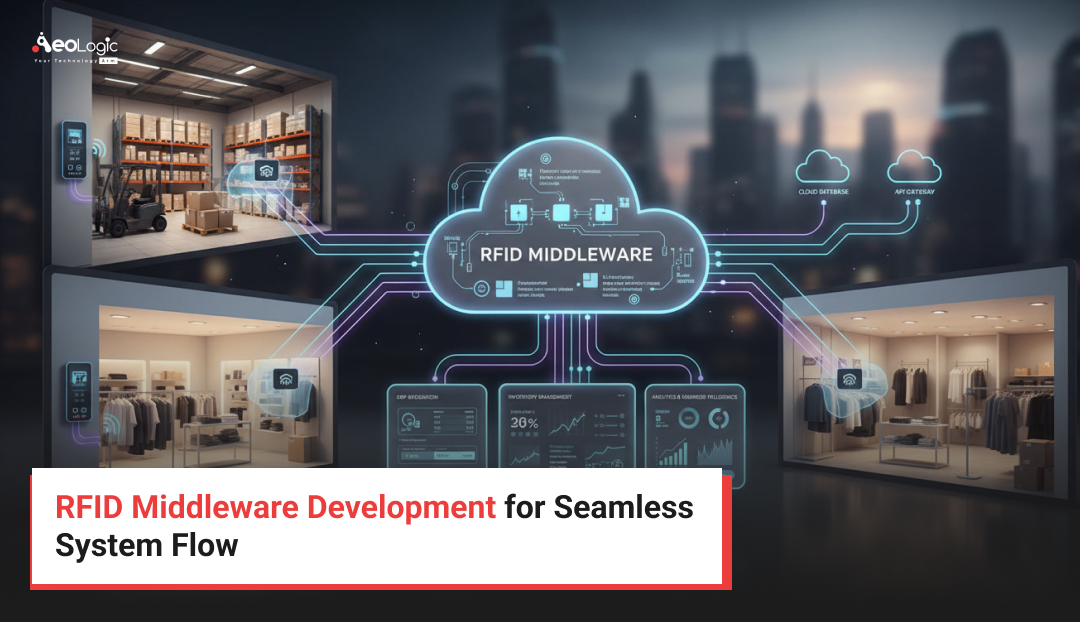
In today’s business world, success is determined by speed, accuracy, and visibility. Businesses heavily rely on interconnected systems that must communicate flawlessly with one another, whether they are tracking inventory across warehouses, monitoring assets in real time, or guaranteeing secure access to facilities. Although RFID technology is essential to this ecosystem, raw RFID data is insufficient on its own. RFID systems can easily become noisy, disjointed, and ineffective in the absence of intelligent processing and orchestration. RFID middleware development becomes crucial in this situation.
By filtering data, controlling device communication, and facilitating insightful business analysis, middleware serves as the intelligent link between RFID hardware and enterprise applications, ensuring smooth system flow. As businesses expand and digitise their operations, RFID middleware has evolved from a supporting component into a strategic foundation for automation and data-driven decision-making.
The Significance of RFID Middleware Development
Comprehending RFID Middleware
RFID middleware is a software layer that sits between enterprise systems like ERP, WMS, MES, or analytics platforms and RFID devices like readers, antennas, and tags. Its main responsibility is to gather, filter, process, and route RFID data in order to make it valuable and useful for business applications.
The design, modification, and deployment of this software layer to satisfy particular operational, technical, and business requirements is referred to as RFID middleware development. Well-developed middleware scales with organisational growth, integrates with current systems, and adjusts to workflows, in contrast to off-the-shelf solutions.
The Significance of Middleware in RFID Systems
Massive amounts of raw data are produced by RFID readers, which frequently contain noise, redundant reads, and unrelated events. This data would overwhelm backend systems in the absence of middleware. This data would overwhelm backend systems and lead to inaccurate insights. RFID Middleware Development ensures:
- Data flow that is orderly and clean
- Rather than dumping raw data, use event-driven processing
- Regular communication between apps and devices
- Centralised management of dispersed RFID systems
Middleware essentially turns RFID from a technology that generates data into a solution that generates value.
 RFID Middleware Development’s Significance in the Modern World
Encouraging Digital Transformation Projects
Digital transformation is now a must. Companies are implementing Industry 4.0 concepts, automating processes, and updating supply chains. By facilitating real-time visibility and smooth integration across digital ecosystems, RFID middleware development is essential to this transition.
RFID systems stay isolated and underutilised in the absence of strong middleware. It gives businesses a networked, intelligent layer that facilitates analytics, automation, and AI-driven insights.
Handling Complexity and Scale
Businesses’ RFID deployments become more complex as they grow. Only well-designed middleware can manage the challenges presented by numerous locations, thousands of tags, and a variety of hardware vendors. By offering centralised management and uniform data handling across environments, RFID Middleware Development guarantees scalability.
Facilitating Instantaneous Decision Making
Delayed information is a lost opportunity in the current competitive environment. Real-time data processing by RFID middleware allows for quicker decision-making, automated actions, and immediate alerts. In sectors where timing directly affects results, such as manufacturing, logistics, and healthcare, this real-time capability is essential.
Principal Advantages of Developing RFID Middleware
Smooth Integration of Systems
The seamless integration of RFID Middleware Development with enterprise systems is one of its biggest benefits. Middleware acts as a translator, ensuring RFID data aligns with business logic and application requirements.
Data silos are eliminated and a single operational view is produced across departments thanks to this integration.
Enhanced Data Quality and Accuracy
Middleware makes sure that only relevant data reaches backend systems by removing unnecessary events and duplicate reads. This increases confidence in RFID-driven insights, lowers errors, and improves reporting accuracy.
Automation and Operational Efficiency
Automated processes like asset movement alerts, inventory updates, and compliance checks are made possible by RFID middleware. Automation speeds up operational procedures, minimises errors, and requires less human intervention.
Flexibility and Scalability
Businesses can scale deployments without rearchitecting systems thanks to custom RFID middleware development. Middleware offers the flexibility required for expansion, whether adding new locations, devices, or applications.
Improved Control and Security
Middleware has the ability to monitor device behaviour, encrypt data, and impose access controls. This centralized governance improves system security and ensures compliance with organizational policies.
The Operation of RFID Middleware in Corporate Settings
Data Gathering and Device Interaction
RFID middleware gathers raw tag data in real time by interacting directly with RFID readers and antennas. To guarantee reliable performance, it controls device configurations, monitoring, and health checks.
Event processing and data filtering
Middleware uses filtering rules to eliminate noise and duplicates after data is gathered. After that, it transforms raw reads into meaningful events like “unauthorised access detected,” “item received,” or “asset moved.”
Execution of Business Rules
Custom business rules that initiate automated actions are frequently included in RFID middleware development. For instance, the middleware can alert procurement systems or start replenishment processes if inventory drops below a certain level.
Connectivity to Business Applications
Enterprise systems receive processed data via message queues, APIs, or web services. This ensures seamless system flow across ERP, WMS, analytics platforms, and dashboards.
RFID Middleware Development Applications in Industry
Omnichannel and Retail Commerce
Real-time inventory visibility across retail locations and warehouses is made possible by RFID middleware. Use cases like click-and-collect fulfilment, theft prevention, and automated stock replenishment are supported.
Supply Chain Management and Logistics
Accurate tracking of shipments, pallets, and containers throughout intricate supply chains is ensured by RFID middleware development. Event-based tracking is made possible by middleware, which speeds up delivery and increases accuracy.
Automation in Manufacturing and Industry
RFID middleware is used by manufacturers to monitor production stages, track work-in-progress, and guarantee quality compliance. To improve production flow, middleware combines RFID data with MES and ERP systems.
Medical and Biological Sciences
RFID middleware helps with inventory management, patient safety, and asset tracking in the healthcare industry. Real-time, accurate data improves patient care, lowers losses, and increases compliance.
Smart Infrastructure and Access Control
In smart cities, transportation networks, and corporate campuses, secure access management is made possible by RFID middleware. Middleware guarantees the secure and dependable processing of authentication events.
Methods and Technologies Used in the Development of RFID Middleware
Architecture Driven by Events
Event-driven architecture is a key component of modern RFID middleware development. Systems improve performance and scalability by reacting to significant events rather than continuously polling data.
Microservices and API-First Design
Microservices and API-first strategies are becoming more and more popular in middleware. This enables quicker updates, simpler integration, and modular development without affecting the system as a whole.
Integration of Edge Computing
RFID middleware can handle data closer to the source thanks to edge processing. In distributed environments, this facilitates real-time decision-making while lowering latency and network load.
Deployments in the Cloud and Hybrid
RFID middleware can be implemented in cloud, hybrid, or on-premises settings. While hybrid models accommodate latency-sensitive operations, cloud-based middleware provides scalability and remote management.
Obstacles in the Development of RFID Middleware and Workable Solutions
Managing Large Data Volumes
RFID systems generate massive data streams. Without proper design, middleware can become a bottleneck. Implementing efficient filtering, batching, and event processing ensures performance remains stable.
Connectivity to Legacy Systems
Many businesses use outdated WMS or ERP systems. By utilizing adapters and APIs that convert RFID data into compatible formats, Custom RFID Middleware Development fills this gap.
Problems with Hardware Compatibility
Different RFID providers employ different standards and protocols. To guarantee seamless interoperability, middleware must abstract hardware complexity and offer a unified interface.
Risks to Security and Compliance
RFID data often includes sensitive operational information. To reduce security risks, middleware must use access controls, encryption, and authentication.
The Best Methods for Developing RFID Middleware
Align Business Objectives with Middleware Design
It is not advisable to develop middleware separately. To optimize ROI, match development initiatives with operational goals like efficiency, visibility, or compliance.
From the beginning, design for scalability
RFID deployments, even tiny ones, usually expand. Middleware can manage growing data volumes and new use cases over time thanks to scalable architecture.
Give data quality and governance top priority
Clear data rules, validation checks, and governance policies ensure RFID insights remain accurate and reliable.
Invest in Analytics and Monitoring
Dashboards and alerts that track data flow, device performance, and system health in real time should be part of middleware.
Permit Ongoing Improvement
The development of RFID middleware is a continuous process. Continuous optimization guarantees that systems adapt to changing business requirements and technological breakthroughs.
Future Directions for the Development of RFID Middleware
RFID Intelligence Powered by AI
By facilitating predictive analytics, anomaly detection, and automated decision-making based on past data, artificial intelligence is improving RFID middleware.
Increased Edge-to-Cloud Cooperation
In order to provide deep insights and real-time responsiveness, future middleware solutions will strike a balance between edge processing and cloud analytics.
Interoperability and Standardization
As industry standards advance, vendor lock-in decreases and RFID middleware becomes more interoperable.
Connectivity to Digital Twins
Digital twin models will be fed more and more RFID data, allowing for real-time simulation and process and asset optimization.
Conclusion
The unseen force that turns RFID technology into a smooth, clever, and expandable business solution is RFID middleware development. Middleware guarantees precise data flow, real-time insights, and automated operations across complex environments by connecting hardware and enterprise applications.
Investing in strong RFID middleware is now a strategic requirement as companies continue to pursue digital transformation. Businesses that place a high priority on well-architected middleware benefit from increased visibility, long-term scalability, and operational resilience. Working with a reliable RFID Solutions Company in India ensures the right implementation approach and better system integration outcomes.
Businesses like Aeologic Technologies assist companies in creating and implementing RFID middleware solutions that match technology with business goals, guaranteeing smooth system operation and quantifiable impact.
Frequently Asked Questions
Q1. What is RFID Middleware Development?
In order to process and manage RFID data for business purposes, RFID middleware development entails developing software that links RFID hardware with enterprise systems.
Q2. What makes RFID middleware crucial?
It guarantees precise, instantaneous insights for decision-making, permits system integration, and filters unprocessed RFID data.
Q3. Is it possible to customize RFID middleware?
Indeed, companies can customize workflows, integrations, and rules to meet particular operational requirements with custom RFID middleware development.
Q4. Can small businesses use RFID middleware?
Of course. Scalable middleware solutions can be designed to fit both small deployments and large enterprise environments.
Q5. In what ways does RFID middleware enhance data accuracy?
By eliminating duplicate reads, filtering noise, and applying validation rules before data reaches backend systems.
Q6. Which sectors gain the most from RFID middleware?
RFID middleware development greatly benefits the manufacturing, retail, logistics, healthcare, and access control sectors.
Q7. How will RFID middleware develop in the future?
Cloud scalability, edge computing, AI integration, and deeper integration with digital transformation projects are all part of the future.

Currently, as a Senior Manager of Technology, I oversee a dynamic team, ensuring the delivery of high-quality software solutions that meet the evolving needs of our clients. A seasoned technology leader with over a decade of experience in the software development industry, I have been instrumental in driving the end-to-end software development lifecycle since my career inception in 2011.