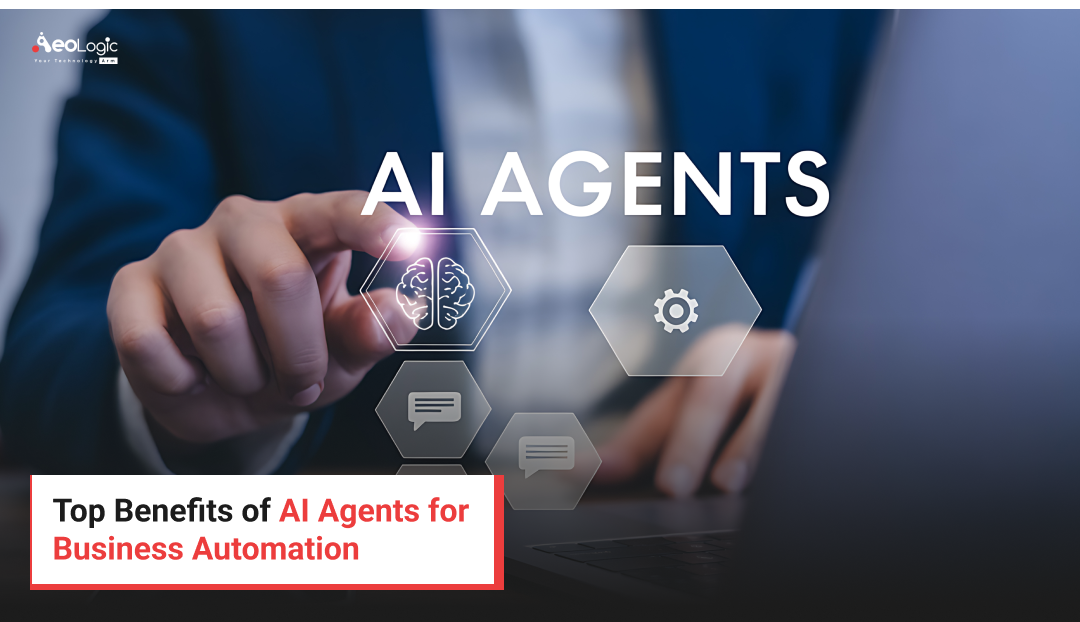
Running a business today means juggling more moving parts than ever — customer requests, data entry, scheduling, reporting, approvals, and a dozen other repetitive tasks that eat into the hours your team could spend on higher-value work. This is exactly the gap that AI Agents for Business Automation are built to close.
Unlike traditional automation tools that follow rigid, pre-programmed steps, AI agents can reason, make decisions, and adapt to changing conditions in real time. They don’t just execute a script — they understand context, learn from outcomes, and act with a degree of independence that was simply not possible with earlier automation technology.
In this guide, we’ll break down what AI agents actually are, why businesses across every industry are adopting them, and the concrete benefits you can expect when you bring AI Agents for Business Automation into your own operations.
What are AI Agents?
An AI agent is a software system that can perceive its environment, make decisions, and take actions toward a specific goal — largely without constant human supervision. Think of it as a digital employee that can read an email, understand what’s being asked, pull relevant data from your systems, and respond or escalate appropriately, all on its own.
This is different from classic “if-this-then-that” automation. A traditional bot might automatically forward an email containing the word “refund” to a specific folder. An AI agent, by contrast, can read the email, understand the customer’s intent, check the order history, determine whether the refund request is valid under company policy, and either process it or draft a response for human approval — adapting its behavior based on what it finds.
This flexibility is why AI Agents for Business Automation are being adopted so quickly: they handle the messy, judgment-based work that used to require a human in the loop at every step.
 Why Businesses Are Turning to AI Agents for Automation
Three forces are driving this shift:
- Rising operational costs are pushing companies to do more with leaner teams.
- Customer expectations for instant, accurate responses have never been higher.
- Data volume has outgrown what manual processes can realistically keep up with.
AI agents sit at the intersection of all three. They reduce the cost of repetitive work, respond faster than human teams often can, and can process far more information than any individual employee. That combination is precisely why interest in AI Agents for Business Automation has grown so sharply among operations leaders, CFOs, and IT teams alike.
Top Benefits of AI Agents for Business Automation
Significant Time Savings on Repetitive Tasks
The most immediate benefit of AI agents is how much manual, repetitive work they remove from your team’s plate. Data entry, invoice processing, meeting scheduling, status updates, and routine customer replies can all be handled by an agent instead of a person.
This doesn’t just save time in the abstract — it frees your team to focus on strategic work: relationship-building, problem-solving, and creative projects that genuinely require a human touch. Businesses that implement AI Agents for Business Automation for these functions typically see employees reclaiming hours each week that were previously lost to low-value tasks.
Improved Accuracy and Fewer Costly Errors
Manual processes are prone to human error — a mistyped figure, a missed field, a forgotten follow-up. AI agents execute tasks consistently, following the same logic every time, which drastically reduces the error rate in processes like data entry, order processing, and compliance checks.
Fewer errors mean fewer costly corrections, fewer customer complaints, and less time spent on cleanup. For industries like finance, healthcare, and logistics — where a single mistake can be expensive or even dangerous — this reliability is one of the strongest arguments for adopting AI Agents for Business Automation.
Round-the-Clock Availability
AI agents don’t take breaks, go on vacation, or clock out at 5 p.m. They can monitor systems, respond to customer inquiries, and trigger workflows 24 hours a day, 7 days a week. For customer-facing businesses, this means support doesn’t stop just because your office does.
This constant availability is especially valuable for companies serving customers across multiple time zones, where waiting until “business hours” to get a response can mean losing a sale or frustrating a client.
Faster Decision-Making Through Real-Time Data Processing
AI agents can pull from multiple data sources simultaneously — CRM records, inventory systems, support tickets, financial dashboards — and synthesize that information into actionable insights far faster than a human analyst could. This speed translates directly into faster business decisions.
For example, an AI agent monitoring inventory levels can detect a stock shortage, cross-reference sales trends, and automatically trigger a reorder before a human even notices the problem. This is the kind of proactive, real-time responsiveness that makes AI Agents for Business Automation so valuable in fast-moving industries.
Scalability Without Proportional Cost Increases
Traditional business growth usually means hiring more people to handle more volume. AI agents break that linear relationship. A well-configured agent can handle 10 customer inquiries or 10,000 with the same underlying infrastructure — scaling up or down based on demand without the lag time of recruiting and training new staff.
This scalability is particularly valuable for seasonal businesses, fast-growing startups, or companies entering new markets, where demand can spike unpredictably.
Enhanced Customer Experience
Modern customers expect fast, personalized responses — and they notice when they don’t get them. AI agents can instantly retrieve a customer’s history, understand their request, and provide a relevant, accurate response without making the customer wait in a queue.
Beyond speed, agents can also personalize interactions at scale — recommending products based on past purchases, tailoring support responses to a customer’s specific plan or history, and escalating complex issues to a human agent seamlessly when needed. This blend of speed and personalization is a major reason AI Agents for Business Automation are becoming central to customer experience strategies.
Better Resource Allocation
When routine tasks are handled by AI agents, human employees can be allocated to work that actually requires judgment, creativity, or relationship management. This shift doesn’t just improve morale — it improves the overall return on your payroll investment, since skilled employees spend less time on tasks that don’t require their specific expertise.
Stronger Compliance and Auditability
Many AI agent platforms log every action they take, creating a clear audit trail of decisions and processes. This is particularly valuable in regulated industries, where demonstrating compliance with internal policies or external regulations is a constant requirement.
Rather than relying on manual documentation (which is often incomplete or inconsistent), businesses can point to a precise, timestamped record of what the agent did and why — strengthening both internal governance and external audits.
Reduced Operational Costs Over Time
While there’s an upfront investment in implementing AI agents, the long-term cost savings are substantial. Lower error rates mean fewer costly corrections. Faster processing means less time (and therefore less labor cost) spent per task. Reduced need for overtime or temporary staffing during busy periods adds up as well.
Businesses that strategically deploy AI Agents for Business Automation across multiple departments — not just one isolated use case — tend to see the most meaningful cost reductions, since the benefits compound across the organization.
Competitive Advantage in a Fast-Moving Market
Businesses that automate intelligently can respond to market changes faster, serve customers better, and operate leaner than competitors still relying on manual processes. In many industries, early and thoughtful adoption of AI agents is becoming a genuine differentiator — not just an efficiency play, but a strategic one.
AI Agents vs. Traditional Automation: What’s the Difference?
| Feature | Traditional Automation | AI Agents |
|---|---|---|
| Decision-making | Follows fixed rules | Reasons and adapts based on context |
| Flexibility | Breaks when inputs change unexpectedly | Handles variability and ambiguity |
| Learning | Static, requires manual updates | Can improve with feedback and new data |
| Task complexity | Best for simple, repetitive tasks | Handles multi-step, judgment-based tasks |
| Human oversight | Often needed for exceptions | Can resolve many exceptions independently |
This comparison highlights why so many businesses are moving beyond basic automation scripts and investing specifically in AI Agents for Business Automation — the adaptability alone unlocks use cases that older tools simply couldn’t handle.
Common Use Cases for AI Agents in Business
- Customer support — answering FAQs, processing returns, routing complex tickets to the right human agent
- Sales and marketing — qualifying leads, personalizing outreach, scheduling demos
- Finance and accounting — invoice processing, expense categorization, fraud detection
- HR and recruiting — screening resumes, scheduling interviews, answering employee policy questions
- IT operations — monitoring systems, triaging support tickets, automating routine maintenance
- Supply chain and logistics — inventory monitoring, demand forecasting, order tracking
Each of these use cases shows a different facet of how AI Agents for Business Automation can be applied — the common thread is replacing manual, repetitive judgment calls with fast, consistent, automated decision-making.
Challenges to Consider Before Implementation
AI agents aren’t a plug-and-play miracle — thoughtful implementation matters. Common challenges include:
- Data quality — agents are only as good as the data they can access; messy or siloed data limits effectiveness.
- Integration complexity — connecting agents to existing systems (CRM, ERP, support platforms) takes planning.
- Change management — employees need training and reassurance about how their roles will evolve.
- Governance and oversight — clear rules about what agents can and can’t do independently are essential, especially for sensitive decisions.
Addressing these challenges upfront leads to a far smoother rollout of AI Agents for Business Automation across your organization.
Best Practices for Implementing AI Agents
- Start with a narrow, well-defined use case rather than trying to automate everything at once.
- Clean up your data before connecting agents to critical systems.
- Set clear boundaries for what the agent can decide independently versus what requires human approval.
- Monitor performance closely in the early stages and adjust based on real outcomes.
- Involve your team in the rollout so they understand the agent as a tool that supports their work, not a replacement for it.
- Scale gradually, expanding to new departments or use cases once the first implementation proves successful.
Following this kind of phased approach tends to produce far better long-term results with AI Agents for Business Automation than attempting a company-wide rollout on day one.
Key Takeaways
- AI agents go beyond traditional automation by reasoning, adapting, and making context-aware decisions.
- The core benefits include time savings, improved accuracy, 24/7 availability, scalability, and better customer experience.
- Successful implementation starts small, prioritizes data quality, and scales gradually.
- AI Agents for Business Automation are becoming a genuine competitive differentiator, not just an efficiency tool.
Conclusion
Adopting AI Agents for Business Automation isn’t about replacing your workforce — it’s about freeing your team from repetitive, low-value tasks so they can focus on the work that actually drives growth. From faster response times and fewer errors to round-the-clock availability and smarter decision-making, the benefits touch nearly every part of a modern business.
The businesses that start exploring AI agents today—with a clear use case and a phased rollout—will be best positioned to compete as this technology evolves. Aeologic Technologies helps businesses explore AI-driven solutions to streamline operations, improve efficiency, and optimize workflows. If you’re ready to discover how AI agents could benefit your organization, now is the time to evaluate where they fit into your business processes.
FAQs
Q1: What industries benefit most from AI Agents for Business Automation?
Industries with high volumes of repetitive, data-heavy tasks benefit most — including finance, customer service, healthcare administration, logistics, and e-commerce. Any business with recurring workflows that currently require manual judgment can see measurable gains from adopting AI agents.
Q2: Do AI agents replace human employees?
No — AI agents are best used to handle repetitive, rules-based, or data-intensive tasks, freeing employees to focus on strategic, creative, and relationship-driven work. Most successful implementations position agents as support tools rather than replacements.
Q3: How long does it take to implement AI agents in a business?
Timelines vary based on complexity, but a narrow, well-scoped use case can often be piloted within a few weeks, while full-scale, multi-department rollouts typically take several months of planning, integration, and testing.
Q4: Are AI agents expensive to implement?
Costs vary widely depending on the platform and scope, but many businesses start with a low-cost pilot project before scaling. Long-term, the time and error-reduction savings often offset the initial investment.
Q5: Can AI agents work with existing business software?
Yes, most modern AI agent platforms are designed to integrate with common business tools like CRMs, ERPs, and support ticketing systems, though the depth of integration depends on the specific platform and your existing tech stack.
Q6: What risks should businesses consider before adopting AI agents?
Key risks include poor data quality leading to inaccurate decisions, insufficient oversight for sensitive actions, and integration challenges with legacy systems. Clear governance and a phased rollout help mitigate these risks.
Q7: How do AI agents improve customer service specifically?
AI agents can instantly access customer history, answer common questions, and resolve straightforward requests around the clock — reducing wait times and freeing human agents to focus on complex or sensitive customer issues.