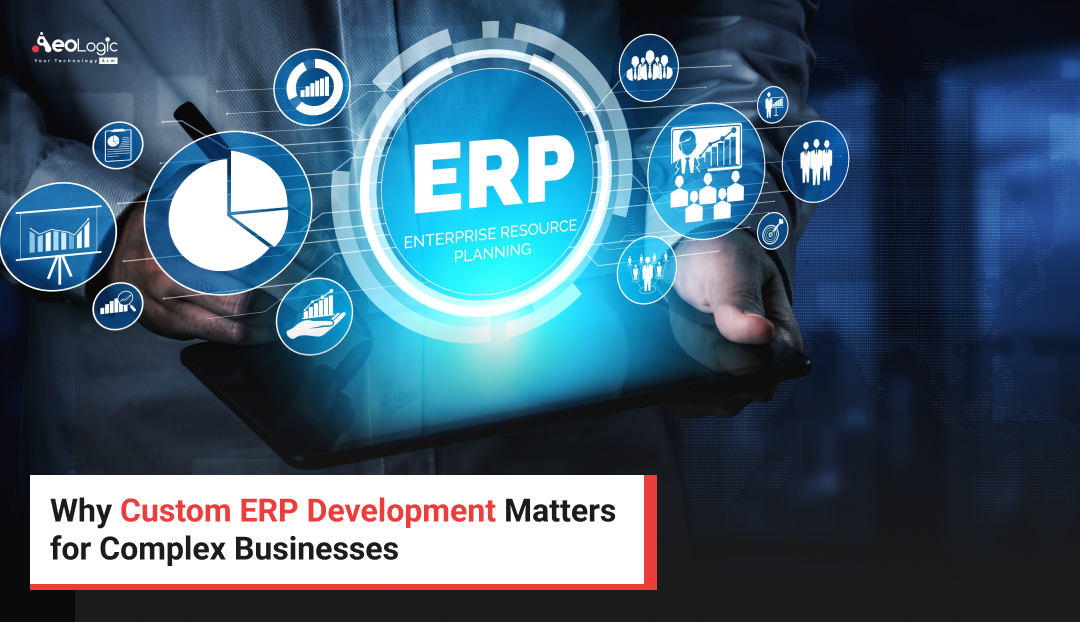
In today’s highly dynamic and interconnected business environment, organizations with complex operations often struggle to manage processes efficiently using off-the-shelf software. This is where Custom ERP Development for Complex Businesses becomes a strategic necessity rather than a luxury. Enterprises dealing with multi-layered workflows, diverse departments, and large-scale data require systems that align precisely with their unique operational models.
Custom-built ERP systems are created to integrate, streamline and automate business processes in a manner that off-the-shelf ERP systems may not be able to. In an ever-changing and competitive market, companies require flexible, scalable and smart systems to support their business. In this blog, we examine the importance of custom ERP systems for complex organisations, how they function, and how companies can harness their power to drive growth.
What is Custom ERP Development for Complex Businesses?
Custom ERP development is the creation of an Enterprise Resource Planning system that is tailor-made to meet an organisation’s specific needs. Custom ERP systems are built to order or modified extensively to align with a company’s unique processes, industry needs and business objectives.
In large enterprises, ERP systems need to manage complex operations like multiple locations, regulatory requirements, sophisticated supply chains and real-time reporting. Customization ensures that each module, integration and feature is tailored to the business model.
The systems usually consolidate essential business areas like finance, human resources, procurement, manufacturing, inventory, and customer relations into a single system. This breaks down data bottlenecks and facilitates inter-team communication.
Why Custom ERP Development for Complex Businesses is Critical
Companies in manufacturing, logistics, healthcare, and large retail, for example, have unique challenges that off-the-shelf ERP systems do not meet. Customisation is required for flexibility, scalability and accuracy.
Complex businesses require systems that adapt to their processes instead of forcing them to change their workflows. Custom ERP solutions provide this flexibility, ensuring that operations remain efficient and aligned with business objectives.
Another critical aspect is integration. Many enterprises use multiple legacy systems that must work together seamlessly. Custom ERP systems are designed to integrate with existing tools, ensuring smooth data flow and minimizing disruption.
Additionally, compliance and security requirements vary across industries. Custom solutions allow businesses to incorporate specific regulatory standards and advanced security protocols, ensuring data protection and legal compliance.
Key Components of a Custom ERP System
An effective ERP system for large and complex organizations has several integrated modules to manage operations more efficiently. All of these are crucial for efficiency and accuracy.
One such module is financial management, which allows for accurate accounting, budgeting and financial reporting. Human resource management facilitates efficient handling of employee records, payroll and performance evaluation.
Inventory and supply chain management features allow for real-time tracking of goods, logistics management and inventory optimization. CRM streamlines customer engagement and service.
Data analytics and reporting tools help businesses understand their operations and make data-driven decisions. These elements form an integrated system that improves efficiency.
 Step-by-Step Approach to Implementing a Custom ERP Solution
Step 1: Requirement Analysis
The process begins with an analysis of the company’s specific requirements, problems and goals. Cross-functional teams work together to outline system requirements and to assess process deficiencies.
Step 2: System Design and Architecture
After establishing the requirements, the system architecture is designed. This involves creating processes, data models and user interfaces that align with the organization’s processes.
Step 3: Development and Customization
In this stage, the ERP system is developed and configured based on the requirements. Software developers incorporate required modules and integrate with other systems.
Step 4: Testing and Quality Assurance
Thorough testing is performed to resolve any problems. This guarantees the system will operate effectively in the real world.
Step 5: Deployment and Training
The ERP system is rolled out within the organisation, and staff are trained on its usage. This helps in the transition and reduces user resistance.
Step 6: Continuous Support and Optimization
After deployment, ongoing support is vital for optimal performance. Periodic upgrades and tuning help keep the ERP system aligned with business requirements.
Benefits of Custom ERP Solutions for Complex Enterprises
Custom ERP systems provide key benefits that enhance business performance and growth. A critical advantage is enhanced efficiency, with processes automated and optimised to meet specific needs.
Customised systems also offer scalability. As the business scales up, the ERP system can be easily scaled and adapted. This ensures long-term usefulness and affordability.
Another key advantage is improved data visibility. Data is managed centrally, providing real-time visibility to support decision-making and planning.
Customization also ensures better user experience. Users can interact with the system through a customised user interface and workflow, improving efficiency and minimising errors.
Additionally, integration features enable businesses to link systems, forming an integrated digital ecosystem, enhancing efficiency.
Real-World Use Cases and Examples
For example, manufacturers often have intricate production workflows, multiple vendors, and stringent quality control requirements. A tailored ERP solution can link production scheduling, inventory control and quality assurance processes, and facilitate efficient operations.
In healthcare, businesses need to handle patient information, adhere to regulations, and integrate various departments. ERP systems allow secure and efficient data exchange while adhering to compliance requirements.
ERP systems help logistics firms with route optimization, real-time shipment tracking, and efficient warehouse management. This improves delivery efficiency and customer service.
Major retailers deploy bespoke ERP systems to track inventory across various stores, understand shoppers’ preferences, and improve supply chain efficiency. This enhances sales and customer satisfaction.
Technologies and Tools Used in ERP Development
Current ERP systems take advantage of new technologies for improved capabilities. Cloud computing is particularly important, allowing for any time, any place access, scalability and cost savings.
Machine learning and AI technologies are also incorporated into ERP systems to offer predictive analytics and automation. These technologies help businesses anticipate trends and make proactive decisions.
Analytics platforms help in analysing massive data sets and extracting valuable insights. Integration technologies, like APIs, provide seamless communication.
Security technologies are also essential as ERP systems deal with critical data. Robust encryption and user authentication help secure the system and meet industry security standards.
Challenges in Custom ERP Development and How to Overcome Them
Custom ERP systems for complex businesses face several challenges. The first is the initial cost. But it can be justified by long-term gains.
Resistance to change by employees is another issue. Training and change management can address this problem and facilitate acceptance.
It can also be difficult to integrate with existing systems. This can be made easier with planning and new integration technologies.
Data integrity and consistency is also a major issue. Effective data management strategies can ensure data quality.
Last, there are expenses for maintenance and upgrades. Companies need to allocate resources for ongoing support to maintain system integrity and efficiency.
Best Practices for Successful ERP Implementation
Proper planning and execution is essential for ERP success. A key factor is engaging users from all areas of the business. This guarantees the system will address the needs of all departments.
Effective communication is key during implementation. Regular communication about the benefits and changes helps to gain acceptance.
Selecting the right developer is also important. This ensures that the system is well-designed and meets industry standards.
Continuous testing and feedback ensure problems are detected and the system is optimised. Ongoing monitoring and improvement keep the ERP system working efficiently.
Future Trends in ERP Development
The next generation of ERP systems will be driven by new technologies and business requirements. ERP systems are increasingly moving to the cloud for their agility and affordability.
Machine learning will be more prevalent in ERP systems, offering enhanced automation and forecasting capabilities. This will assist in making better-informed decisions and increasing efficiency.
The use of Internet of Things technologies will allow for real-time data gathering and monitoring, especially in manufacturing and logistics.
And there’s a growing emphasis on user experience, with today’s ERP systems featuring user-friendly interfaces and mobile support. This is enhancing the user-friendliness of ERP systems.
Conclusion
As businesses grow more complex, they require systems that are able to adapt to their changing needs. Tailored ERP Development for Complex Businesses offers the agility, scalability and efficiency required to handle complex operations and support growth. Custom ERP Development for Complex Businesses allows companies to optimise their processes, enhance decision-making capabilities and maintain a competitive advantage in the market.
If your organization is looking to transform its operations with a powerful and scalable ERP system, partnering with experts like Aeologic Technologies can help you design and implement a solution that aligns perfectly with your business goals.
FAQs
Q1. What is Custom ERP Development for Complex Businesses?
Custom ERP Development for Complex Businesses is the creation of bespoke enterprise resource planning (ERP) systems that are specifically tailored to the needs of complex businesses. These systems assist businesses in managing functions like accounting, logistics, and human resources. This is especially advantageous for businesses in niche industries as it offers flexibility, scalability, and enhanced visibility of information across all functions.
Q2. Why do complex organizations need custom ERP?
Complex businesses have specific operational processes, multiple departments, and varying operational needs, which cannot be supported by out-of-the-box ERP systems. Custom ERP systems allow for the development of systems tailored to business processes. This enhances efficiency, accuracy and integration with other systems.
Q3. How long does it take to build an ERP system?
The time required to develop a custom ERP system depends on the business complexities, the modules to be developed, and the degree of customisation required. Typically, it takes several months to more than a year to plan, build and implement an ERP system. This involves gathering requirements, designing the system, development, testing and implementation. Effective planning and communication between stakeholders and the development team can help expedite the process and reduce the timeframe.
Q4. What are the advantages of custom ERP systems?
The benefits of custom ERP systems include increased efficiency, visibility and scalability. They enable automation of business processes, minimisation of errors, and optimisation of workflows. Moreover, custom systems offer improved integration with other systems, enabling data sharing across the organisation. They are also more flexible, allowing companies to modify the system according to their changing requirements. In summary, custom ERP systems deliver improved performance, cost savings and competitive edge for businesses.
Q5. How much does custom ERP development cost?
Developing a custom ERP system is generally more expensive up-front than purchasing a pre-built solution. But this investment can pay off in the long run. Custom ERP systems provide a solution that fits the business, eliminating inefficiencies and boosting productivity. Custom ERP solutions also reduce the need for various software systems, resulting in cost savings. And the flexibility of custom systems means that companies do not have to replace their systems, making it a cost-effective choice over time.
Q6. What industries benefit most from custom ERP systems?
Custom ERP systems are most beneficial to industries with complex processes and unique needs. Examples include manufacturing, healthcare, logistics, retail, and finance. Manufacturers use ERP systems to manage production and supply chains. Freight companies use them for location tracking and route planning. Retailers use ERP systems for inventory management and customer insights. These industries all have solutions that meet their specific needs.