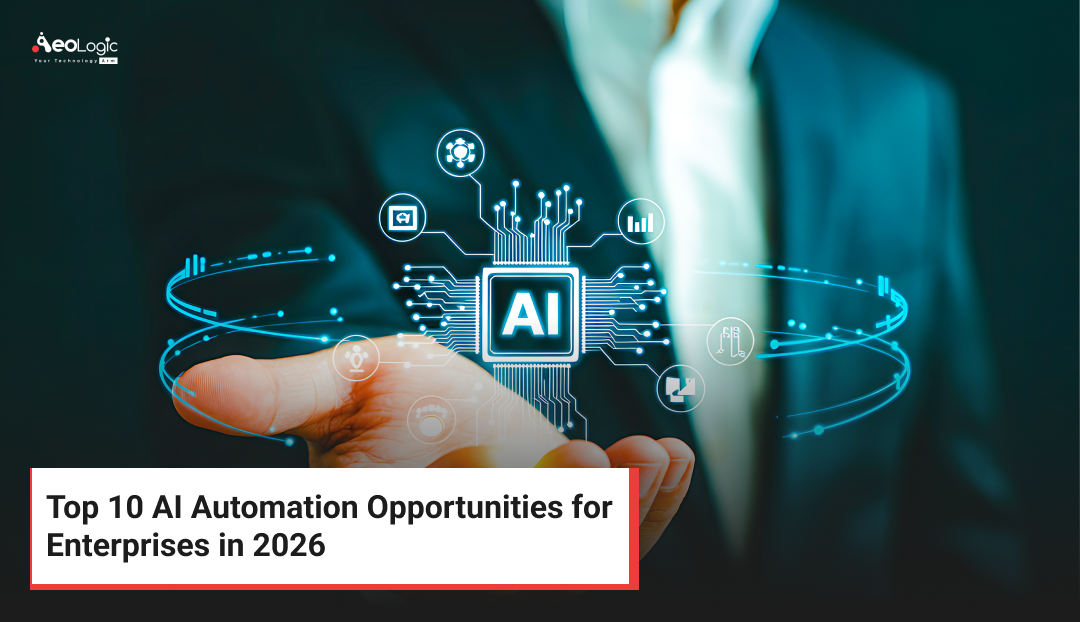
AI is no longer just an emerging technology. It has become a key business enabler. In 2026, AI Automation for Enterprises is a top priority for organizations looking to improve efficiency, reduce costs, accelerate decision-making, and deliver better customer experiences. Businesses across various industries, including manufacturing, healthcare, finance, and retail, are leveraging AI to streamline repetitive tasks and empower their workforce to handle more complex matters. In manufacturing, healthcare, finance, and even retail, enterprises are incorporating AI into their daily operations, automating mundane tasks and allowing their human employees to focus on more intricate work.
Unlike traditional automation, AI-powered systems learn from data. They adapt to changing business conditions and continuously improve their performance over time. This capability helps businesses remain competitive and supports their digital transformation initiatives.
This article explores the top ten AI automation opportunities that enterprises should prioritize in 2026 and how these technologies are reshaping business operations across industries.
Why AI Automation is Becoming a Business Priority?
Enterprises generate massive amounts of data every day. This data comes from customer interactions, internal processes, connected devices, and digital platforms. This type of information, if it is managed and utilized manually, is simply unfeasible. With AI automation, organizations can analyze data as it happens, spot trends, forecast outcomes, and automate intricate workflows with hardly any human involvement.
Embracing automation is no longer just about cutting down on labor costs, as many business leaders are understanding. It is, however, now a strategic investment that enhances the operational agility, facilitates innovation and provides value to the customer. AI Automation for Enterprises is making a significant impact on business processes, compliance, human error reduction, and decision-making.
Top 10 AI Automation Opportunities for Enterprises
These are the most impactful AI automation opportunities that will bring the highest business value to enterprises in 2026.
Intelligent Customer Support Automation
Customers’ expectations for quick, correct and personalized support are growing. Customer Support Automation using AI allows organizations to manage a vast customer base by using intelligent chatbots, virtual assistants, and voice-based bots. In contrast to the rule-based chatbots, AI systems can comprehend human language, learn from past interactions, and respond with context-relevant messages.
These solutions answer common customer questions and assist with order tracking. They also process service requests. When needed, they recommend products and transfer complex issues to human agents.
Automated Business Process Management
Document approvals, workflow routing, data validation and compliance checks are just a few of the repetitive tasks performed in many enterprise processes. AI automation streamlines these tasks by efficiently handling business processes from end to end. AI systems can handle these tasks automatically, cross-checking information, assigning tasks, and initiating approvals according to pre-defined business rules, without requiring human intervention.
Departments such as finance, procurement, legal, and administration benefit significantly from automated business process management. This improves operational consistency, reduces delays, minimizes human errors, and increases overall organizational productivity while ensuring business processes remain compliant with internal policies.
AI-Powered Predictive Maintenance
Industries that depend on machinery and equipment can suffer from significant production losses and expenses resulting from unexpected breakdowns. By leveraging sensors and Industrial Internet of Things (IIoT) devices that gather equipment operational data in real time, AI-based predictive maintenance enables companies to keep an eye on equipment performance.
Machine learning algorithms analyze vibration, temperature, pressure, and performance trends. This helps identify early signs of equipment failure before breakdowns occur. Maintenance teams receive alerts before problems become critical, allowing repairs to be scheduled proactively rather than reactively. This approach extends equipment lifespan, reduces maintenance costs, minimizes operational disruptions, and improves overall asset reliability.
 Intelligent Document Processing
Enterprises process thousands of invoices, contracts, purchase orders, insurance claims, legal documents, and customer forms every month. It can be time-consuming, costly and prone to error when documents are handled manually. Intelligent Document Processing (IDP) is a type of AI that automates the extraction, classification, validation, and data entry of documents.
By combining Optical Character Recognition (OCR) with machine learning and natural language processing, AI systems can understand both structured and unstructured documents. Extracted information is automatically validated and transferred into enterprise applications, eliminating repetitive manual work while improving accuracy, compliance, and processing speed across business operations.
AI Automation in Financial Operations
Finance departments have a lot of repetitive tasks and data-heavy work that are suitable for AI automation. Automating invoice processing, expense management, bank reconciliation, budgeting, financial forecasting and regulatory reporting with intelligent systems will cut the involvement of manual labor.
AI also improves fraud detection. It continuously analyzes transaction patterns and identifies unusual financial activities in real time. Automated financial operations improve reporting accuracy, accelerate month-end closing processes, support better cash flow management, and provide executives with actionable financial insights for strategic decision-making.
Human Resources and Talent Management Automation
Companies are seeing the benefits of AI in HR, including enhanced recruitment, employee onboarding, workforce planning, and talent development. AI-driven recruitment platforms evaluate resumes, align with job specifications, arrange interviews, and aid hiring managers in selecting the best candidates.
Beyond recruitment, AI automation supports employee engagement by delivering personalized learning recommendations, monitoring workforce performance, identifying skill gaps, and predicting employee retention risks. Automating administrative HR tasks allows professionals to focus more on employee development, organizational culture, and long-term workforce planning.
AI-Driven Supply Chain Optimization
There are many activities in the supply chain such as demand forecasting, transportation, warehousing, inventory management and procurement. By leveraging historical data, market trends, supplier performance, and customer demand, AI automation optimizes supply chain operations in real time, enhancing overall performance.
Machine learning models forecast inventory requirements with greater accuracy. They reduce stock shortages, optimize warehouse utilization, and recommend the most efficient transportation routes. AI also enables organizations to detect supply chain risks early and respond quickly to disruptions, improving operational resilience while reducing logistics costs.
Sales and Marketing Automation
A sales and marketing team has access to a great deal of customer information distributed throughout the website, CRM systems, email marketing campaigns and social media. AI automation makes this information a powerful asset for businesses, driving better customer engagement and sales results.
AI can automatically qualify leads and predict customer buying behavior. It also personalizes marketing campaigns, recommends products, and automates follow-up communications. Sales teams receive intelligent recommendations on high-value prospects, while marketers can create targeted campaigns based on customer preferences and behavior. This results in higher conversion rates, stronger customer relationships, and improved return on marketing investment.
Cybersecurity Threat Detection and Response
With all the sophisticated cyber threats occurring, businesses need intelligent security solutions that can detect threats and prevent them from affecting business operations. AI-driven cybersecurity solutions stay alert to networks, applications, endpoints, and user activity to identify suspicious activity as it happens.
Machine learning algorithms identify unusual login attempts, malware infections, phishing attacks, insider threats, and unauthorized access by recognizing deviations from normal patterns. AI also automates incident investigation, threat prioritization, and response actions, enabling security teams to react faster and reduce the impact of potential cyberattacks.
Business Intelligence and Decision Automation
In the modern business world, there is a huge flow of business data generated daily, which makes it difficult to analyze it manually. Business intelligence platforms powered by AI automatically gather, structure, analyze and visualize data from various business systems, providing valuable insights.
Predictive analytics models forecast sales trends, customer demand, operational performance, and business risks, helping leaders make informed decisions with greater confidence. AI-driven decision automation recommends actions based on historical patterns and real-time information. This allows organizations to respond quickly to changing market conditions and improve overall business performance.
Key Benefits of AI Automation for Enterprises
AI Automation for Enterprises is more than just automation of tasks. It allows companies to streamline their business processes, enhance productivity, and make informed decisions based on real-time data and intelligent technologies. Here are some of the top advantages that businesses can enjoy from AI-powered automation.
Improved Operational Efficiency
A major benefit of AI automation is its potential to streamline the business. There are many repetitive and time-consuming business processes, like data entry, document verification, workflow approval, inventory updates and report generation. These activities can be automated with AI, and done in a fast and accurate manner, freeing up your workers’ time to concentrate on more strategic and value-adding tasks.
Unlike traditional automation systems that follow predefined rules, AI can analyze data, recognize patterns, and adapt to changing business conditions. This makes workflows faster, more flexible, and less dependent on manual intervention. As a result, enterprises experience shorter process cycles, improved productivity, fewer bottlenecks, and better utilization of resources across departments.
Better Decision-Making
Businesses nowadays create huge amount of business data on a daily basis and it is difficult for the decision makers to analyze the information manually. AI automation can leverage this data to generate valuable insights, analyzing vast amounts of information in real-time and uncovering trends that might not be apparent.
By leveraging predictive analytics and machine learning, AI helps business leaders forecast demand, monitor performance, identify risks, and evaluate future opportunities with greater confidence. Instead of relying solely on historical reports or intuition, organizations can make faster, data-driven decisions supported by accurate and actionable insights. This enables enterprises to respond quickly to market changes, improve strategic planning, and maintain a competitive advantage.
Reduced Operational Costs
Another big motivation for enterprises to invest in AI automation is the reduction in operational costs. Manual techniques can be labour intensive, time-consuming, and prone to costly human mistakes. AI reduces the need for repetitive business tasks and boosts accuracy, which helps companies to save on administrative costs and optimize resource allocation.
Over time, these efficiencies contribute to substantial cost savings while improving overall business performance and return on investment.
Challenges Enterprises Should Prepare For
Though the benefits of AI automation are tremendous, the successful implementation of AI goes beyond simply implementing new technologies. Ensuring data quality, governance and AI readiness among employees are imperative.
 Data Quality and Integration
Good data is crucial to the success of any AI endeavor. The accuracy, consistency, and completeness of the data are crucial for achieving accurate results, as AI models rely on both historical and real-time data. Historical and real-time data are used by AI models, and accuracy, consistency, and completeness are all key to successful outcomes. AI systems can make incorrect predictions and automate processes if the business data is not accurate, duplicated, or missing parts.
Many enterprises also operate with multiple legacy systems that store data in different formats. Integrating information from ERP platforms, CRM systems, cloud applications, and departmental databases can be a complex task. Without proper data integration, AI solutions may struggle to access a complete view of business operations. Organizations should invest in data cleansing, standardized data management practices, and seamless system integration before implementing large-scale AI automation.
AI Governance and Compliance
Businesses face the challenge of setting up governance frameworks that maintain the responsible and ethical use of AI as it increasingly enters the business world. AI systems frequently handle sensitive customer, employee, and financial data, necessitating stringent data privacy norms and regulatory compliance. The development, monitoring, and updating of AI models must be defined by policies and transparency must be ensured in automated decision making.
By building governance into their AI strategy from the beginning, organizations can reduce operational risks and strengthen stakeholder trust.
Employee Training and Change Management
When organizations implement AI automation, it can significantly impact employees’ everyday workflows. Although automation takes repetitive work out of the equation, it is also a requirement for employees to learn new technologies and adjust to new employee workflows and skills needed to work with AI-powered systems. Employees might be reluctant to adapt to the changes, or they may not understand how AI will affect their jobs.
A successful AI implementation should include structured training programs, hands-on learning opportunities, and continuous support to help employees build confidence in using AI tools. Business leaders should also communicate the purpose of AI automation clearly, emphasizing that the technology is designed to enhance productivity rather than replace human expertise. Effective change management encourages collaboration, increases user adoption, and helps enterprises realize the full value of their AI investments.
The Future of AI Automation in Enterprises
The future of enterprise automation is not just about automating tasks—it’s about intelligent decision-making and autonomous operations. Generative AI, multimodal AI, agentic AI systems, and industry-specific AI models will empower businesses to automate more complex tasks with greater precision and flexibility.
AI will be embedded in all departments, establishing integrated systems of business applications that communicate, share knowledge, and sync action seamlessly. This transformation will change the way enterprises are productive and generate new business models based on intelligent automation.
By investing in AI automation now, businesses can better prepare for future market shifts, enhance customer experiences, and stay one step ahead in the years to come.
Conclusion
AI is not just an investment for the future; it’s a crucial component of today’s business. The possibilities for AI Automation for Enterprises are as limitless as the imagination in 2026, ranging from intelligent customer service to predictive maintenance, cybersecurity, finance and human resources to business intelligence.
Successful organizations are not simply replacing manual work with automation. They’re building smart systems that continuously learn, optimize operations, enable quicker decisions and open new innovation possibilities. Collaborating with technology partners like Aeologic Technologies, who have a deep understanding of AI solutions and their implementation, can assist businesses in achieving a seamless integration and implementing AI solutions that meet their business objectives. AI is poised to transform how businesses operate, and those that embrace the strategy, invest in the right tools, and educate their teams about AI’s capabilities will be empowered to succeed in the digital age.
Frequently Asked Questions (FAQs)
Q1. What is AI Automation for Enterprises?
AI Automation for Enterprises refers to the use of artificial intelligence technologies such as machine learning, natural language processing, and computer vision to automate business processes, improve decision-making, and increase operational efficiency. It helps organizations streamline repetitive tasks while enabling employees to focus on strategic activities.
Q2. Which industries benefit the most from AI automation?
AI automation is widely adopted across industries, including manufacturing, healthcare, retail, banking, finance, logistics, telecommunications, education, and energy. Each sector uses AI to optimize workflows, enhance customer experiences, reduce operational costs, and improve productivity.
Q3. What are the biggest benefits of AI Automation for Enterprises?
The major benefits include improved operational efficiency, reduced manual errors, lower business costs, faster decision-making, enhanced customer service, predictive analytics, stronger cybersecurity, and better resource utilization. AI automation also enables organizations to scale operations without significantly increasing workforce requirements.
Q4. What challenges should enterprises consider before implementing AI automation?
Enterprises should evaluate data quality, integration with existing systems, employee training, cybersecurity, regulatory compliance, and AI governance. A well-planned implementation strategy helps maximize ROI while ensuring responsible and secure AI adoption.
Q5. Why is AI Automation for Enterprises important in 2026?
In 2026, AI automation is becoming a strategic necessity as businesses face increasing competition, growing data volumes, and rising customer expectations. Enterprises that adopt AI-powered automation can improve productivity, make faster data-driven decisions, enhance innovation, and remain competitive in a rapidly evolving digital economy.

Project Lead with 9+ years of experience in Web Technologies and AI. Expert in leading end-to-end development of scalable, AI-driven solutions. Driving innovation through smart architecture, agile execution, and team leadership.