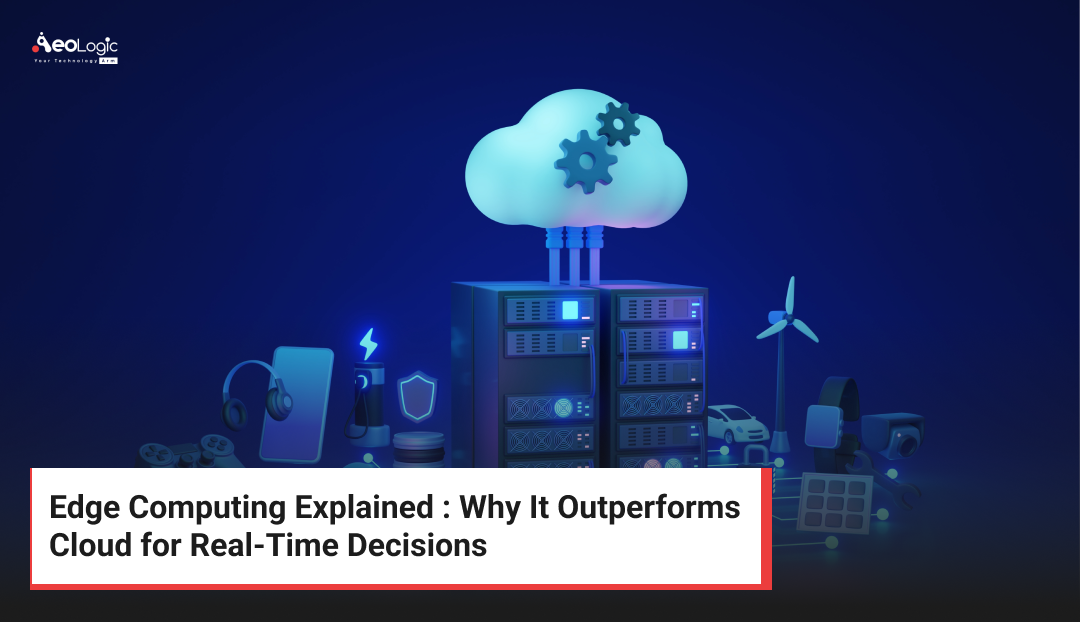
With businesses collecting vast amounts of data from connected devices, sensors, cameras and intelligent applications, the need to process data at speed has never been so great. While traditional cloud computing has revolutionized the way organizations store and manage data and analyze information, it also adds latency, as information needs to be sent from the device to the central cloud servers before analysis can proceed. In scenarios where time is a critical factor, such as time-sensitive applications, this delay can have a substantial impact on performance, efficiency, and user experience. This is where Edge Computing for Real-Time Decisions is shaking up the tech world.
Edge computing runs off data at the edge of the network, rather than sending all data to the cloud. The shorter the distance data needs to cover, the quicker businesses can respond to changing conditions, automate essential processes and enhance the reliability of their overall systems.
This article explains how edge computing works, why it outperforms traditional cloud computing in time-sensitive applications, and how organizations can leverage it to gain a competitive advantage.
What is Edge Computing?
Edge computing is a distributed computing approach that is expected to support processing of data at or close to the source of its creation instead of using a large centralized cloud infrastructure. The information produced by IoT sensors, industrial machines, cameras, mobile devices, and smart equipment can be processed locally on edge devices, gateways or local servers before only critical data is sent to the cloud.
Edge computing differs from the traditional cloud computing approach, which relies on internet connectivity and far-flung data centers to process data in real time. Edge computing reduces latency by shifting the processing of data closer to the end users and connected devices, unlike traditional cloud computing, where each request necessitates connectivity with the internet and distant datacenter to process data in real time.
Why Real-Time Decisions Matter in Modern Businesses
In today’s world of business, even a few seconds of response time can mean the difference between profitability, operational efficiency, or safety. There’s been a rise in businesses that depend on automated systems that need to respond to changing circumstances.
Manufacturing Operations
Thousands of sensors today are deployed in modern factories to keep track of the machines, production quality and environmental conditions. By waiting for the cloud to process all of the sensor readings, when a corrective action is needed, it may have been delayed. Edge computing enables the equipment to detect any abnormalities and initiate any necessary preventive maintenance in real time before failures happen.
Healthcare Systems
Medical devices are constantly taking measurements of patients’ vital signs. Should anything be found to be out of the ordinary, health practitioners need immediate notification. By taking the data analysis closer to the edge, users can perform real-time analysis without relying on internet connections only to enhance patient safety and emergency response times.
Smart Transportation
Autonomous vehicles have to handle tons of data from their sensors every second. Braking, steering and avoidance of obstacles can’t wait for cloud communication. These vehicles can use edge computing to make decisions that affect their driving behavior without compromising the safety of their passengers.
Retail Experience
Retailers increasingly deploy smart cameras, digital shelves, and intelligent checkout systems. Edge computing can offer real-time inventory monitoring, customer analytics, and automated checkout without any apparent delays.
Understanding the Difference Between Edge Computing and Cloud Computing
Both the technologies work on data, but for different purposes.
Cloud computing focuses processing in a large offsite data center that can process massive workloads. It offers scalability, centralized management, long-term storage and advanced analytics.
Only meaningful information or summarized data are sent to the cloud, instead of everything.
As a distributed architecture, this can help to lower latency, bandwidth consumption and enhance the responsiveness of applications.
Why Edge Computing Outperforms Cloud for Real-Time Decisions
Lower Latency Improves Response Speed
Latency is the delay between the data transmission from a device to a processor and back to the device. Even small delays become unacceptable in applications requiring immediate responses.
Edge computing has the ability to process data locally, significantly minimizing communication latency. This allows automated systems to respond almost instantaneously, without having to wait for cloud servers.
In sectors where every millisecond counts, a lower latency translates to more efficient operations, enhanced customer experiences, and safer conditions.
Improved Reliability During Network Failures
Stable internet connection is a critical component of cloud based systems. In the event of a network outage, data processing may be disrupted and critical applications temporarily disabled.
Edge computing enables a device to operate without the Internet. Local processing means that critical business functions continue to run until connections re-establish themselves.
Reduced Bandwidth Consumption
There are massive amounts of information generated by connected devices. Having to transmit all raw data to cloud servers requires significant bandwidth and costs.
Edge computing analyzes the data at the edge and only sends relevant information, alerts, and/or summarized reports to a central system.
This will help to alleviate network congestion, communication costs and enable the organizations to scale IoT deployments efficiently.
Enhanced Data Privacy and Security
Numerous organizations are required to take care of confidential information like customer records, monetary records, healthcare data, or confidential industrial processes.
Edge computing stores sensitive data near the source as opposed to sending all raw data information over public networks. With local processing, there is less data movement to reduce potential exposure to cyber threats.
Organizations also have more control over compliance with privacy laws and regulations and reduce risks of centralizing data transfers.
Better Performance for IoT Applications
The Internet of Things is still spreading across all industries. Millions of devices are connected and are producing continuous operating information.
With a cloud only architecture, large numbers of concurrent device communications can be inefficient.
Edge computing spreads out the processing load over various local nodes to ensure that IoT ecosystems can react in time and perform at a consistent level.
Edge computing is becoming more significant with the growing need for scalable infrastructure without compromising on speed as organizations have increased their connected infrastructure.
 Core Components of an Edge Computing Architecture
Edge Devices
Edge devices include smart sensors, industrial controllers, surveillance cameras, autonomous machines, wearable devices, and connected equipment capable of collecting operational data directly from the physical environment.
These devices are frequently used to do some basic processing before passing off information for further analysis.
Edge Gateways
Edge gateways are the intermediaries between the devices that are connected to the central systems. They collect, filter, analyze and secure data before sending the selected data to the cloud.
Gateways also help to minimize system traffic and enhance system efficiency.
Local Edge Servers
For organizations that have high performance needs, they may choose to install special edge servers in factories, hospitals, warehouses, retail stores, or branch offices.
These servers run complex analytics, AI inference and business apps locally and synchronize with cloud infrastructure when needed.
Industries Benefiting from Edge Computing
Edge computing is utilized by manufacturing firms to track manufacturing lines, forecast equipment failures, enhance product quality, and automate manufacturing processes with minimal latency. Medical devices with edge capabilities are used in healthcare to provide real-time monitoring of patients and quick emergency notifications. By handling data locally, logistics providers can streamline their fleet tracking, warehouse management, and route optimization processes. Edge AI helps retail businesses improve customer experiences with intelligent checkout, inventory management, and customer-specific in-store services.
Edge Computing for Real-Time Decisions is on the rise as organizations realize that faster insights mean better outcomes. In the era of digital transformation across industries, Edge Computing for Real-Time Decisions is gaining traction as organizations realize that faster insights mean better outcomes.
How Edge Computing Supports Artificial Intelligence
The integration of Artificial Intelligence and edge computing is becoming more and more interconnected. Using cloud platforms for training machine learning models with large datasets is a great choice, but models trained on clouds can be deployed at the edge to deliver instant decision-making without continuous internet connectivity.
AI Inference at the Edge
Machine learning models can be installed directly on edge devices or local servers. Instead of sending all images, sensor readings, and video streams to the cloud, edge devices process the data on-site to generate valuable insights that can trigger real actions.
The camera uses AI to process images locally and eliminates the defective products before they reach the customers, instead of sending all the images to the cloud.
By leveraging AI and edge computing, this synergy not only enhances efficiency but also minimizes delays in operations.
Computer Vision Applications
One of the fastest-growing edge computing applications is computer vision. Intelligent cameras in factories, warehouses, airports, hospitals and retail stores are always processing visual data without having to send huge amounts of video data to distant servers.
Businesses use computer vision for facial recognition, security surveillance, inventory management, people counting, workplace safety monitoring, and automated quality inspections. Since image processing occurs locally, organizations benefit from lower latency, improved privacy, and reduced bandwidth consumption.
Predictive Maintenance
Industrial gear produces constant sensor reading data of temperature, pressure, vibration and energy usage. Predictive maintenance systems are able to identify early signs of equipment failure with the help of edge computing, before they cause expensive breakdowns.
Challenges of Implementing Edge Computing
Although edge computing offers numerous advantages, successful implementation requires careful planning. Organizations must address several challenges before deploying edge infrastructure at scale.
Infrastructure Complexity
Unlike centralized cloud environments, edge computing involves managing distributed devices across multiple physical locations. Businesses must monitor hardware, software, security updates, and network performance across hundreds or even thousands of edge nodes.
A well-designed management strategy is essential to maintain operational consistency and minimize administrative overhead.
Security Across Distributed Networks
While edge computing improves data privacy by processing information locally, distributed infrastructure introduces new security considerations. Every connected device, gateway, and edge server represents a potential entry point for cyberattacks if not properly secured.
Organizations should implement device authentication, encrypted communications, endpoint protection, continuous monitoring, and regular software updates to protect distributed environments from emerging threats.
Hardware Maintenance
Edge devices often operate in harsh environments such as factories, warehouses, construction sites, transportation networks, or outdoor installations. Businesses must ensure that hardware remains reliable despite exposure to dust, vibration, moisture, and temperature fluctuations.
Selecting industrial-grade hardware and implementing proactive maintenance strategies can significantly improve long-term system performance.
Best Practices for Adopting Edge Computing
Organizations should begin by identifying business processes that require immediate decision-making. Not every workload benefits from edge computing, so understanding where latency impacts performance is the first step toward successful implementation.
Businesses should also design a hybrid architecture where edge computing and cloud computing work together rather than compete. Edge systems can handle time-sensitive processing, while cloud platforms continue managing historical analytics, centralized storage, application management, and large-scale machine learning.
Strong identity management, encryption, secure device provisioning, and continuous monitoring help organizations protect sensitive data across distributed environments. Scalability is another critical consideration. As IoT deployments expand, businesses should select edge platforms capable of supporting future growth without requiring extensive redesigns.
The Future of Edge Computing
The future of edge computing is closely tied to emerging technologies such as Artificial Intelligence, 5G connectivity, autonomous systems, digital twins, robotics, and Industry 4.0. As businesses deploy increasingly intelligent devices, the need for local processing will continue to grow.
The rollout of 5G networks is expected to accelerate edge computing adoption by enabling faster communication between connected devices while supporting massive IoT deployments. Together, 5G and edge computing create an ecosystem where intelligent systems can exchange information with minimal delay.
Autonomous vehicles, connected healthcare systems, smart manufacturing, precision agriculture, and intelligent retail environments will increasingly rely on distributed computing architectures capable of making instant decisions without depending entirely on centralized cloud infrastructure.
Conclusion
The growing demand for instant insights has transformed how organizations process and manage data. While cloud computing remains an essential foundation for storage, large-scale analytics, and centralized application management, it cannot always meet the speed requirements of modern, data-intensive operations.
Edge Computing for Real-Time Decisions addresses this challenge by bringing processing power closer to where data is generated. The result is lower latency, improved reliability, stronger security, reduced bandwidth usage, and faster decision-making across industries. As organizations accelerate their digital transformation initiatives, partnering with experienced technology providers like Aeologic Technologies can help them design and implement scalable edge computing solutions tailored to their operational needs, ensuring improved efficiency, real-time responsiveness, and long-term business growth.
Frequently Asked Questions (FAQs)
Q1. What is Edge Computing for Real-Time Decisions?
Edge Computing for Real-Time Decisions is a computing approach that processes data closer to where it is generated rather than sending it to a centralized cloud server. This reduces latency and enables faster responses for time-sensitive applications such as IoT, autonomous vehicles, industrial automation, and healthcare systems.
Q2. How is edge computing different from cloud computing?
Cloud computing processes and stores data in centralized data centers, making it ideal for large-scale analytics and long-term storage. Edge computing, on the other hand, performs data processing near the source, enabling real-time decision-making, lower latency, reduced bandwidth usage, and improved reliability.
Q3. Which industries benefit the most from edge computing?
Edge computing is widely used across manufacturing, healthcare, logistics, retail, finance, energy, telecommunications, and smart cities. These industries rely on real-time data processing to improve operational efficiency, automate processes, enhance customer experiences, and support mission-critical applications.
Q4. Why is edge computing important for IoT applications?
IoT devices generate massive amounts of data that often require immediate analysis. Edge computing processes this data locally, reducing network congestion and enabling connected devices to respond instantly. This improves the performance, scalability, and reliability of IoT ecosystems.
Q5. Can edge computing replace cloud computing?
No. Edge computing is designed to complement, not replace, cloud computing. While edge computing handles real-time data processing and low-latency workloads, cloud computing remains essential for centralized storage, advanced analytics, machine learning model training, and enterprise-wide data management. Together, they create a powerful hybrid infrastructure.

I’m a Software Developer with 9 years of experience building scalable web and mobile applications. Currently focused on React.js and React Native, I specialize in creating high-performance, user-friendly interfaces that drive business outcomes.
My background spans cross-platform development using Flutter, and native Android development, giving me a strong understanding of the entire mobile ecosystem. I’ve contributed to products in EdTech, Healthcare, and Enterprise SaaS—helping scale apps to 100K+ users and improving performance, reliability, and user engagement.
I’m passionate about clean architecture, modular design, and seamless user experiences. Whether it’s setting up robust state management with Redux Toolkit, optimizing API integrations with GraphQL/REST, or automating workflows with CI/CD pipelines (GitHub Actions)—I focus on writing maintainable code and delivering value to both users and stakeholders.