Today, businesses rely on information to help manage inventory, assets, orders, shipments and workflows accurately and in a timely fashion. Technologies that quickly capture operational data and convert it to digital systems are essential to businesses in manufacturing, retail, logistics, healthcare, warehousing and distribution. This is where Data Capture Solutions come into play. These technologies enable organizations to minimize manual processes, enhance accuracy and provide greater visibility into day-to-day operations.
AIDC (Automatic Identification and Data Capture) is a set of technologies that is intended to identify objects, gather data, and move data to business systems with minimal manual intervention. AIDC technologies include barcode scanners, RFID systems, biometric identification, magnetic stripe technologies, optical character recognition and mobile data collection devices.
Choosing the right technology is not about selecting the newest option. Every organization has different operational requirements. These include budgets, data volumes, environments, and integration needs. Understanding how different AIDC technologies work and where they deliver the most value can help businesses select Data Capture Solutions that support their specific operational goals.
What is AIDC and Why does it matter?
Automatic Identification and Data Capture refers to technologies that automatically identify objects, people, products, documents, or other information sources and capture related data without requiring employees to manually enter every detail into a computer system. The data collected can be passed to enterprise resource management (ERM), warehouse management (WM), inventory, transportation management (TM), customer resource management (CRM), or healthcare applications, among others.
Manual data entry has the potential for human error and can be time-consuming. If employees are required to repeatedly enter product numbers, quantities, serial numbers, shipment information, asset details, etc.,, even a minor error could result in incorrect records. These can later impact on inventory, order fulfillment, accounting, reporting and customer service.
Understanding the major AIDC technologies
AIDC is not a single technology. It covers several methods for identifying and collecting data. The right choice depends on your operational requirements. It also depends on the identification process, data volume, and processing speed.
Barcode Technology
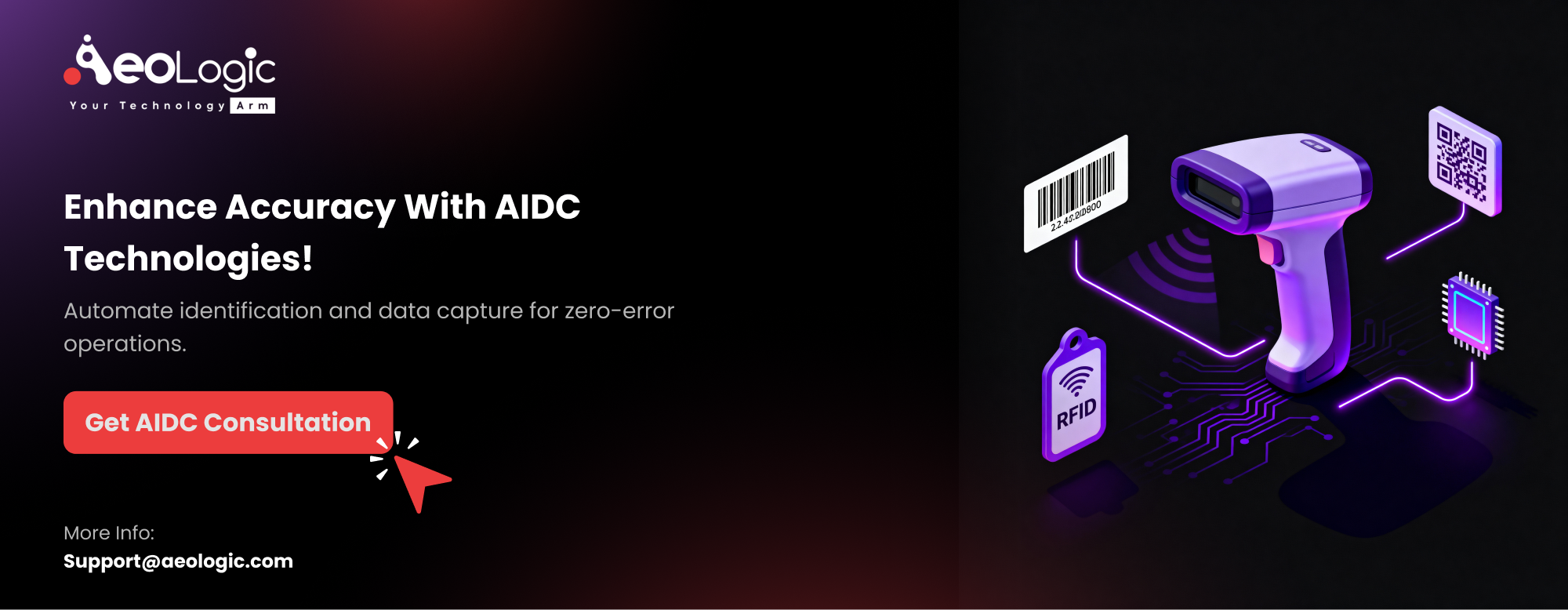
Barcode is still one of the most popular methods of automatic data collection. The barcode is a pattern of lines, spaces or other symbols that can be read by a machine. A scanner reads the code and turns it into digital data that can be passed down to a linked application.
Barcodes are very popular due to the fact that they can be implemented with a comparatively low investment, they are easy to use, and they are supported by most of the other countries in the world. They are used in retail stores to identify the products and performing the checkout operations and they are also used in receiving, picking, packing and shipping products in the warehouse. Barcodes can be used for work-in-progress tracking, product identification and quality processes within manufacturing facilities.
But the traditional barcode systems normally require a line of sight between the barcode and the scanner. Labels may also be damaged, dirty or scan-fail. In certain operations, rapid moving or difficult to access products, another technology might yield better results when products are tightly packed.
QR codes and 2D Barcodes
Two dimensional barcodes (such as QR codes) have a higher capacity for data than the one dimensional barcodes do. They can include product identifiers, URLs, batch information, serial numbers, or other structured information.
QR codes are now available in many business processes due to the increasing adoption of smartphone technology and scanning with the camera. They can be utilized in businesses for equipment identification, product information, document accessibility, maintenance records, and customer engagement.
2D barcode technology can be a viable solution for businesses that require more data than conventional barcodes and want to offer cost-effective Data Capture Solutions.
RFID Technology
Radio Frequency Identification (RFID) is a technology that uses radio waves to identify an object with an RFID tag. Unlike traditional barcodes, RFID doesn’t always need to be in a straight line for the reading. Multiple tagged objects can be identified also in short time depending on the type of RFID system and the operating environment.
RFID technology is particularly useful in the warehouse, manufacturing, retail, healthcare and supply chain sectors, where more visibility is needed into the movement and location of product or assets.
Optical character recognition
Printed or handwritten characters can be translated to machine-readable characters by using OCR. When an organization has to record information that is already written on paper, labels, forms, invoices or identification documents, OCR can be helpful.
Organizations can use OCR to reduce manual document processing and make information searchable within digital systems. It can support applications involving invoices, forms, shipping documents, identification records, and other text-heavy processes.
How to choose the right Data Capture Technology
Selecting the right technology requires more than comparing features. The first step in tackling an operational problem is to understand it clearly. The goal should be to choose technology that aligns with the existing process rather than forcing the process to adapt to the technology. The right Data Capture Solutions should support business requirements, improve accuracy, simplify workflows, and deliver measurable operational value without creating unnecessary complexity.
Start with your operational requirements
The first step is identifying what needs to be captured and why. Requirements can vary greatly between businesses. A company may monitor individual products, work-in-progress materials, or medical equipment. Each process can require a different data capture approach.
Consider the type of information you need to capture. You should also consider transaction volume, physical space, reader distance, and collection frequency. These factors can help you select the technology that best fits your needs.
A barcode can work well for simple product identification at a checkout counter. However, large-scale asset tracking may require faster identification. In such cases, RFID can provide greater operational value.
Evaluate the operating environment
The operating environment can strongly influence your technology choice. Warehouses may have dust, temperature changes, vibration, heavy machinery, and constant movement. Manufacturing facilities can also expose equipment to chemicals, moisture, and heat.
Retail environments may prioritize speed and ease of use. Healthcare facilities may need compact devices that work reliably around patients and medical equipment.
Consider accuracy and data volume
Data accuracy becomes more important as transaction volumes increase. Even a small error rate can create serious problems. This is especially true when employees process hundreds or thousands of items each day.
Organizations should consider how much information they need to collect. They should also consider how quickly that information must be processed. RFID can work well when many tagged items need to be identified with minimal manual effort. Barcode systems are effective for sequential scanning processes.
 Integration with existing business systems
AIDC technology creates value when captured information integrates smoothly with existing business systems. Scanners, RFID readers, and OCR systems must work with the organization’s software. Poor integration can create another data silo instead of improving the workflow.
Connecting data capture with ERP and WMS platforms
Data Capture Solutions are often coupled with ERP and WMS. Upon scanning or identification of an item, the information can be used to update inventory, order status, receiving records, shipments, or asset information.
In an example, images of goods received at a warehouse can be captured at a receiving point and identification information captured. This information can then be passed on to the warehouse management system, thus eliminating the need for staff to enter product information manually.
Supporting real-time operational visibility
The demand for real-time operational information has grown in recent years and is now a requirement of modern businesses. The goal of data capture technologies can be attainment by technologically gathering data directly from the operational activities.
Managers can have more up-to-the-minute insight into inventory, assets, shipments or production activities when data is collected at the point and sent straight to business applications. This can facilitate quicker decision making and provide the earlier detection of operational problems.
The Role of Mobile Data Capture
Mobile technology has revolutionized the way employees gather information in warehouses, retail stores, field jobs and manufacturing plants. Identification technologies can be integrated with software applications, such as rugged handheld scanners, mobile computers, tablets and smartphones.
For instance, a person working in a warehouse could use a handheld device to scan an item, see where it is, confirm the amount needed and update the warehouse management system all from the same device.
Mobile Data Capture Solutions can thus short-circuit the disparity between the employee and business systems. Workers do not need to go back to a workstation to enter information; they can capture and process information at the location at which the activity occurs.
Security and Data Governance considerations
Finally, for the implementation plan, security and data governance should also be part of the plan as organizations increase the adoption of automated data capture. Information may be captured and include product information, employee information, customer information, asset information or operational information.
Businesses need to manage users’ access to data collection applications and make sure data gathered is securely moved to back-end systems. Devices should also be managed appropriately, especially if mobile scanners and tablets are used outside of a controlled office setting.
Data Governance is also important. Organizations should decide on the information they want to collect, the amount of time it will be kept on file, who will have access to it, and how it will be used. Effective implementation of Data Capture Solutions should help enhance data quality, not just collect data.
Common mistakes when implementing AIDC
A frequent error is choosing technology before a problem is clearly identified as operational. At times, businesses buy equipment because of the specifications and don’t consider if it is a good fit for their workflow.
One problem is looking at data capture as a stand-alone hardware initiative. Scanners, RFID readers and mobile devices have to interact with software applications and current processes and impart value.
Adoption of employees is also important. However, technically sophisticated Data Capture Solutions are not a foolproof solution if they are not easy for workers to use or if the new workflow is not properly explained.
Thus, it is important to include operational teams in the planning, testing, and deployment. They can identify workflow problems in practice, which could not be detected in technical evaluations.
Building a future-ready Data Capture strategy
As businesses push for faster, more connected, and more intelligent operations, AIDC technology is continually evolving. Data capture increasingly is no longer a standalone process, but part of a digital transformation strategy.
By leveraging the advantages of barcode, RFID, mobile computers, sensors, cloud platforms, analytics, and AI, organizations can establish connected operational environments. Collected data may be used to fuel analytics and automation, giving companies insights into what is going on throughout their processes and what they can do better.
Data Capture Solutions will therefore move beyond object identification towards intelligent association of captured data and workflow. Creating robust data foundations now will create better opportunities for automation and advanced analytics in the near future.
Conclusion
Choosing the right AIDC technology requires a clear understanding of operational requirements, data volumes, working environments, integration needs, costs, and long-term business objectives. Barcodes can provide a simple and cost-effective solution for many applications, while QR codes can support higher information density. RFID can provide greater automation and visibility for environments where large numbers of assets or products need to be identified, while OCR can help organizations convert document-based information into digital data.
The most effective Data Capture Solutions are not necessarily the most technologically advanced. For businesses like Aeologic Technologies, the right solution should fit the organization’s workflow, provide accurate information, integrate smoothly with existing systems, and deliver measurable operational value.
Frequently Asked Questions
Q1. What are Data Capture Solutions?
Data Capture Solutions are technologies and systems used to collect information from products, assets, documents, people, or operational activities and convert it into digital data. Examples include barcode scanners, RFID systems, QR codes, OCR, and mobile data capture devices.
Q2. What is AIDC technology used for?
AIDC technology is used to automatically identify and capture information with minimal manual data entry. It is commonly used for inventory management, asset tracking, warehouse operations, manufacturing, retail, logistics, healthcare, and supply chain processes.
Q3. How do I choose the right data capture technology?
The right technology depends on factors such as the type of information being captured, operating environment, required accuracy, data volume, scanning distance, budget, and integration requirements. Businesses should evaluate their workflow before selecting a solution.
Q4. Is RFID better than barcode technology?
Neither technology is universally better. Barcodes are generally cost-effective and suitable for straightforward identification processes, while RFID can provide faster identification, support multiple-item reading, and work without direct line of sight in suitable environments.
Q5. Can Data Capture Solutions integrate with ERP and WMS systems?
Yes. Modern Data Capture Solutions can integrate with ERP, WMS, inventory, asset management, and other enterprise applications. This allows captured information to flow directly into business systems, improving data accuracy and operational visibility.

Manoj Kumar is a seasoned Digital Marketing Manager and passionate Tech Blogger with deep expertise in SEO, AI trends, and emerging digital technologies. He writes about innovative solutions that drive growth and transformation across industry.
Featured on – YOURSTORY | TECHSLING | ELEARNINGINDUSTRY | DATASCIENCECENTRAL | TIMESOFINDIA | MEDIUM | DATAFLOQ