
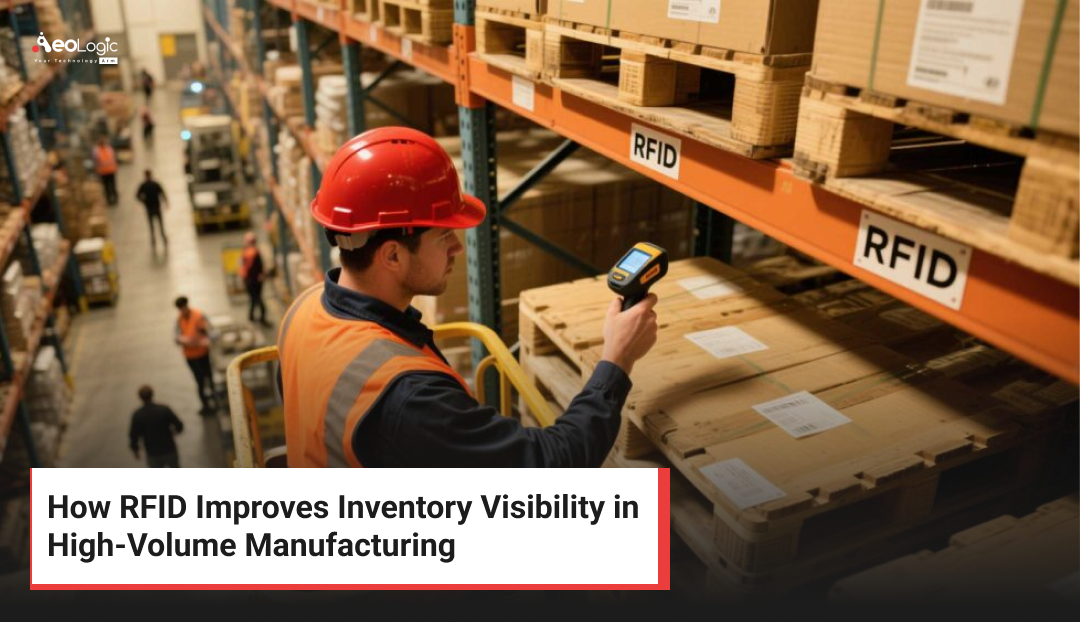
Walk onto the floor of any high-volume manufacturing plant and you’ll see the same scene playing out: pallets moving, forklifts weaving between racks, and a production schedule that doesn’t pause to wait for someone to find a missing part. In that environment, knowing exactly what inventory you have, where it sits, and how fast it’s moving isn’t a nice-to-have — it’s the difference between hitting a shipment deadline and explaining to a customer why their order is late. This is exactly where RFID inventory visibility in manufacturing changes the game.
Instead of relying on spreadsheets, manual counts, or barcode scans that only capture a single point in time, radio frequency identification gives plant managers a continuous, real-time picture of materials, work-in-progress, and finished goods as they move through the facility.
In this guide, we’ll break down what RFID inventory visibility in manufacturing actually means, how the technology works on the shop floor, the concrete benefits it delivers for high-volume operations, the challenges to plan for, and the best practices that separate a successful rollout from an expensive shelf-ware project.
Key Takeaways
RFID inventory visibility in manufacturing means tracking materials, work-in-progress, and finished goods automatically and continuously, using radio tags instead of manual scans.
Industry discussions commonly note RFID reaching higher inventory accuracy than barcode scanning once tuned — validate the exact figure with your own pilot data.
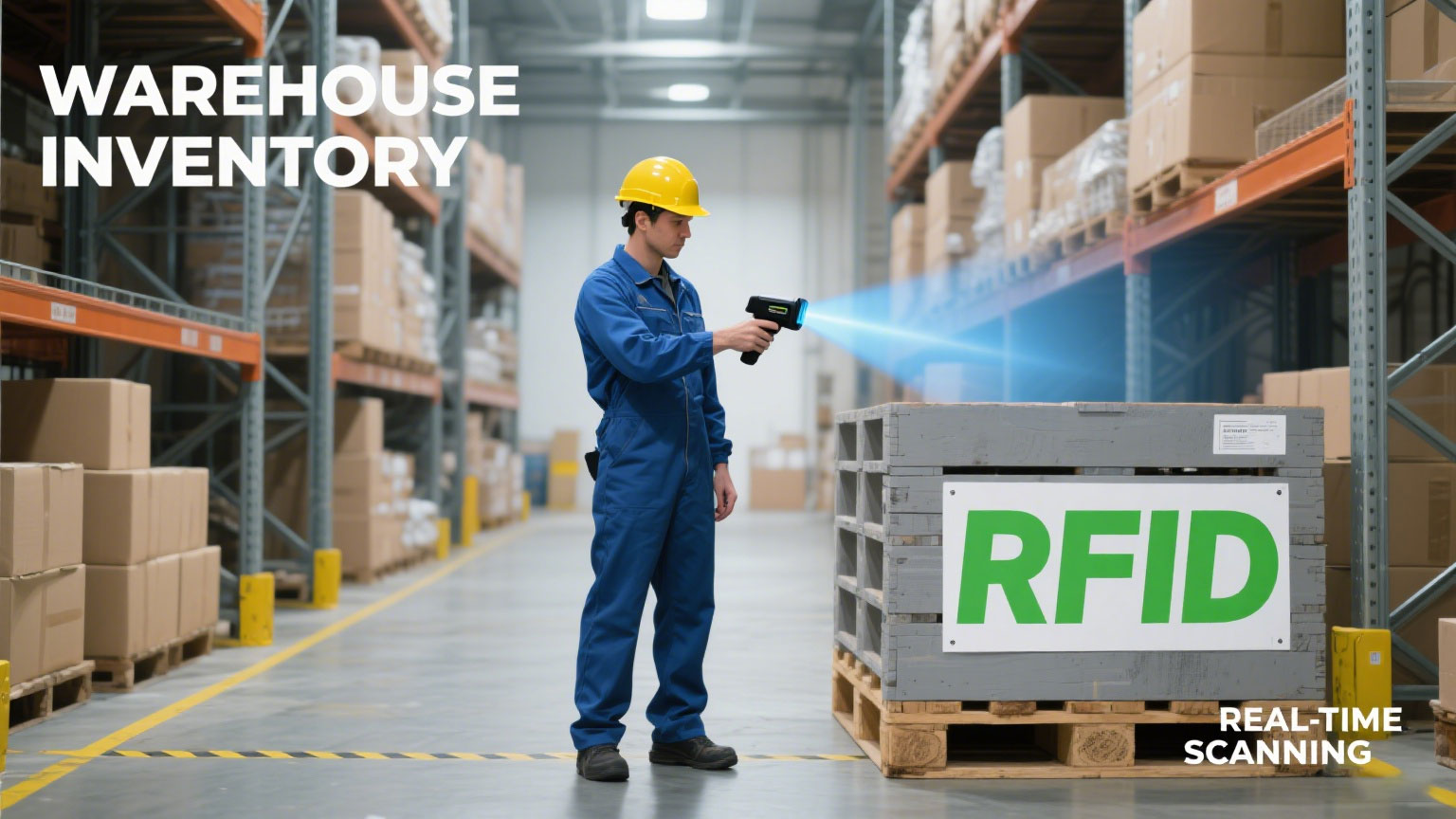
Cycle counts that take hours with barcode scanners can often be completed in minutes with handheld RFID readers.
The strongest ROI usually comes from starting with a focused pilot line, not a full facility rollout on day one.
Successful deployments plan ERP or MES integration alongside the hardware, not as a separate afterthought.
 What is RFID Inventory Visibility in Manufacturing?
RFID inventory visibility in manufacturing helps track raw materials, components, work-in-progress, and finished products. RFID tags and readers automate this process and reduce the need for periodic manual checks. Each item, pallet, or container carries a small RFID tag containing a unique identifier. Tagged inventory can move past fixed readers at dock doors, production cells, or storage racks. Handheld readers can also capture tagged items. The system then updates inventory records without requiring barcode line-of-sight.
In short: RFID inventory visibility in manufacturing turns inventory from a periodic snapshot into a live data stream. For plants running multiple shifts and thousands of SKUs, that shift from static to continuous tracking is what makes real operational control possible.
Why High-Volume Manufacturers Struggle With Traditional Inventory Tracking
The Hidden Cost of Manual and Barcode-Based Systems
Barcode scanning was a major upgrade over pen-and-paper inventory logs. However, it still requires a person to scan each item individually with a clear line of sight. In a high-volume plant moving thousands of units per shift, that creates bottlenecks at receiving docks, production handoffs, and shipping. Inventory data is only as fresh as the last scan. Any movement between scans can remain invisible until someone finds the discrepancy. This may happen during a cycle count or after a stockout occurs.
Common Blind Spots in Plant-Floor Inventory
Without automated tracking, manufacturers commonly lose visibility in a handful of predictable places: materials sitting in a staging area that never got logged, components pulled for a rework order and not returned to inventory, finished goods waiting on a dock for a truck that’s running late, and consigned inventory that technically belongs to a supplier but is physically on-site. Each of these blind spots chips away at inventory accuracy, and inaccurate inventory data cascades into bad purchasing decisions, unnecessary safety stock, and production delays.
How RFID Technology Works in a Manufacturing Environment
RFID Tags, Readers, and Middleware Explained
An RFID system for manufacturing has three core components. First, tags — small chips paired with an antenna — are attached to pallets, totes, components, or finished units. Second, readers, which can be fixed at chokepoints like dock doors and conveyor lines or handheld for cycle counts, emit radio waves that power passive tags and capture their unique ID. Third, middleware software filters the raw read data, removes duplicate reads, and pushes clean, structured inventory events into the ERP, MES, or warehouse management system. Middleware is an important part of RFID inventory visibility in manufacturing. Raw RFID reads can be noisy. Middleware converts this data into structured and trustworthy inventory records.
Passive vs. Active RFID for Manufacturing Use Cases
Passive RFID tags have no internal power source. They receive power from the reader’s radio signal. This makes them inexpensive for tagging components, cartons, and pallets in high volumes. Active RFID tags carry their own battery, broadcast continuously, and can be read from much greater distances — useful for tracking high-value assets, tooling, or reusable containers across a large facility or yard. Most high-volume manufacturers use a mix: passive tags for high-quantity, lower-value SKUs, and active tags for expensive equipment, molds, or returnable transport items that need to be located quickly.
Core Benefits of RFID Inventory Visibility in Manufacturing
Real-Time Tracking Across the Production Line
The most immediate benefit of RFID inventory visibility in manufacturing is that inventory status updates automatically as materials move — from receiving, into staging, onto the line, and out to shipping — without manual data entry. Supervisors can see exactly how much raw material is at each work cell and how much finished product is ready to ship, at any moment, rather than waiting for an end-of-shift count.
Reduced Shrinkage and Inventory Discrepancies
Because every tagged item is accounted for automatically, RFID makes it far harder for inventory to simply “disappear” between processes. Plants that adopt RFID inventory visibility in manufacturing commonly report meaningfully lower shrinkage and fewer unexplained variances during audits, since the system captures movement events that manual processes would have missed entirely.
Faster Cycle Counts and Audits
A cycle count can take several hours with handheld barcode scanners. A handheld RFID reader can often complete the same task in minutes. It can capture multiple tags without direct line of sight. That speed doesn’t just save labor hours — it means counts can happen more frequently, which keeps inventory records more accurate year-round instead of only around a big annual count.
Better Demand Planning and Replenishment
When planners can trust that inventory data reflects reality, they can set tighter, more confident reorder points and safety stock levels. RFID inventory visibility in manufacturing feeds cleaner data into forecasting and MRP systems, which reduces both stockouts on the line and the excess safety stock that ties up working capital.
RFID Use Cases in High-Volume Manufacturing
| Use Case | What RFID Tracks | Business Impact |
| Receiving & dock management | Incoming raw materials and components | Faster put-away, fewer receiving errors |
| Work-in-progress tracking | Components/sub-assemblies in production cells | Real-time production status, fewer lost parts |
| Finished goods staging | Completed units awaiting shipment | Accurate ship-ready counts, fewer delays |
| Tool & fixture tracking | High-value tooling, molds, jigs | Less search time, lower replacement costs |
| Returnable container management | Totes, pallets, reusable packaging | Reduced asset loss, lower packaging spend |
| Yard & dock-door management | Trailers and outbound shipments | Better trailer turnaround & scheduling |
RFID vs. Barcode vs. Manual Tracking — A Quick Comparison
| Factor | Manual Tracking | Barcode Scanning | RFID Inventory Visibility |
| Read speed | Very slow | One item at a time | Dozens of items/second |
| Line of sight required | N/A | Yes | No |
| Labor required | High | Moderate | Low, mostly automated |
| Data freshness | Periodic, often outdated | Point-in-time | Continuous, near real-time |
| Best fit | Very low-volume ops | Moderate volume, cost-sensitive | High-volume, high-SKU manufacturing |
Key Challenges When Implementing RFID Inventory Visibility in Manufacturing
Upfront Costs and ROI Timelines
Tags, readers, antennas, and middleware all carry upfront costs, and a plant-wide rollout is a bigger investment than adding a few barcode scanners. Manufacturers typically see the strongest ROI when they start with a focused pilot — one production line or one high-value inventory category — rather than tagging the entire facility on day one.
Tag Placement and Read Accuracy in Metal-Heavy Environments
Metal surfaces and liquids can interfere with radio signals, which is a real consideration in a manufacturing plant full of steel racking, machinery, and metal components. This is usually solved with tags engineered for on-metal use, careful antenna placement, and a site survey before full deployment — not by avoiding RFID altogether.
Integration With Existing ERP/MES Systems
RFID only delivers value once its data flows into the systems people already use to make decisions. That means planning integration with the ERP, MES, or warehouse management system early, rather than treating RFID as a standalone tracking layer that lives outside core operations. A common mistake is treating the rollout as a hardware project first and an integration project second; in practice, middleware and integration work usually takes longer than installing readers and tags, so it deserves an equal share of the project timeline.
 Change Management on the Plant Floor
Even a technically sound RFID inventory visibility in manufacturing deployment can stall if the people using it every day aren’t part of the planning process. Operators who don’t understand why a new tag or reader has appeared at their station may work around it rather than with it.
Best Practices for a Successful RFID Rollout
- Start with a single pilot area, such as one production line or one high-value SKU category, before scaling plant-wide.
- Run a radio-frequency site survey to identify interference from metal racking, machinery, or building materials.
- Choose tag types matched to the surface they’ll be applied to, especially for on-metal or high-heat applications.
- Involve production and warehouse staff early so tagging and scanning fit naturally into existing workflows.
- Plan the ERP or MES integration alongside the hardware rollout, not as an afterthought.
- Set clear accuracy and ROI benchmarks before expansion, so you can prove the pilot’s value with data.
- Build a maintenance plan for readers and tags, since hardware in an industrial environment needs regular upkeep.
How RFID Fits Into a Broader Warehouse and Supply Chain Strategy
RFID inventory visibility in manufacturing rarely stays confined to the plant floor for long. Once a facility has reliable, real-time inventory data internally, that same data becomes valuable further up and down the supply chain. Suppliers can get earlier, more accurate signals about consumption rates instead of relying on periodic purchase orders. Distribution and logistics teams can plan outbound shipments around confirmed ship-ready quantities rather than estimates. And finance teams get a more accurate, real-time view of inventory value on the books, which matters for everything from insurance to working-capital planning. Manufacturers that treat RFID as an enterprise-wide visibility tool, rather than a plant-floor gadget, tend to unlock more of its long-term value.
How to Measure ROI From RFID Inventory Visibility in Manufacturing
The clearest way to measure ROI is to compare a small set of metrics before and after deployment in the pilot area: inventory accuracy rate, average cycle count time, hours of labor spent on manual counts, incidence of stockouts or line stoppages caused by missing materials, and shrinkage or unexplained inventory variance. Manufacturers that track these numbers consistently find that RFID inventory visibility in manufacturing pays for itself through labor savings and reduced downtime, well before the technology delivers its full strategic value in better planning and forecasting.
The Future — RFID, IoT, and AI-Driven Inventory Intelligence
RFID is increasingly becoming one input into a broader connected-factory strategy. Paired with IoT sensors and AI-driven analytics, RFID inventory visibility in manufacturing is evolving from “where is this item right now” into predictive insight — flagging unusual movement patterns, forecasting replenishment needs before a shortage occurs, and feeding digital twin models of the production floor. Manufacturers that build a solid RFID data foundation today will be better positioned to adopt these more advanced capabilities as they mature.
Conclusion
High-volume manufacturing runs on tight margins and tighter schedules, and inventory blind spots are one of the most avoidable causes of downtime, shrinkage, and missed shipments. RFID inventory visibility in manufacturing replaces guesswork and periodic counts with continuous, automated tracking of materials as they move through the plant — from receiving, through production, to the shipping dock.
Manufacturers can gain more value from RFID by starting with a focused pilot rather than focusing only on budget size. Aeologic Technologies can help businesses plan system integration early and use accurate inventory data to support better planning decisions.
If your team is still relying on manual counts or barcode scans to answer “where is our inventory right now,” it may be time to evaluate whether RFID inventory visibility in manufacturing is the right next step for your operation. Talk to your operations or automation partner about scoping a pilot line this quarter.
Frequently Asked Questions
Q1. What is RFID inventory visibility in manufacturing?
RFID inventory visibility in manufacturing is the use of radio frequency identification tags and readers to automatically and continuously track materials, work-in-progress, and finished goods as they move through a plant, replacing manual counts and one-at-a-time barcode scans with real-time inventory data.
Q2. How is RFID different from barcode scanning in a factory?
Barcode scanning requires a direct line of sight and one scan per item, so data is only as current as the last scan. RFID readers can capture dozens of tags per second without line of sight, which means inventory records update automatically as materials move rather than only when someone stops to scan them.
Q3. Is RFID worth the cost for a smaller manufacturing plant?
It depends on volume and SKU complexity. Plants with high transaction volumes, frequent cycle counts, or high-value components tend to see faster payback. Many smaller manufacturers start with a single-line or single-category pilot to validate ROI before a larger investment.
Q4. Does metal on the plant floor interfere with RFID reads?
Yes, metal and liquids can interfere with radio signals, but this is a well-understood challenge. On-metal tags, careful antenna placement, and a pre-deployment site survey typically resolve read-accuracy issues in metal-heavy manufacturing environments.
Q5. How long does an RFID rollout usually take?
Timelines vary by facility size and scope, but a focused pilot on a single production line can often be planned and deployed in a matter of weeks, while a full plant-wide rollout with ERP integration is typically a multi-month project.
Q6. Can RFID integrate with our existing ERP or MES system?
In most cases, yes. RFID middleware is designed to translate raw tag reads into structured inventory events that can be pushed into common ERP, MES, and warehouse management platforms, though the integration effort should be scoped early in the project.
Q7. What is the difference between passive and active RFID tags?
Passive tags have no battery, are powered by the reader’s signal, and are inexpensive, making them suited to high-volume item-level tracking. Active tags carry their own battery, transmit over longer distances, and are typically used for higher-value assets like tooling or reusable containers.

I’m a Software Developer with 9 years of experience building scalable web and mobile applications. Currently focused on React.js and React Native, I specialize in creating high-performance, user-friendly interfaces that drive business outcomes.
My background spans cross-platform development using Flutter, and native Android development, giving me a strong understanding of the entire mobile ecosystem. I’ve contributed to products in EdTech, Healthcare, and Enterprise SaaS—helping scale apps to 100K+ users and improving performance, reliability, and user engagement.
I’m passionate about clean architecture, modular design, and seamless user experiences. Whether it’s setting up robust state management with Redux Toolkit, optimizing API integrations with GraphQL/REST, or automating workflows with CI/CD pipelines (GitHub Actions)—I focus on writing maintainable code and delivering value to both users and stakeholders.