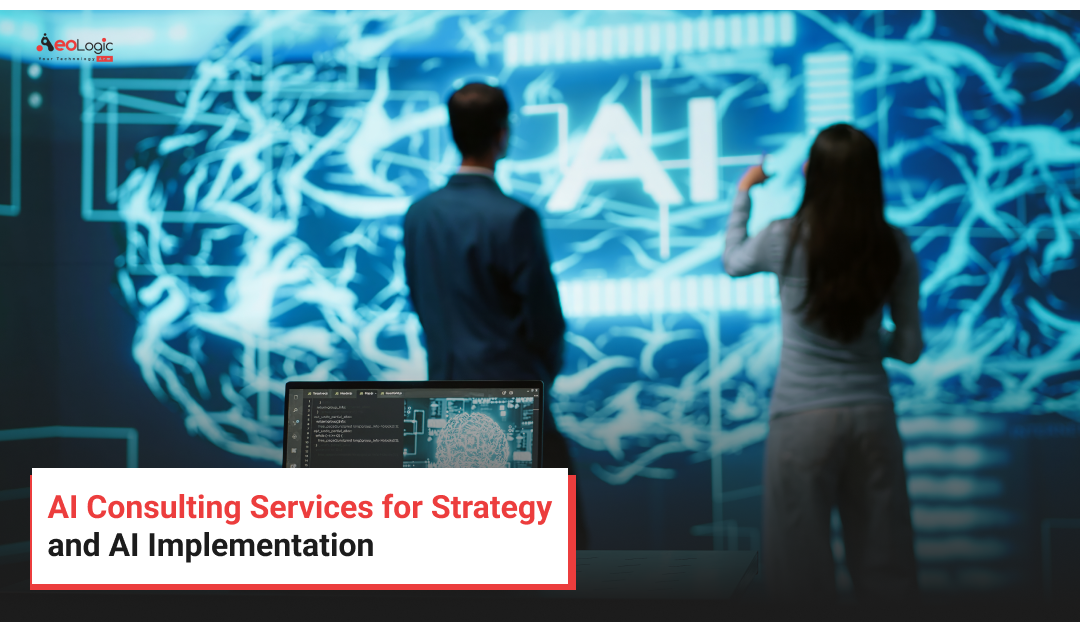
Artificial intelligence has moved from an experimental technology to a core part of how competitive businesses operate. Yet most organizations still struggle to turn AI ambition into measurable results. That gap is exactly where AI consulting services come in. Whether a company is exploring its first AI pilot or scaling machine learning across multiple departments, experienced AI consulting services help translate strategy into working systems that actually deliver value.
This guide breaks down what AI consulting services are, how they work, what they cost in terms of effort and investment, and how to choose the right partner for your organization’s goals.
What are AI Consulting Services?
AI consulting services are professional advisory and implementation offerings that help organizations plan, build, and operationalize artificial intelligence solutions. Rather than simply recommending tools, a strong AI consulting services provider works alongside internal teams to assess readiness, define a realistic roadmap, build or integrate AI models, and manage the organizational change required for adoption.
In short: AI consulting services combine strategic advice with hands-on technical execution, so businesses don’t just understand AI in theory — they actually use it in production.
AI consulting services are expert-led engagements that guide companies through AI strategy, model selection, data preparation, implementation, and ongoing optimization, so that artificial intelligence initiatives produce real business outcomes instead of stalling as isolated experiments.
 Why Businesses Need AI Consulting Services Today
Many companies already have the data and the ambition to adopt AI, but they lack three things: a clear strategy, in-house AI expertise, and a structured way to manage risk during implementation. This is precisely the gap that AI consulting services are built to close.
A few forces are driving demand for AI consulting services:
- Talent scarcity. Skilled machine learning engineers and AI architects are expensive and hard to hire, so AI consulting services offer immediate access to specialized talent without a long recruitment cycle.
- Rapid technology change. New models, frameworks, and platforms appear constantly. AI consulting services help businesses evaluate which technologies are actually mature enough to deploy, rather than chasing every new release.
- Risk and compliance pressure. Data privacy, security, and responsible AI requirements are becoming stricter. AI consulting services bring frameworks for governance that reduce legal and reputational risk.
- Pressure to show ROI. Boards and executives want proof that AI spending translates into revenue, cost savings, or efficiency. AI consulting services are typically structured around measurable business outcomes, not just technology deployment.
Core Areas Covered by AI Consulting Services
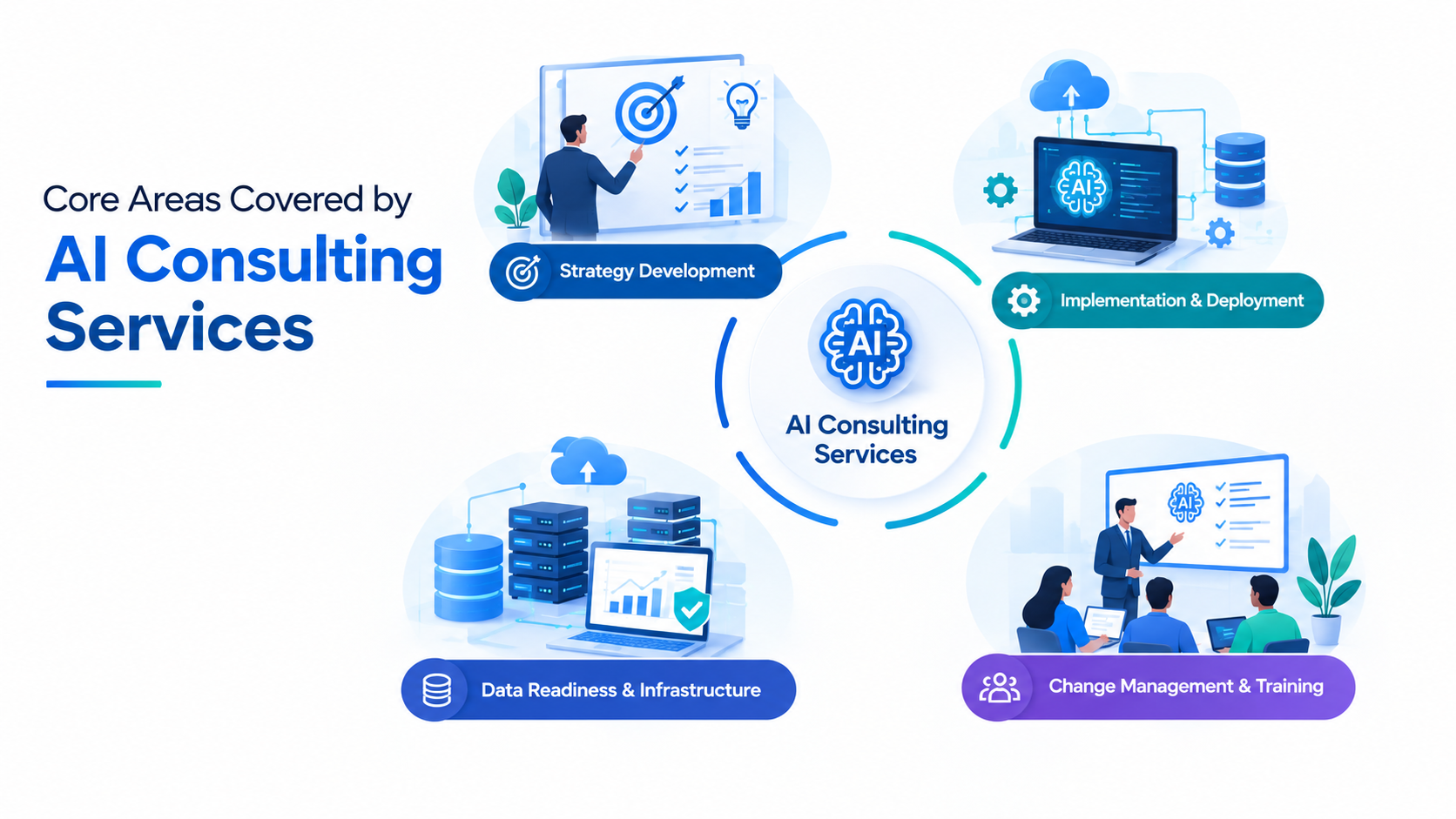
Most full-service AI consulting services engagements are organized around four core pillars.
AI Strategy Development
Before any model gets built, AI consulting services start with strategy: identifying which business problems are worth solving with AI, estimating potential impact, and prioritizing use cases based on feasibility and value. A good strategy phase answers questions like: Which processes are too manual or too slow? Where does the organization have enough quality data to train a reliable model? What does success actually look like in six, twelve, and twenty-four months?
AI Implementation and Deployment
This is the technical core of AI consulting services — building, testing, and deploying machine learning models, generative AI applications, automation workflows, or predictive analytics systems into production environments. Implementation work typically includes model selection or custom development, integration with existing software (CRM, ERP, data warehouses), and setting up infrastructure for training and inference.
Data Readiness and Infrastructure
AI is only as good as the data behind it. A major part of AI consulting services involves auditing data quality, consolidating fragmented data sources, building pipelines, and establishing governance so that models are trained on accurate, representative, and well-labeled data.
Change Management and Training
Even a technically perfect AI system fails if employees don’t trust it or know how to use it. AI consulting services typically include training programs, documentation, and change management support to help teams adopt new AI-powered workflows smoothly.
 How AI Consulting Services Work: The Process
While every provider structures engagements a little differently, most AI consulting services follow a similar five-step process.
Step 1: Discovery and Assessment
Consultants review current systems, data infrastructure, team capabilities, and business goals. This phase of AI consulting services typically involves stakeholder interviews, technical audits, and a maturity assessment to establish a realistic starting point.
Step 2: Strategy and Roadmap
Based on the discovery findings, the AI consulting services team builds a prioritized roadmap of use cases, estimated timelines, required resources, and expected outcomes. This roadmap becomes the reference point for the rest of the engagement.
Step 3: Pilot and Proof of Concept
Rather than committing to a company-wide rollout immediately, most AI consulting services recommend starting with a focused pilot. This limits risk, validates assumptions about data and performance, and builds internal confidence before scaling.
Step 4: Implementation and Integration
Once a pilot proves viable, the AI consulting services team moves into full build-out: refining models, connecting systems, setting up monitoring, and preparing the solution for production use.
Step 5: Monitoring and Optimization
AI systems require ongoing attention. Reputable AI consulting services providers don’t disappear after launch — they help monitor model performance, retrain as needed, and refine the solution as business conditions change.
Key Benefits of AI Consulting Services
Organizations that invest in experienced AI consulting services typically see benefits across several dimensions:
| Benefit | What It Means in Practice |
|---|---|
| Faster time to value | Experienced teams avoid common pitfalls and shortcut the learning curve |
| Reduced implementation risk | Structured pilots and governance frameworks limit costly missteps |
| Access to specialized skills | No need to hire a full in-house AI team immediately |
| Objective technology selection | Vendor-neutral recommendations based on actual fit, not hype |
| Stronger data foundations | Data audits and pipeline work benefit the whole organization, not just one project |
| Better change adoption | Structured training increases the odds employees actually use the new tools |
AI Consulting Services vs. In-House AI Teams
A common question business leaders ask is whether to build an internal AI team or rely on outside AI consulting services. In most cases, the answer isn’t strictly one or the other — many organizations use AI consulting services to get started and build internal capability over time.
| Factor | AI Consulting Services | In-House AI Team |
|---|---|---|
| Speed to start | Fast — existing expertise ready to deploy | Slow — hiring and onboarding take months |
| Upfront cost | Lower initial investment, project-based | Higher fixed costs (salaries, benefits, tools) |
| Breadth of expertise | Access to specialists across many domains | Limited to the skills already hired |
| Long-term ownership | Knowledge transfer needed for full independence | Full internal control and institutional knowledge |
| Best for | Early-stage AI adoption, specific projects, strategy validation | Mature AI programs with ongoing, large-scale needs |
Many companies find the most practical path is to engage AI consulting services for strategy and initial implementation, while gradually building internal capacity for day-to-day maintenance.
Industries That Benefit Most from AI Consulting Services
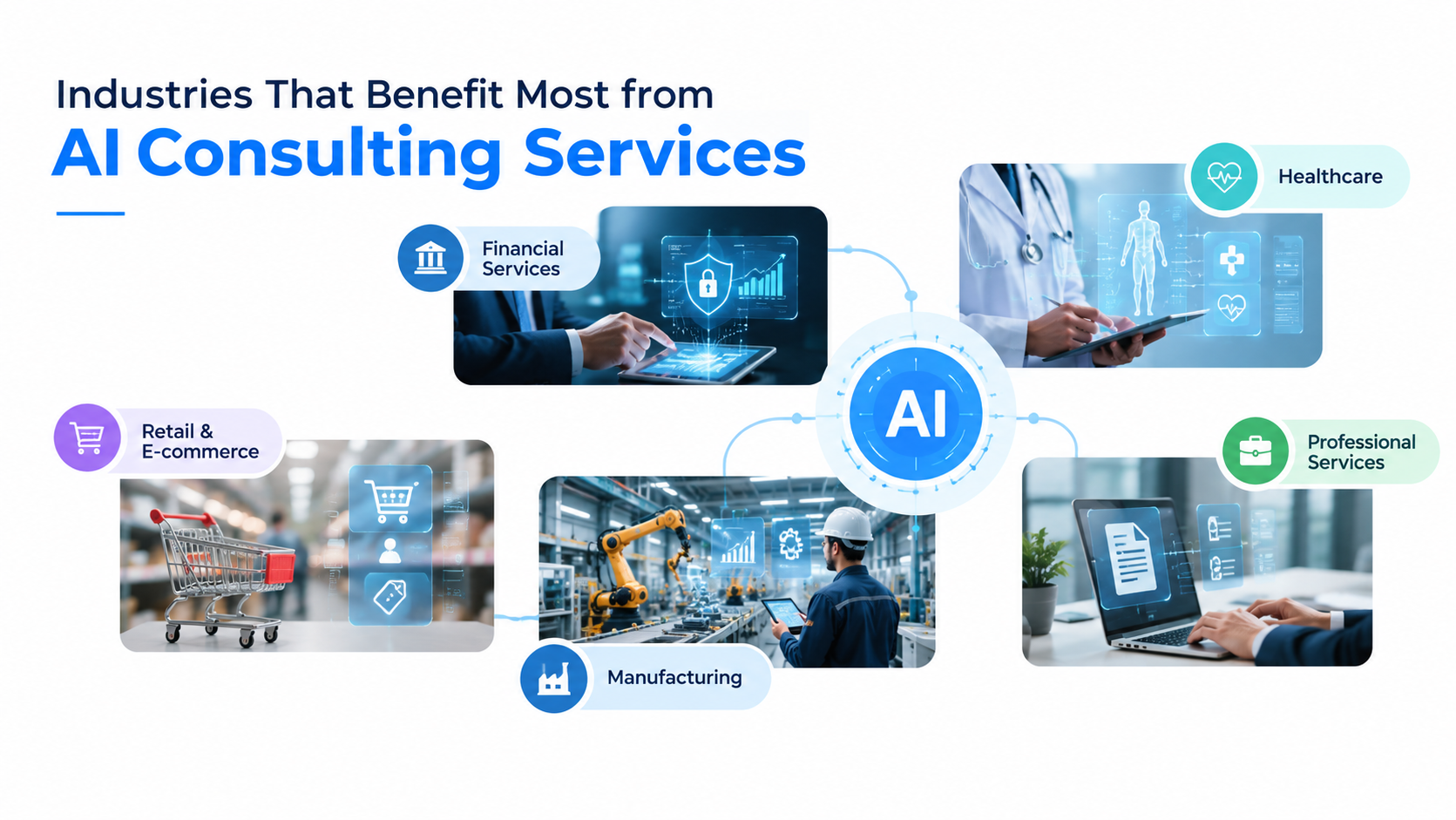
While AI consulting services apply broadly, certain industries tend to see outsized returns:
- Financial services — fraud detection, credit risk modeling, and customer service automation
- Healthcare — administrative automation, diagnostic support tools, and operational forecasting
- Retail and e-commerce — demand forecasting, personalization, and inventory optimization
- Manufacturing — predictive maintenance, quality control, and supply chain optimization
- Professional services — document automation, research assistance, and workflow efficiency
Across all of these sectors, the common thread is that AI consulting services help translate industry-specific pain points into targeted, achievable AI use cases.
 Common Challenges AI Consulting Services Help Solve
Organizations approaching AI consulting services often face a predictable set of obstacles:
- Unclear ROI expectations. Leadership wants results but hasn’t defined what success looks like. AI consulting services help set concrete, measurable goals upfront.
- Poor data quality. Fragmented, inconsistent, or incomplete data undermines model accuracy. Data audits are a standard early step in most AI consulting services engagements.
- Lack of internal AI literacy. Teams may not understand what AI can and cannot realistically do. Education and expectation-setting are built into good AI consulting services work.
- Integration complexity. Connecting AI tools to legacy systems is often harder than building the model itself. Experienced AI consulting services teams plan for this from day one.
- Change resistance. Employees may distrust automated recommendations. Structured rollout and training, a core part of AI consulting services, address this directly.
Best Practices for Choosing an AI Consulting Services Partner
Not all AI consulting services providers are equal. When evaluating a partner, consider the following:
- Ask for a clear methodology. A credible AI consulting services provider should be able to explain their discovery, strategy, and implementation process in plain language — not just buzzwords.
- Check for vendor neutrality. Be cautious of AI consulting services that only recommend one technology stack regardless of your needs; the right fit depends on your data, systems, and goals.
- Look for measurable outcomes in past work. Ask how success was defined and measured in previous engagements, rather than relying on vague claims.
- Evaluate data governance expertise. Responsible AI consulting services should address privacy, security, and compliance as a core part of the engagement, not an afterthought.
- Confirm knowledge transfer. The best AI consulting services leave your internal team more capable, not permanently dependent on the consultant.
- Start small. A reliable AI consulting services provider will usually recommend a pilot project before a large-scale commitment, so you can evaluate fit with lower risk.
What to Expect When Working with AI Consulting Services
Engagements with AI Consulting Solutions generally run from a few weeks for a focused strategy assessment to several months or longer for full implementation and scaling. Costs vary widely based on scope — a strategy-only engagement is far less expensive than a full build-and-deploy project. Most providers offer either project-based pricing or ongoing retainer arrangements, depending on whether the work is a one-time initiative or continuous optimization.
Throughout the engagement, clear communication matters. The best AI consulting services relationships involve regular check-ins, transparent reporting on pilot results, and honest conversations about what is and isn’t working — AI implementation rarely goes exactly as planned, and a good partner adjusts the roadmap as new information emerges.
Conclusion
Artificial intelligence offers real competitive advantage, but only when it’s implemented thoughtfully. AI consulting services exist to bridge the gap between ambition and execution — bringing structured strategy, technical expertise, and change management together so that AI initiatives actually succeed rather than stalling as isolated experiments. Whether your organization is exploring its first use case or scaling AI across multiple teams, the right AI consulting services partner can shorten the path to measurable results while reducing risk along the way.
If you’re ready to move from AI strategy to AI implementation, Aeologic Technologies can help you identify where AI consulting services can deliver the fastest, most reliable return for your business through a focused assessment.
Frequently Asked Questions
Q1. What do AI Consulting Solutions actually include?
AI consulting services typically include strategy development, data readiness assessment, model selection or development, system integration, deployment, and employee training. The exact scope depends on the provider and the organization’s specific needs, but most engagements combine advisory work with hands-on technical implementation.
Q2. How much do AI Consulting Solutions cost?
Costs vary significantly based on scope, from a few thousand dollars for a focused strategy assessment to six or seven figures for enterprise-wide implementation. Project-based and retainer pricing models are both common; it’s best to request a scoped proposal based on your specific goals.
Q3. How long does an AI Consulting Solutions engagement take?
A strategy and assessment phase can often be completed in two to six weeks. Full implementation, including pilots and integration, commonly takes three to nine months, depending on complexity, data readiness, and organizational size.
Q4. Do small businesses need AI Consulting Solutions, or is this only for large enterprises?
Small and mid-sized businesses can benefit significantly from AI Consulting Solutions, particularly for focused use cases like customer service automation or demand forecasting, where the investment required is modest compared to the operational savings.
Q5. What is the difference between AI consulting and AI implementation?
AI consulting focuses on strategy, planning, and advisory work, while AI implementation refers to the hands-on technical work of building and deploying solutions. Most full-service AI consulting services combine both, guiding a project from initial planning through to a live, working system.
Q6. Can AI consulting services help if we don’t have clean data yet?
Yes. Data readiness is one of the most common starting points for AI Consulting Solutions engagements. Consultants typically begin with a data audit and help build the pipelines and governance needed before any model training begins.
Q7. How do we measure the success of an AI consulting services engagement?
Success should be tied to specific business metrics defined at the start of the engagement — such as reduced processing time, improved forecast accuracy, or cost savings — rather than vague technical milestones. Good AI consulting services providers help define these metrics upfront.
Q8. What industries use AI consulting services the most?
Financial services, healthcare, retail, manufacturing, and professional services are among the heaviest users of AI consulting services, largely because these industries have significant volumes of data and clear opportunities for automation and forecasting.