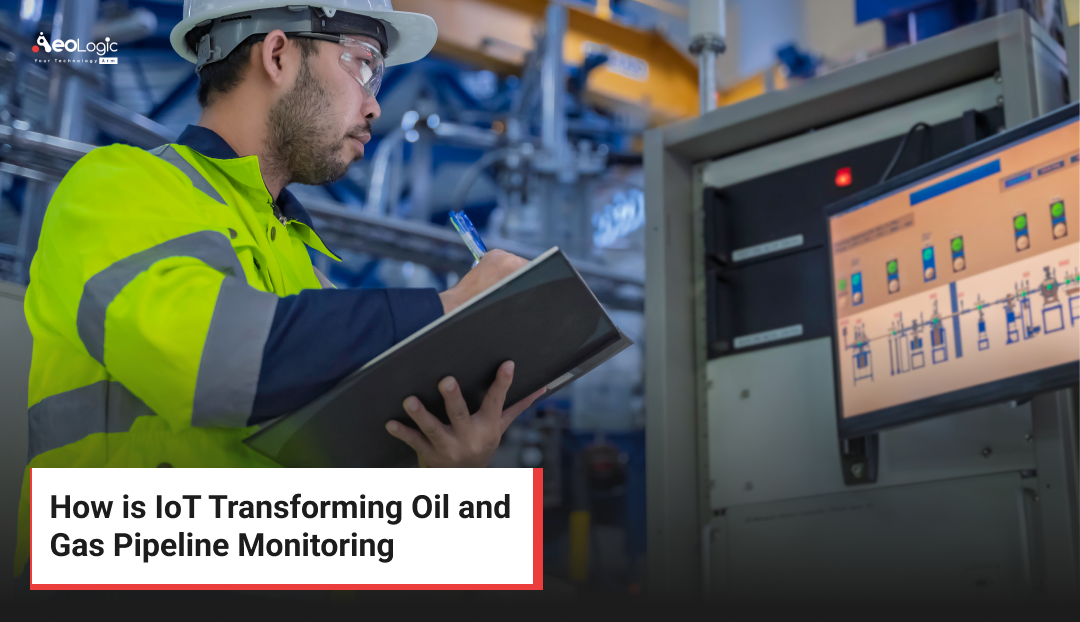
Oil and gas pipelines move the lifeblood of the global economy across thousands of miles of remote terrain, often through deserts, mountains, where a human inspector can’t check a valve every hour. For decades, operators relied on scheduled walk-downs, aerial patrols, and manual pressure readings to catch problems — a model that is slow, expensive, and frequently too late. That’s exactly the gap that IoT in oil and gas pipeline monitoring is closing. By placing networked sensors directly on pipeline infrastructure and streaming that data to cloud platforms in real time, operators can now see a leak, a pressure drop, or a corrosion hotspot the moment it starts, not days or weeks later.
This shift isn’t a minor upgrade. It’s a fundamental change in how the industry thinks about safety, compliance, and cost control. In this guide, we’ll break down exactly what IoT in oil and gas pipeline monitoring means, how it works, what it costs operators to get wrong, and how forward-looking companies are putting it to use today.
What is IoT in Oil and Gas Pipeline Monitoring?
IoT in oil and gas pipeline monitoring refers to the use of connected sensors, wireless networks, and cloud-based software to continuously track the condition, flow, pressure, and integrity of pipeline infrastructure. Instead of relying on periodic manual checks, IoT devices collect data around the clock and send instant alerts the moment a reading falls outside a safe range — turning a historically reactive process into a proactive one.
At its core, the idea is simple: attach small, low-power sensors to critical points along a pipeline — valves, joints, compressor stations, and high-risk corridors — and let those sensors talk to each other and to a central system without needing a technician physically present. The result is a pipeline network that effectively monitors itself.
 Why Traditional Pipeline Monitoring Methods Fall Short
Before IoT, operators leaned on a mix of approaches that all shared the same weakness: time lag.
- Manual inspections — technicians walking or driving pipeline routes on a fixed schedule, sometimes weeks apart.
- Aerial and satellite patrols — useful for spotting surface damage but blind to internal corrosion or slow leaks.
- Legacy SCADA systems — often limited to a handful of fixed monitoring stations with infrequent data refreshes.
- Pigging operations — in-line inspection tools that check pipe interiors but only run periodically, not continuously.
Each of these methods can miss a problem for days, and in remote or offshore pipelines, the gap can stretch even longer. A small leak that goes unnoticed for a week isn’t just a safety risk — it’s lost product, environmental liability, and a potential regulatory fine. This is precisely the failure mode that IoT in oil and gas pipeline monitoring was built to eliminate.
Key Components of an IoT Pipeline Monitoring System
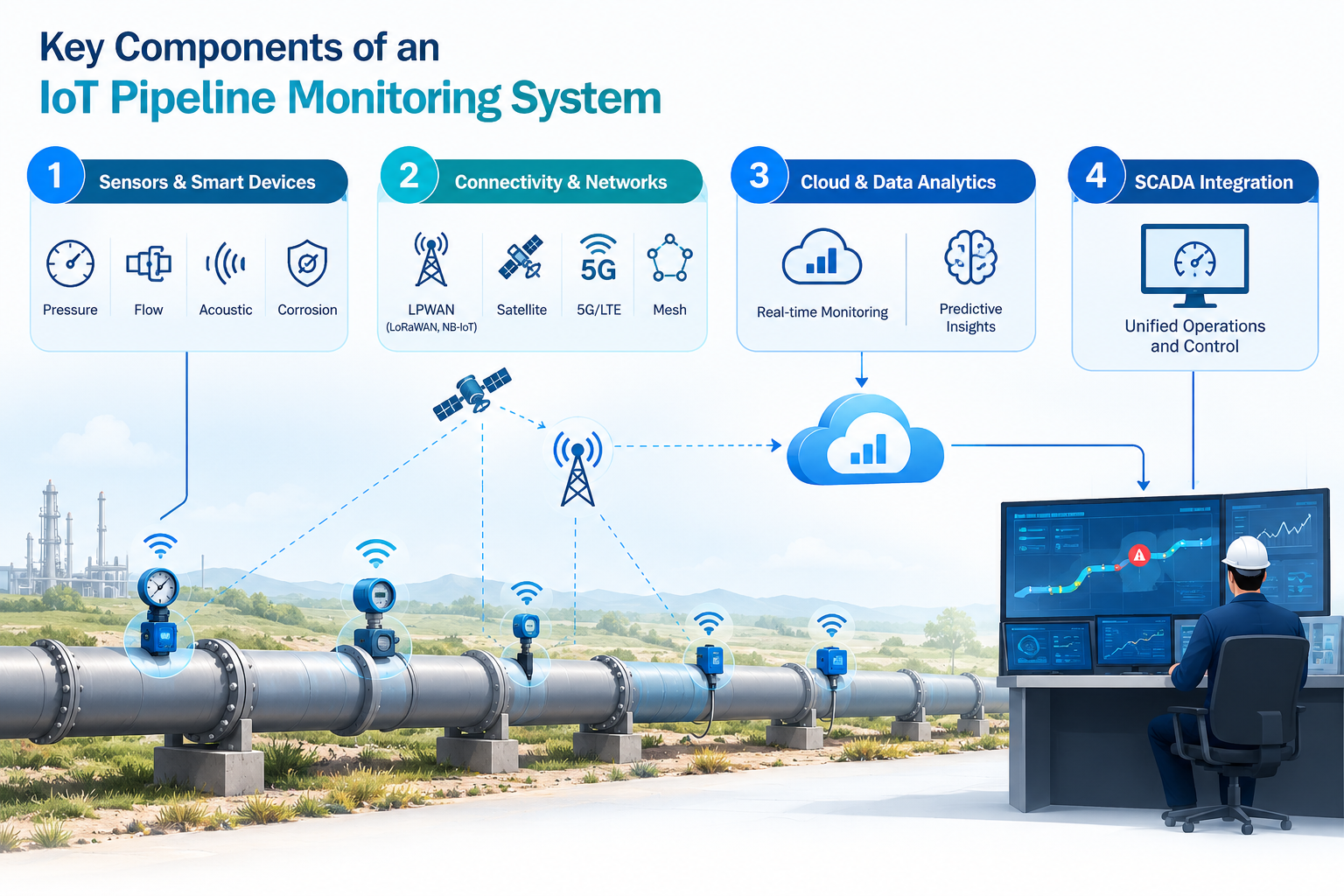
A working IoT in oil and gas pipeline monitoring deployment is built from four layers that work together.
1. Sensors and Smart Devices
These are the “eyes and ears” of the system, physically attached to or embedded near the pipeline. Common sensor types include:
- Pressure sensors — detect sudden drops that may indicate a rupture or leak.
- Flow meters — track volume moving through a segment to catch discrepancies between input and output.
- Acoustic sensors — “listen” for the distinct sound signature of a leak or crack.
- Fiber-optic distributed sensing (DAS/DTS) — runs the length of the pipe, detecting temperature and strain changes at precise locations.
- Corrosion and thickness sensors — measure wall degradation before it becomes a failure point.
- Vibration sensors — flag unusual mechanical stress near compressor stations and joints.
2. Connectivity and Networks
Because pipelines often run through areas with no cellular coverage, IoT in oil and gas pipeline monitoring depends heavily on long-range, low-power connectivity options:
- LPWAN (LoRaWAN, NB-IoT) — low bandwidth but excellent range and battery life, ideal for remote stretches.
- Satellite connectivity — used where no terrestrial network exists at all, such as offshore platforms.
- Private 5G and LTE — deployed near high-value assets like compressor stations where bandwidth needs are higher.
- Mesh networks — sensors relay data to each other, extending coverage without needing a tower at every point.
3. Cloud Platforms and Data Analytics
Raw sensor readings are only useful once they’re processed. Cloud platforms ingest the data streams, apply machine learning models to detect anomalies, and present the results on dashboards that operations teams can act on immediately. This layer is also where predictive maintenance models live — flagging equipment likely to fail before it actually does.
4. SCADA and IoT Integration
Most pipeline operators already run a SCADA (Supervisory Control and Data Acquisition) system. Rather than replacing it, modern IoT in oil and gas pipeline monitoring solutions typically integrate with SCADA, feeding it a much denser, more granular stream of field data than legacy hardware ever could.
 How IoT in Oil and Gas Pipeline Monitoring Works
In practice, the monitoring cycle follows a consistent pattern:
- Sensors collect data — pressure, flow, temperature, vibration, or acoustic readings at set intervals or continuously.
- Data transmits over the network — via LPWAN, satellite, or cellular links to a gateway device.
- The gateway forwards data to the cloud — often with basic filtering done at the edge to reduce bandwidth use.
- Analytics software processes the stream — comparing live readings against historical baselines and machine learning models.
- Alerts trigger automatically — operations teams receive instant notifications via dashboard, SMS, or integration with existing control-room software.
- Teams respond and document — field crews are dispatched with precise location data, and the incident is logged for compliance reporting.
This loop can run in seconds rather than days, which is the single biggest advantage IoT brings to pipeline operations.
Key Benefits of IoT in Oil and Gas Pipeline Monitoring
| Benefit | What It Means for Operators |
|---|---|
| Faster leak detection | Minutes instead of days, reducing product loss and environmental exposure |
| Lower operating costs | Fewer manual inspection trips, less windshield time for field crews |
| Predictive maintenance | Equipment is serviced before it fails, avoiding unplanned shutdowns |
| Improved safety | Real-time alerts reduce the chance of catastrophic incidents |
| Regulatory compliance | Continuous data logging simplifies reporting and audits |
| Reduced environmental impact | Smaller, faster-caught leaks mean less soil and water contamination |
| Better asset lifespan planning | Corrosion and wear data inform replacement schedules years in advance |
The common thread across all of these benefits is that IoT in oil and gas pipeline monitoring turns pipeline management from a calendar-driven task into a condition-driven one — action happens because something actually needs attention, not because a date on a schedule arrived.
Real-World Applications of IoT in Oil and Gas Pipeline Monitoring
Leak Detection
Acoustic sensors and fiber-optic cables can pinpoint a leak’s location to within a few meters, often before it’s visible on the surface. This is especially valuable for buried or underwater pipelines where visual inspection isn’t practical.
Corrosion Monitoring
Internal and external corrosion is one of the leading causes of pipeline failure. IoT-enabled thickness sensors track wall degradation over time, giving engineers hard data instead of estimates when deciding where to prioritize maintenance budgets.
Pressure and Flow Monitoring
Continuous pressure and flow tracking catches both sudden ruptures and slow, gradual losses that older systems would miss entirely.
Predictive Maintenance
By analyzing vibration and temperature trends at compressor stations and pump units, machine learning models can flag a bearing or seal that’s likely to fail weeks before it actually does — turning an emergency repair into a scheduled one.
Environmental and Regulatory Compliance
Regulators increasingly expect continuous monitoring data, not periodic snapshots. IoT in oil and gas pipeline monitoring systems automatically generate the time-stamped logs needed for environmental reporting and audit trails.
Challenges in Implementing IoT in Oil and Gas Pipeline Monitoring
No technology rollout is without friction. Common hurdles include:
| Challenge | Practical Response |
|---|---|
| High upfront hardware and installation cost | Start with a phased rollout on the highest-risk pipeline segments first |
| Connectivity gaps in remote areas | Combine LPWAN with satellite backup for full-route coverage |
| Integrating with legacy SCADA systems | Choose platforms built with open APIs and SCADA-compatible protocols |
| Cybersecurity of connected field devices | Apply network segmentation, encryption, and regular firmware updates |
| Data overload for operations teams | Use anomaly-detection analytics to surface only actionable alerts |
| Harsh field conditions affecting hardware | Specify ruggedized, weatherproof, explosion-proof sensor housings |
Most of these challenges are solvable with careful planning rather than being fundamental blockers — which is why adoption of IoT in oil and gas pipeline monitoring continues to accelerate across the industry despite the initial complexity.
Best Practices for Successful IoT Pipeline Monitoring Adoption
- Start with a risk-based pilot. Deploy sensors on the segments with the highest consequence of failure first — river crossings, populated areas, aging infrastructure.
- Prioritize interoperability. Choose sensors and platforms that speak standard industrial protocols so you’re not locked into a single vendor.
- Build in redundancy. Critical segments should have more than one sensing method (e.g., pressure plus acoustic) to avoid false negatives.
- Train field and control-room staff together. The best dashboard is useless if the team doesn’t trust or understand the alerts it generates.
- Plan for data governance early. Decide who owns the data, how long it’s retained, and how it feeds into compliance reporting before deployment, not after.
- Budget for lifecycle costs, not just installation. Battery replacement, firmware updates, and connectivity fees are ongoing costs that should be planned for from day one.
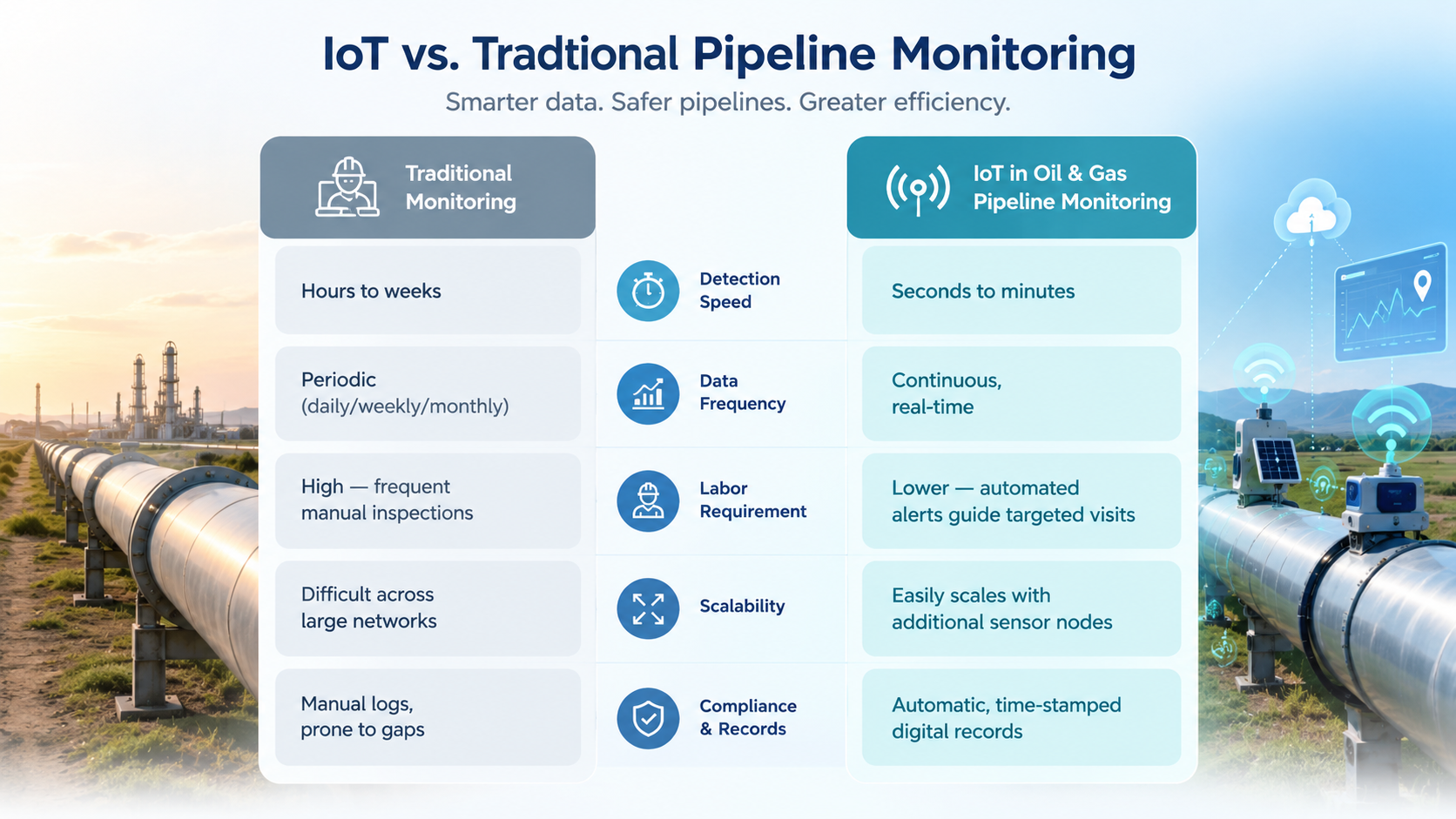
IoT vs. Traditional Pipeline Monitoring: A Side-by-Side Comparison
| Factor | Traditional Monitoring | IoT in Oil and Gas Pipeline Monitoring |
|---|---|---|
| Detection speed | Hours to weeks | Seconds to minutes |
| Data frequency | Periodic (daily/weekly/monthly) | Continuous, real-time |
| Labor requirement | High — frequent manual inspections | Lower — automated alerts guide targeted visits |
| Scalability | Difficult across large networks | Easily scales with additional sensor nodes |
| Predictive capability | Minimal | Strong, via trend analysis and machine learning |
| Compliance documentation | Manual logs, prone to gaps | Automatic, time-stamped digital records |
 The Future of IoT in Oil and Gas Pipeline Monitoring
Looking ahead, several trends are shaping where this technology goes next:
- AI-driven anomaly detection will keep reducing false positives, making alerts more trustworthy and actionable.
- Digital twins — virtual replicas of pipeline networks fed by live IoT data — will let engineers simulate failure scenarios before they happen in the real world.
- Satellite-IoT convergence will close the last connectivity gaps in the most remote pipeline corridors.
- Edge computing will push more analysis onto the sensor itself, cutting the time between detection and alert even further.
- Tighter regulatory expectations will likely make continuous monitoring a baseline requirement rather than a competitive advantage, pushing adoption of IoT in oil and gas pipeline monitoring across the entire industry, not just among early movers.
Conclusion
IoT in oil and gas pipeline monitoring has moved from an experimental upgrade to an operational necessity. It replaces slow, manual, calendar-based inspection with continuous, condition-based visibility — catching leaks faster, predicting equipment failures before they happen, and generating the documentation regulators now expect. The operators who invest in this shift today are the ones best positioned to reduce risk, control costs, and keep their networks running safely for decades to come.
If your organization is still relying on scheduled walk-downs and periodic SCADA snapshots, now is the time to evaluate how IoT sensors can close critical pipeline monitoring gaps. Aeologic Technologies can help you explore IoT-enabled monitoring solutions, starting with your highest-risk pipeline segment and expanding from there.
FAQs
Q1. What is IoT in oil and gas pipeline monitoring?
It’s the use of networked sensors, wireless connectivity, and cloud analytics to continuously track a pipeline’s pressure, flow, temperature, and structural condition. Instead of waiting for a scheduled inspection, operators get real-time alerts the moment a reading moves outside a safe range, enabling a much faster response to leaks or equipment issues.
Q2. How does IoT improve pipeline leak detection?
IoT sensors — acoustic, fiber-optic, and pressure-based — continuously scan the pipeline for the subtle signs a leak produces, such as a pressure drop or unusual vibration. Because the data streams in real time, alerts reach operations teams within minutes, far faster than a manual patrol could catch the same event.
Q3. What sensors are commonly used in IoT pipeline monitoring?
Common sensor types include pressure transducers, flow meters, acoustic leak detectors, fiber-optic distributed sensing cables, corrosion and wall-thickness sensors, and vibration sensors near compressor stations. Each targets a different failure mode, and most robust systems combine several sensor types for redundancy.
Q4. Is IoT pipeline monitoring expensive to implement?
Upfront hardware, installation, and connectivity costs can be significant, especially across long pipeline networks. Most operators manage this by starting with a phased rollout on their highest-risk segments first, then expanding coverage as the system proves its value in reduced losses and avoided downtime.
Q5. How does IoT improve pipeline safety?
By shortening the time between a problem occurring and a team being alerted, IoT reduces the window in which a small issue can escalate into a major incident. Continuous monitoring also means safety-critical readings are never missed simply because an inspection schedule hasn’t come around yet.
Q6. What’s the difference between SCADA and IoT pipeline monitoring?
SCADA is the control system operators have long used to monitor and manage pipeline operations, typically from a limited number of fixed stations. IoT in oil and gas pipeline monitoring adds a much denser layer of field sensors that feed SCADA richer, more frequent data rather than replacing it outright.
Q7. Can IoT predict pipeline failures before they happen?
Yes. By analyzing trends in vibration, temperature, and corrosion data over time, machine learning models can flag equipment that’s likely to fail weeks in advance. This predictive maintenance approach lets teams schedule repairs proactively instead of responding to emergencies.
Q8. What connectivity options work best for remote pipelines?
Low-power wide-area networks (LoRaWAN, NB-IoT) are popular for their long range and battery efficiency, while satellite connectivity fills gaps where no terrestrial network exists, such as offshore or desert routes. Many operators combine both for full-route coverage.

I’m a Software Developer with 9 years of experience building scalable web and mobile applications. Currently focused on React.js and React Native, I specialize in creating high-performance, user-friendly interfaces that drive business outcomes.
My background spans cross-platform development using Flutter, and native Android development, giving me a strong understanding of the entire mobile ecosystem. I’ve contributed to products in EdTech, Healthcare, and Enterprise SaaS—helping scale apps to 100K+ users and improving performance, reliability, and user engagement.
I’m passionate about clean architecture, modular design, and seamless user experiences. Whether it’s setting up robust state management with Redux Toolkit, optimizing API integrations with GraphQL/REST, or automating workflows with CI/CD pipelines (GitHub Actions)—I focus on writing maintainable code and delivering value to both users and stakeholders.