
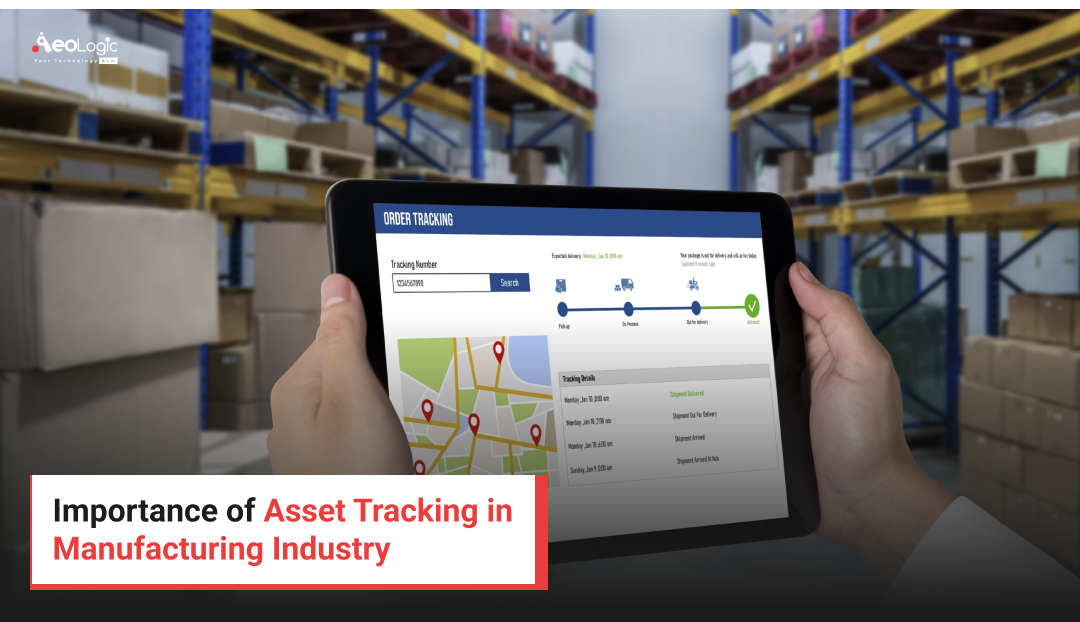
Walk onto almost any plant floor today and you’ll see the same quiet problem playing out: a maintenance technician scrolling through a spreadsheet trying to figure out which forklift is due for service, or a supervisor walking the length of a warehouse looking for a tool cart that was “somewhere over there” last week. These small frustrations add up fast, and they’re a big reason why asset tracking in manufacturing industry operations has moved from a nice-to-have to a genuine competitive necessity.
Manufacturers run on physical assets — machinery, tools, vehicles, molds, sensors, safety equipment, and raw material stock. When a company can’t answer basic questions like “where is this asset, what condition is it in, and when was it last serviced,” the costs show up everywhere: in unplanned downtime, wasted labor hours, duplicate purchases, failed audits, and safety incidents. That’s exactly the gap that asset tracking in manufacturing industry practices are designed to close.
This guide breaks down what asset tracking actually means on a factory floor, why it matters more now than it did a decade ago, the technologies manufacturers use to do it well, and the practical steps to get started — without needing a six-figure software budget to see results.
What is Asset Tracking in Manufacturing Industry?
In simple terms, asset tracking in manufacturing industry refers to the process of monitoring the location, condition, usage, and maintenance history of physical assets throughout a production facility — from heavy machinery and conveyor systems to hand tools, molds, pallets, vehicles, and safety equipment.
- Where is this asset right now?
- What condition is it in, and when does it need maintenance?
- Who is using it, and for how long?
Asset tracking typically covers several categories of equipment:
| Asset Category | Examples |
|---|---|
| Production machinery | CNC machines, injection molding presses, assembly robots |
| Material handling equipment | Forklifts, pallet jacks, conveyors |
| Tools and fixtures | Hand tools, jigs, molds, calibration equipment |
| Vehicles | Delivery trucks, yard trucks, service vans |
| Safety equipment | Fire extinguishers, PPE stations, emergency shutoffs |
| IT and facility assets | Servers, HVAC units, generators |
 Why Asset Tracking in Manufacturing Industry Matters More Than Ever
A decade ago, many plants got by with manual logs and institutional knowledge — the senior technician who “just knew” where everything was. That approach doesn’t scale, and it breaks down completely the moment that employee retires, calls in sick, or moves to another facility.
Today, the role of asset tracking in manufacturing industry operations has shifted for a few clear reasons:
- Supply chains are tighter. A single missing or broken piece of equipment can stall an entire production line with little buffer to absorb the delay.
- Labor is harder to replace. Losing institutional knowledge about where equipment lives and how it’s maintained is a bigger risk when skilled workers are difficult to hire.
- Compliance expectations are higher. Regulators and customers increasingly expect documented maintenance histories, calibration records, and safety inspections.
- Capital equipment costs more. With machinery and tooling costing more to replace, protecting and extending the life of existing assets has a direct bottom-line impact.
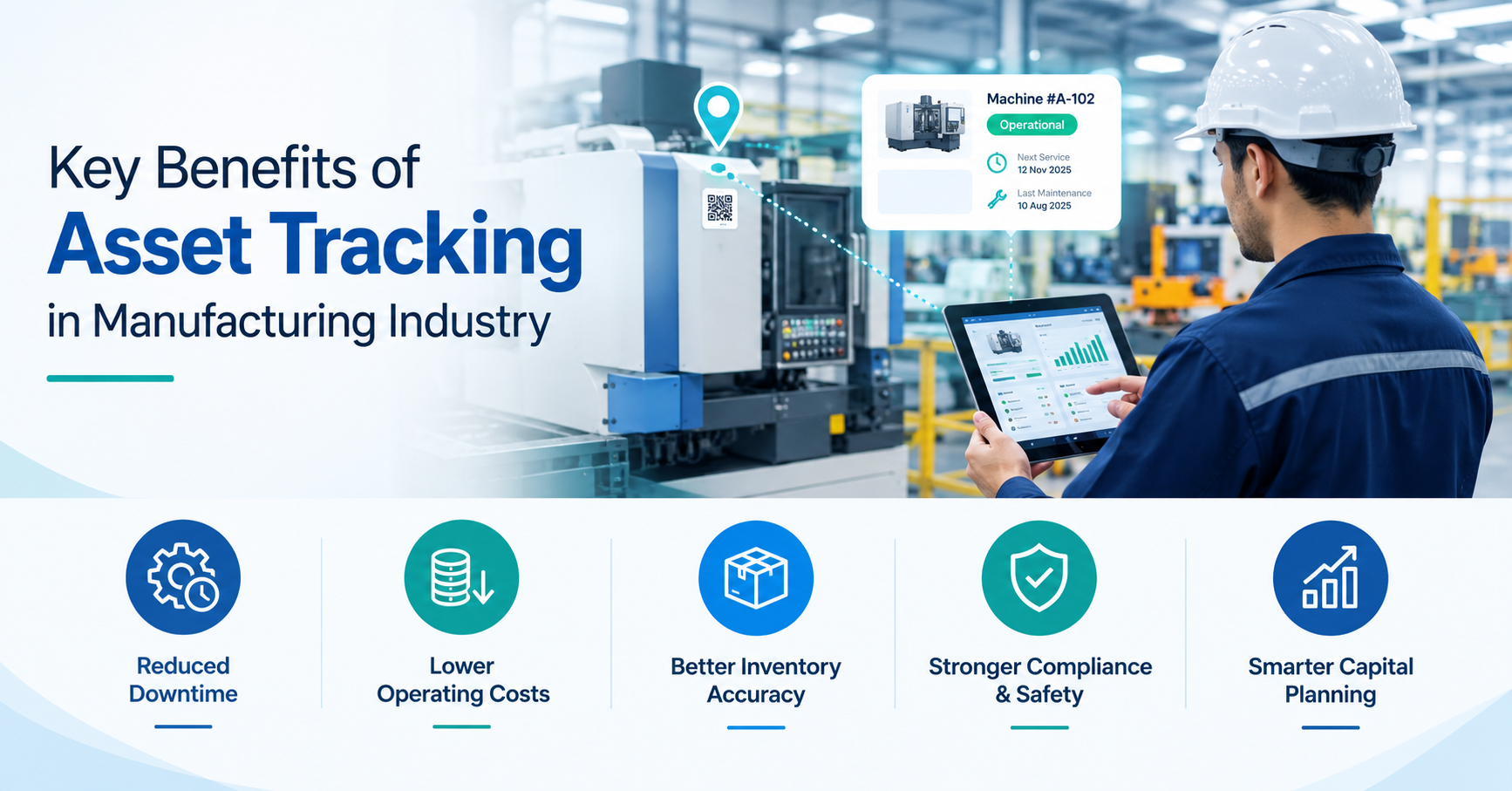
Key Benefits of Asset Tracking in Manufacturing Industry
The benefits of asset tracking in manufacturing industry extend well beyond simply knowing where things are. Done well, it touches nearly every operational metric a plant manager cares about.
Reduced Equipment Downtime
Unplanned downtime is one of the costliest problems in manufacturing. When assets are tracked with maintenance schedules attached, teams can shift from reactive repairs (fixing things after they break) to preventive maintenance (servicing equipment before failure). Knowing exactly which machine is due for service — and having its full maintenance history on hand — shortens repair times and reduces the frequency of surprise breakdowns.
Lower Maintenance and Operating Costs
When maintenance is scheduled based on actual usage and condition data rather than guesswork, companies avoid both extremes: over-maintaining equipment that doesn’t need it, and under-maintaining equipment that’s quietly heading toward failure. Over time, this discipline reduces parts spend, labor hours, and emergency service calls.
Improved Inventory and Spare Parts Accuracy
Asset tracking isn’t limited to big machinery — it extends to tools, fixtures, and spare parts inventory. Accurate records prevent duplicate purchases (buying a replacement tool that was actually just misplaced) and reduce the time technicians spend searching for the right part during a repair.
Stronger Regulatory Compliance and Safety
Many manufacturing sectors — food and beverage, pharmaceuticals, aerospace, automotive — require documented proof of equipment calibration, inspection, and maintenance for audits and certifications.
Smarter Capital Planning and ROI
When a company can see the full usage and repair history of each asset, it becomes much easier to decide when to repair versus replace. This data-driven approach to capital planning helps finance and operations teams justify equipment budgets with evidence instead of instinct.
 Core Technologies Powering Asset Tracking in Manufacturing Industry
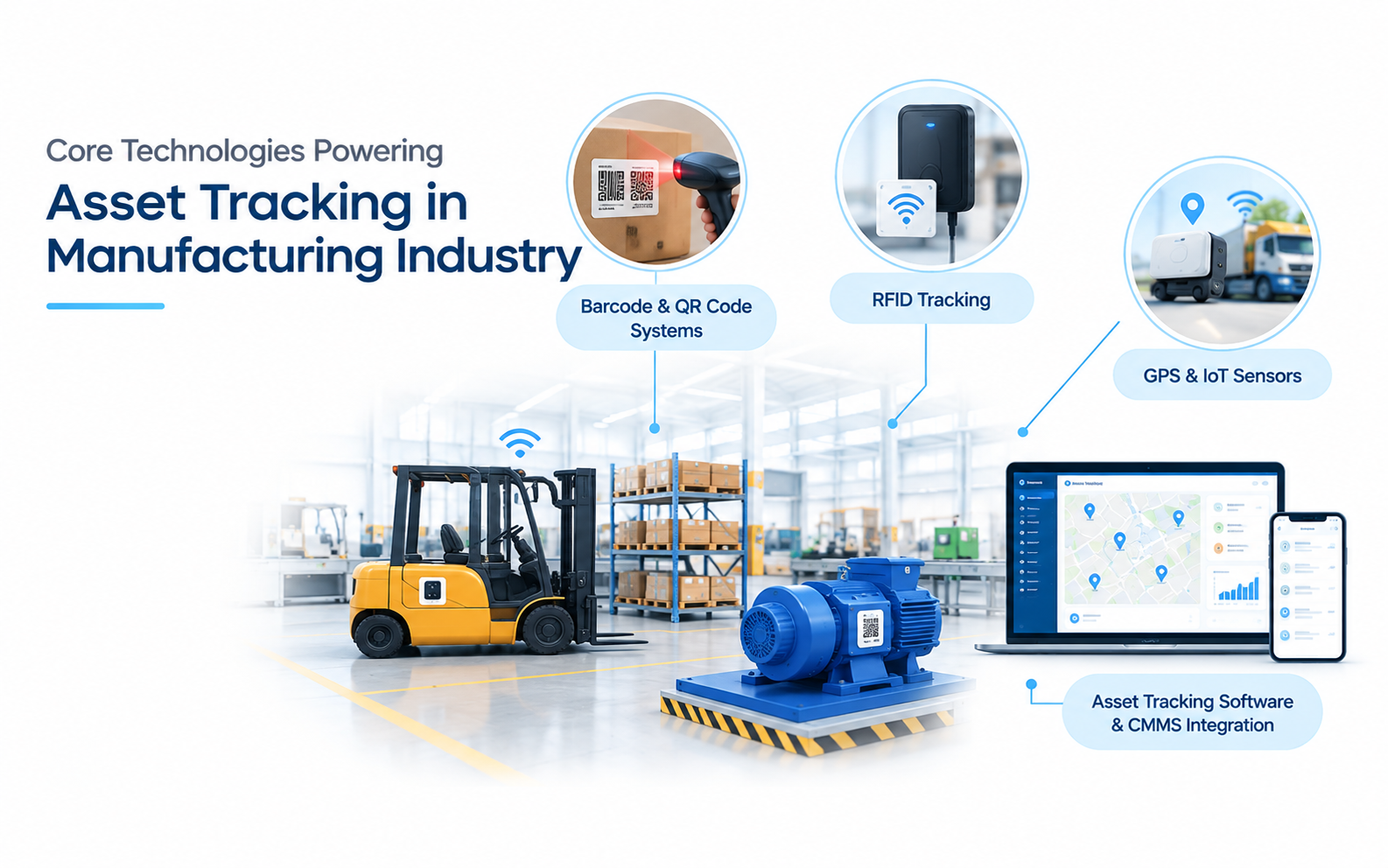
Modern asset tracking in manufacturing industry solutions rely on a mix of identification hardware and software. Most facilities combine more than one of the following, depending on asset value, movement frequency, and environment.
Barcode and QR Code Systems
The most affordable entry point. A printed barcode or QR code is attached to an asset, and workers scan it with a phone or handheld scanner to log location, condition, or usage. It’s low-cost and easy to roll out, though it requires a manual scan at each checkpoint.
RFID Tracking
Radio-frequency identification (RFID) tags can be read automatically as assets pass through a reader’s range, without a direct line of sight or manual scan. This makes RFID well suited for high-volume environments like tool cribs, warehouses, and loading docks where manual scanning would be too slow.
GPS and IoT Sensors
For mobile, high-value assets like forklifts, service vehicles, or yard equipment, GPS and IoT sensors provide continuous real-time location data, along with condition metrics like temperature, vibration, or run-hours — useful for both security and predictive maintenance.
Asset Tracking Software and CMMS Integration
The hardware only matters if the data goes somewhere useful. Asset tracking software — often integrated with a Computerized Maintenance Management System (CMMS) — centralizes location data, maintenance schedules, repair history, and depreciation records into a single dashboard that managers and technicians can access from the floor or office.
 Common Challenges in Implementing Asset Tracking in Manufacturing Industry
No system is plug-and-play. Manufacturers commonly run into a few recurring obstacles:
- Upfront cost and tagging labor. Tagging thousands of existing assets takes real time, even if the per-tag cost is low.
- Inconsistent employee adoption. A tracking system only works if workers actually scan and log activity; without buy-in, data quality suffers fast.
- Harsh environments. Heat, dust, moisture, and vibration can damage tags or interfere with RFID and sensor readings.
- Integration with legacy systems. Older ERP or inventory platforms may not connect cleanly with newer tracking software, requiring middleware or manual workarounds.
- Data without action. Collecting tracking data is only valuable if maintenance teams actually use it to change schedules and workflows — dashboards that nobody checks don’t move the needle.
Best Practices for Successful Asset Tracking in Manufacturing Industry
- Start with a pilot area. Tag and track one production line or asset category first, prove the value, then expand rather than tagging an entire facility on day one.
- Prioritize high-value and high-risk assets. Begin with equipment that’s expensive to replace, critical to production, or subject to compliance requirements.
- Choose technology that matches the environment. RFID for high-traffic zones, barcodes for lower-cost or infrequently moved items, GPS for mobile equipment.
- Build scanning into existing workflows. If logging an asset requires an extra, separate step, adoption will suffer — integrate it into checkout, maintenance, and shift-change routines.
- Review the data on a set schedule. A weekly or monthly review of maintenance alerts and utilization reports keeps the system driving decisions instead of sitting idle.
- Train frontline staff, not just managers. The technicians and operators using the system daily need to understand why it matters, not just how to scan a tag.
Real-World Use Cases
- Preventive maintenance scheduling: A plant uses run-hour data from tagged machinery to trigger service alerts automatically, instead of relying on a wall calendar.
- Tool crib management: RFID-tagged tools are checked in and out automatically as they pass through crib doorways, cutting time spent searching for missing tools.
- Fleet and yard management: GPS-tagged forklifts and yard trucks let supervisors locate equipment instantly across a large facility or multi-building campus.
- Audit readiness: Calibration and inspection records tied to each asset’s tag make it possible to pull a complete compliance history in minutes rather than days.
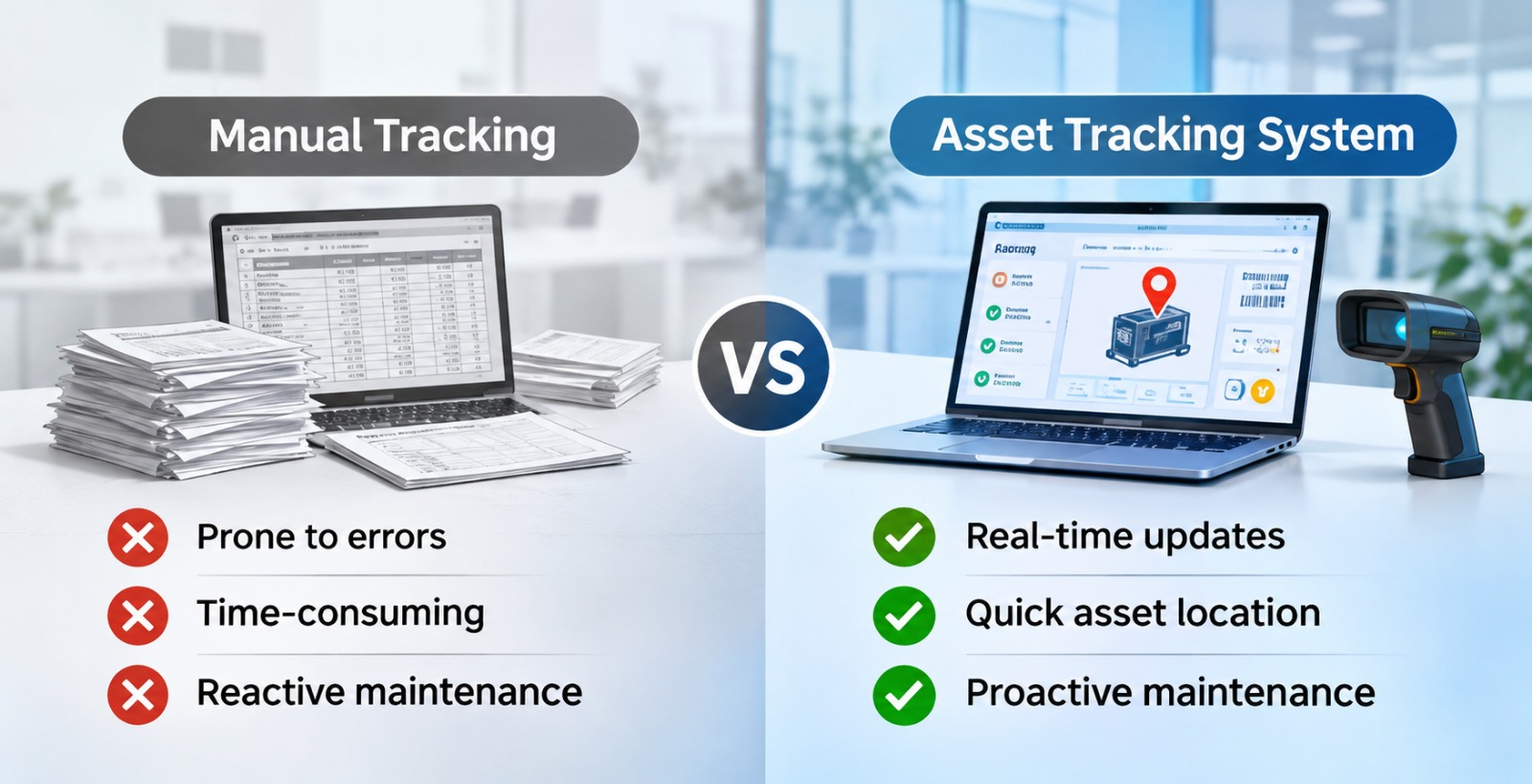
Asset Tracking vs. Traditional Manual Tracking Methods
| Factor | Manual Tracking (Spreadsheets/Paper) | Modern Asset Tracking System |
|---|---|---|
| Accuracy | Prone to human error and outdated entries | Updated in real time as assets move |
| Time to locate an asset | Minutes to hours | Seconds to minutes |
| Maintenance scheduling | Reactive, based on memory | Proactive, based on usage data |
| Audit readiness | Manual compilation, time-consuming | Records generated on demand |
| Scalability | Breaks down as asset count grows | Scales with tags and software, not headcount |
| Upfront investment | Minimal | Moderate, with long-term savings |
 Conclusion
The plants that run most predictably aren’t the ones with the newest machines — they’re the ones that know, at any moment, where every asset is, what shape it’s in, and when it’s due for service. That’s the real value of asset tracking in manufacturing industry operations: it turns scattered, tribal knowledge into data every shift can act on, cutting downtime, trimming maintenance spend, and keeping compliance audits stress-free.
You don’t need to tag an entire facility on day one. The return shows up quickly through fewer unexpected breakdowns and less time spent searching for equipment. Aeologic Technologies helps businesses explore smarter asset tracking approaches to improve visibility and operational efficiency.
Frequently Asked Questions
Q1. How does asset tracking reduce downtime in a factory?
Asset tracking links each machine to its maintenance history and usage data, so teams can schedule service before a failure happens instead of reacting after a breakdown. This shift from reactive to preventive maintenance shortens repair windows and keeps production lines running longer between stops.
Q2. What’s the difference between asset tracking and inventory management?
Asset tracking focuses on physical equipment — its location, condition, and maintenance history — while inventory management focuses on consumable stock like raw materials and components. Many manufacturers use both together, since tools and spare parts often sit at the overlap of the two systems.
Q3. Is RFID or barcode tracking better for manufacturing?
It depends on volume and environment. Barcodes are cheaper and simple to deploy but need a manual scan each time. RFID costs more per tag but reads automatically without line of sight, which makes it a better fit for high-traffic areas like tool cribs or loading docks.
Q4. How much does an asset tracking system cost?
Costs vary widely based on tag type, asset count, and software features, ranging from low-cost barcode setups for a single production line to larger RFID or IoT deployments across an entire facility. Most manufacturers start with a pilot area to estimate cost before scaling company-wide.
Q5. Can small manufacturers benefit from asset tracking, or is it only for large plants?
Small and mid-sized manufacturers often see faster returns, since even a handful of lost tools or missed maintenance windows represents a larger share of total output. Barcode-based systems in particular offer a low-cost starting point that doesn’t require large capital investment.
Q6. How does asset tracking support regulatory compliance?
A tracking system keeps a timestamped record of inspections, calibrations, and repairs attached to each asset, so compliance teams can produce documentation on demand during an audit instead of searching through paper files or disconnected spreadsheets.

I’m a Software Developer with 9 years of experience building scalable web and mobile applications. Currently focused on React.js and React Native, I specialize in creating high-performance, user-friendly interfaces that drive business outcomes.
My background spans cross-platform development using Flutter, and native Android development, giving me a strong understanding of the entire mobile ecosystem. I’ve contributed to products in EdTech, Healthcare, and Enterprise SaaS—helping scale apps to 100K+ users and improving performance, reliability, and user engagement.
I’m passionate about clean architecture, modular design, and seamless user experiences. Whether it’s setting up robust state management with Redux Toolkit, optimizing API integrations with GraphQL/REST, or automating workflows with CI/CD pipelines (GitHub Actions)—I focus on writing maintainable code and delivering value to both users and stakeholders.