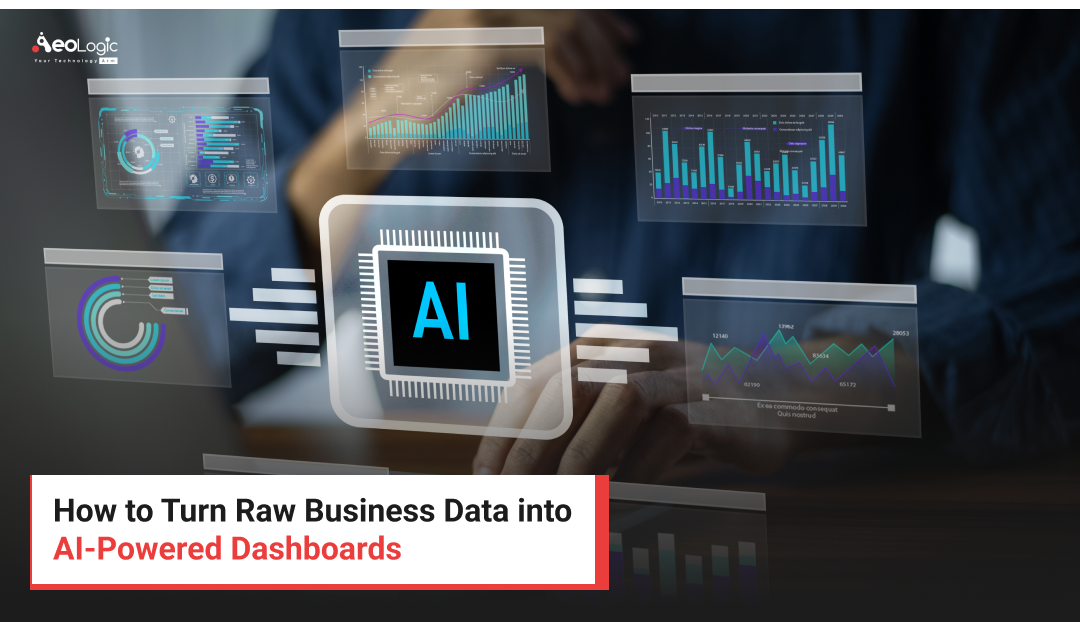
Businesses generate enormous amounts of data every day, from customer interactions and sales transactions to operational metrics and financial records. However, raw data alone has little value unless it can be transformed into meaningful insights that support better decision-making. This is where AI-Powered Dashboards are changing the way organizations analyze and utilize information.
Unlike traditional dashboards that simply display charts and reports, AI-powered dashboards use artificial intelligence, machine learning, and predictive analytics to identify trends, detect anomalies, forecast outcomes, and recommend actions. They enable organizations to move beyond reactive reporting and embrace data-driven strategies that improve efficiency, productivity, and business growth.
This article explores how businesses can transform scattered raw data into intelligent dashboards, the technologies involved, implementation strategies, common challenges, and the future of AI-powered business intelligence.
Understanding Raw Business Data
Every organization collects data from multiple sources, including CRM platforms, ERP systems, accounting software, e-commerce platforms, IoT devices, HR systems, cloud applications, and customer support channels. While these systems generate valuable information, the data often remains isolated in different databases and formats.
Raw business data is typically unstructured, inconsistent, or incomplete. Duplicate records, missing values, inconsistent naming conventions, and outdated information make it difficult for organizations to gain meaningful insights. Without proper processing, even large volumes of business data fail to deliver strategic value.
The journey toward AI-Powered Dashboards begins by converting this fragmented information into a structured, reliable, and centralized data foundation.
Why traditional dashboards are no longer enough?
Traditional dashboards have long helped organizations monitor KPIs, generate reports, and visualize historical data. While useful, they often require users to manually interpret charts and identify patterns.
Modern businesses need far more than descriptive analytics. Decision-makers require dashboards that not only explain what has happened but also predict what is likely to happen next and recommend the best course of action.
The Shift from Reporting to Intelligence
Artificial intelligence introduces a new level of intelligence into business dashboards by continuously learning from historical and real-time data. Instead of waiting for analysts to discover trends manually, AI algorithms automatically identify opportunities, risks, and unusual business activities.
For example, rather than simply displaying declining sales figures, an AI-powered dashboard can identify the products responsible for the decline, determine contributing factors, predict future sales performance, and recommend corrective actions.
This evolution significantly reduces the time between identifying a business problem and taking action.
Building the Foundation for AI-Powered Dashboards
Creating intelligent dashboards requires more than simply connecting data sources. It involves establishing a robust data infrastructure capable of supporting advanced analytics and machine learning.
Collecting Data from Multiple Business Systems
The first step involves gathering information from every critical business application. Customer data, financial transactions, inventory records, marketing analytics, manufacturing systems, and operational databases all contribute valuable insights.
Modern integration tools and APIs make it possible to consolidate information from cloud-based and on-premises systems into a unified environment.
By bringing all business information together, organizations eliminate data silos and create a single source of truth for decision-making.
Cleaning and Preparing Data
Artificial intelligence performs best when trained on accurate and reliable information. Before any dashboard is developed, businesses must clean and standardize their datasets.
Data preparation includes removing duplicate records, correcting formatting inconsistencies, handling missing values, validating records, and transforming data into standardized formats suitable for analysis.
High-quality data directly influences the accuracy of AI-generated insights, predictions, and recommendations.
Creating a Centralized Data Repository
After cleaning the data, organizations typically store it in a centralized data warehouse or data lake. This repository enables AI models to access historical and real-time information efficiently while supporting scalable analytics across departments.
Centralized storage also improves governance, compliance, and security by providing consistent access controls and data management policies.
How Artificial Intelligence Transforms Business Dashboards
The true strength of AI-Powered Dashboards lies in their ability to interpret information rather than simply display it. Artificial intelligence continuously analyzes incoming data, learns business patterns, and delivers meaningful recommendations.
Predictive Analytics
Machine learning models analyze historical business trends to forecast future outcomes.
Sales forecasts, inventory demand, customer churn predictions, workforce planning, and revenue projections become significantly more accurate when powered by AI. Instead of reacting after problems occur, organizations can prepare in advance.
Automated Anomaly Detection
AI continuously monitors business metrics and identifies unusual patterns that may indicate operational issues, fraud, system failures, or unexpected market changes.
Rather than manually reviewing thousands of reports, managers receive instant alerts whenever significant deviations occur.
This proactive monitoring helps organizations reduce financial losses and improve operational stability.
Intelligent Recommendations
Modern dashboards go beyond visualization by providing actionable recommendations.
For example, an AI dashboard may recommend increasing inventory for high-demand products, reallocating marketing budgets toward better-performing campaigns, or identifying customers most likely to respond to promotional offers.
These recommendations accelerate decision-making while reducing dependency on manual analysis.
Natural Language Queries
One of the most valuable advancements in AI dashboards is natural language interaction.
Instead of creating complex filters or writing SQL queries, business users can simply ask questions such as:
“What were last month’s highest-performing products?”
“Which region generated the highest profit margin?”
“Predict next quarter’s revenue.”
The dashboard interprets the request and generates meaningful visualizations instantly, making advanced analytics accessible to non-technical users.
 Choosing the Right Data Visualization Strategy
Even the most sophisticated AI algorithms lose value if presented through confusing visualizations.
Effective dashboards prioritize clarity, simplicity, and business relevance.
Designing Around Business Goals
Every dashboard should focus on measurable business objectives rather than displaying excessive metrics.
Executive dashboards may emphasize revenue growth, profitability, customer acquisition, and operational performance, while operational teams may require production efficiency, delivery timelines, and resource utilization.
Aligning dashboard design with organizational goals ensures users receive actionable insights instead of overwhelming amounts of information.
Prioritizing Real-Time Insights
Businesses increasingly rely on real-time information to respond quickly to changing market conditions.
AI-powered dashboards continuously refresh data, allowing organizations to monitor operations as events occur rather than relying on delayed reports.
Real-time visibility improves customer service, operational efficiency, and strategic planning.
Integrating Machine Learning into Dashboard Workflows
Machine learning enhances dashboards by identifying patterns that traditional reporting tools cannot detect.
Models continuously improve as they process additional business data, making predictions increasingly accurate over time.
Organizations commonly integrate machine learning for demand forecasting, customer segmentation, fraud detection, predictive maintenance, pricing optimization, and financial forecasting.
As business conditions evolve, AI models automatically adapt without requiring constant manual adjustments.
Ensuring Data Security and Governance
Business dashboards often contain sensitive financial information, customer records, employee details, and confidential operational data.
Implementing strong governance policies is essential for maintaining trust and regulatory compliance.
Role-based access controls ensure employees only view relevant information. Encryption protects data during storage and transmission, while audit logs monitor user activity across dashboard environments.
Organizations should also establish data quality standards to ensure AI models continue generating reliable insights.
Common Challenges When Building AI-Powered Dashboards
Although AI dashboards deliver significant business value, organizations frequently encounter implementation challenges.
Poor data quality remains one of the biggest obstacles, as inaccurate information directly affects AI predictions. Legacy systems often lack modern integration capabilities, making data consolidation more complex.
Many organizations also face shortages of AI specialists, data engineers, and business analysts capable of designing intelligent analytics solutions.
Employee adoption presents another challenge. Teams accustomed to traditional reporting may require training to fully utilize AI-generated recommendations and predictive analytics.
Successfully addressing these challenges requires strong leadership, effective change management, and ongoing investment in data maturity.
Best Practices for Successful AI Dashboard Implementation
Organizations achieve the best results by beginning with clearly defined business objectives rather than focusing solely on technology.
Establishing a strong data governance framework, maintaining high-quality datasets, and selecting scalable cloud platforms provide a reliable foundation for long-term success.
Businesses should continuously monitor AI model performance, update algorithms with new data, and gather user feedback to improve dashboard usability.
Cross-functional collaboration between business leaders, IT teams, and data professionals also ensures dashboards remain aligned with evolving organizational goals.
Future Trends in AI-Powered Dashboards
Artificial intelligence continues to reshape business intelligence platforms at an unprecedented pace.
Future dashboards will become increasingly conversational, allowing users to interact through voice commands and AI assistants. Generative AI will automatically summarize complex reports, explain trends in natural language, and generate executive insights without requiring manual interpretation.
Advanced predictive analytics will evolve into prescriptive analytics, enabling dashboards to recommend optimal business decisions based on multiple scenarios.
Digital twins, IoT integration, edge computing, and autonomous AI agents will further expand dashboard capabilities by providing real-time visibility across physical and digital business environments.
As organizations continue investing in AI, dashboards will transform from reporting tools into intelligent decision-support platforms that actively guide business strategy.
Conclusion
Transforming raw business information into AI-Powered Dashboards is no longer a competitive advantage—it has become a business necessity. By integrating data from multiple sources, improving data quality, leveraging artificial intelligence, and designing dashboards around business objectives, organizations can unlock insights that drive faster and more informed decisions.
Modern AI-powered dashboards empower businesses to predict future outcomes, detect operational risks, automate analysis, and provide actionable recommendations that improve efficiency across every department. As artificial intelligence continues to advance, organizations that embrace intelligent dashboard solutions will be better equipped to respond to market changes, optimize operations, and achieve sustainable growth in an increasingly data-driven world. Businesses looking to accelerate their digital transformation can partner with Aeologic Technologies to build customized AI-powered dashboard solutions that turn complex data into actionable business intelligence.
Frequently Asked Questions
Q1. What are AI-Powered Dashboards?
AI-Powered Dashboards are intelligent business dashboards that use artificial intelligence, machine learning, and predictive analytics to transform raw business data into actionable insights. They help organizations monitor KPIs, identify trends, forecast outcomes, and make data-driven decisions in real time.
Q2. How do AI-Powered Dashboards differ from traditional dashboards?
Traditional dashboards primarily display historical data through charts and graphs, while AI-Powered Dashboards go a step further by analyzing data, detecting anomalies, predicting future trends, and providing actionable recommendations. This enables businesses to make faster and more informed decisions.
Q3. What types of business data can be used in AI-Powered Dashboards?
AI-Powered Dashboards can integrate data from multiple sources, including CRM systems, ERP software, financial applications, marketing platforms, IoT devices, customer support tools, HR systems, and cloud databases. Combining these data sources provides a comprehensive view of business performance.
Q4. What are the key benefits of implementing AI-Powered Dashboards?
AI-Powered Dashboards improve decision-making by delivering real-time insights, automating data analysis, identifying hidden trends, forecasting business outcomes, and reducing manual reporting efforts. They also help organizations improve operational efficiency, enhance customer experiences, and support strategic planning.
Q5. Which industries benefit the most from AI-Powered Dashboards?
AI-Powered Dashboards are widely used across industries such as healthcare, manufacturing, retail, logistics, finance, banking, telecommunications, education, and government. Any organization that relies on large volumes of business data can leverage AI-powered dashboards to improve performance and gain a competitive advantage.

Manoj Kumar is a seasoned Digital Marketing Manager and passionate Tech Blogger with deep expertise in SEO, AI trends, and emerging digital technologies. He writes about innovative solutions that drive growth and transformation across industry.
Featured on – YOURSTORY | TECHSLING | ELEARNINGINDUSTRY | DATASCIENCECENTRAL | TIMESOFINDIA | MEDIUM | DATAFLOQ