For years, “AI in the enterprise” mostly meant smarter search, better forecasts, or a chatbot bolted onto a help desk. That era is ending. A new category of software is now reshaping how large organizations run their day-to-day operations, and it goes by a specific name: agentic AI. Agentic AI in enterprise platforms doesn’t just answer questions or summarize documents — it plans multi-step work, calls on other systems, makes decisions within set boundaries, and follows through until a task is actually done.
This shift matters because it changes what software is for. Traditional enterprise platforms were built to store data and enforce process. Agentic AI in enterprise platforms is built to act on that data and move the process forward on its own, with a person checking in rather than clicking through every step. In this guide, we’ll look at what agentic AI actually means, how it differs from generative AI and traditional automation, where it’s already delivering value, and what it takes to adopt it responsibly.
What is Agentic AI in Enterprise Platforms?
Agentic AI in enterprise platforms refers to AI systems embedded in business software that can independently plan, decide, and execute multi-step tasks across tools and data sources, with minimal human prompting at each step. Instead of waiting for an instruction for every action, an agentic system is given a goal — “resolve this customer ticket,” “reconcile this invoice,” “shortlist candidates for this role” — and it figures out the sequence of steps needed to get there, using the tools and permissions it has been granted.
The word “agentic” comes from “agency”: the capacity to act on behalf of someone, within limits, toward an outcome. Applied to enterprise software, that means the AI isn’t just generating content or predicting a number. It’s taking actions — opening a record, querying a database, sending an approval request, updating a system of record — and adjusting its next move based on what happens.
Agentic AI vs Traditional Automation vs Generative AI
It helps to separate three terms that often get blurred together:
| Capability | Traditional Automation (RPA) | Generative AI / Copilots | Agentic AI in Enterprise Platforms |
|---|---|---|---|
| How it works | Follows fixed, pre-scripted rules | Generates text, code, or images from a prompt | Plans steps, chooses tools, and acts toward a goal |
| Handles change | Breaks when the process changes | Needs a new prompt for each new task | Adapts its plan as conditions change |
| Decision-making | None — purely rule-based | Suggests; a human decides and acts | Can decide and act within defined limits |
| Best fit | Stable, repetitive, rule-based tasks | Drafting, summarizing, answering questions | Multi-step workflows that span several systems |
Generative AI is good at producing a draft. Robotic process automation (RPA) is good at repeating a fixed click-path. Agentic AI in enterprise platforms sits above both: it can call a generative model to draft something, trigger an automation to execute a step, and decide what should happen next — all inside one workflow.
 Why Agentic AI in Enterprise Platforms Matters Now
The Shift From Copilots to Autonomous Agents
The first wave of enterprise AI, roughly 2023 to 2025, was dominated by copilots: AI assistants that sat beside an employee and helped them write, summarize, or search faster. Copilots were useful, but they still required a human to drive every interaction. The current wave is different. Enterprise software vendors across CRM, ERP, ITSM, and HR systems are now shipping agents that can be delegated entire workflows, not just single questions. That’s the practical meaning of agentic AI in enterprise platforms: less “ask and receive,” more “assign and verify.”
Market and Adoption Signals
Several forces are pushing this shift at once. Enterprises are under constant pressure to do more with flat or shrinking headcount. Large language models have become reliable enough at reasoning and tool use to be trusted with bounded, lower-risk decisions. And the enterprise software vendors themselves — the companies that already sit inside CRM, ERP, and service-desk workflows — have a strong incentive to add agentic capabilities, because that’s where the next wave of platform spend is heading. The result is that agentic AI in enterprise platforms is moving from pilot projects to default features inside the tools teams already use.
Core Capabilities That Power Agentic AI in Enterprise Platforms
Not every AI feature labeled “agent” deserves the name. True agentic AI in enterprise platforms tends to share four capabilities:
Planning and Goal Decomposition
Given a broad goal, the system breaks it into an ordered set of sub-tasks — check inventory, then confirm pricing, then draft the quote, then route for approval — and adjusts that plan as new information arrives.
Tool Use and System Integration
An agent is only as useful as what it can touch. Agentic AI in enterprise platforms connects to CRMs, ERPs, ticketing systems, data warehouses, and APIs, and calls on them the way a human employee would use different apps to finish a job.
Memory and Context Retention
Rather than starting fresh each time, agents retain relevant context — a customer’s history, a project’s prior decisions, a vendor’s contract terms — so their actions stay consistent across a multi-step or multi-day task.
Multi-Agent Orchestration
Complex workflows often involve several specialized agents working together — one handling data retrieval, another handling drafting, another handling approvals — coordinated by an orchestration layer that assigns work and resolves conflicts between them.
Real-World Use Cases of Agentic AI in Enterprise Platforms
Customer Support and Service Operations
Agentic AI in enterprise platforms can triage an incoming ticket, pull the customer’s order history, issue a refund within a pre-approved limit, and close the loop with a written response — escalating to a human only when the case falls outside its boundaries.
IT Operations and DevOps
In IT service management, agents can detect an anomaly, correlate it with recent deployments, open an incident, and in some cases roll back a change automatically, cutting the time between detection and resolution.
Finance and Procurement Workflows
Invoice matching, purchase order reconciliation, and vendor onboarding involve many small, rule-governed steps that agentic systems can execute end to end, flagging only the exceptions that need a human judgment call.
Human Resources and Talent Management
From screening applications against a role’s requirements to scheduling interviews across multiple calendars, agentic AI in enterprise platforms removes much of the manual coordination that slows down hiring and onboarding.
Sales and Revenue Operations
Agents can research a prospect, draft a tailored outreach sequence, update the CRM after each interaction, and flag deals that show risk signals — keeping pipeline data accurate without a rep manually logging every touchpoint.
Key Benefits of Agentic AI in Enterprise Platforms
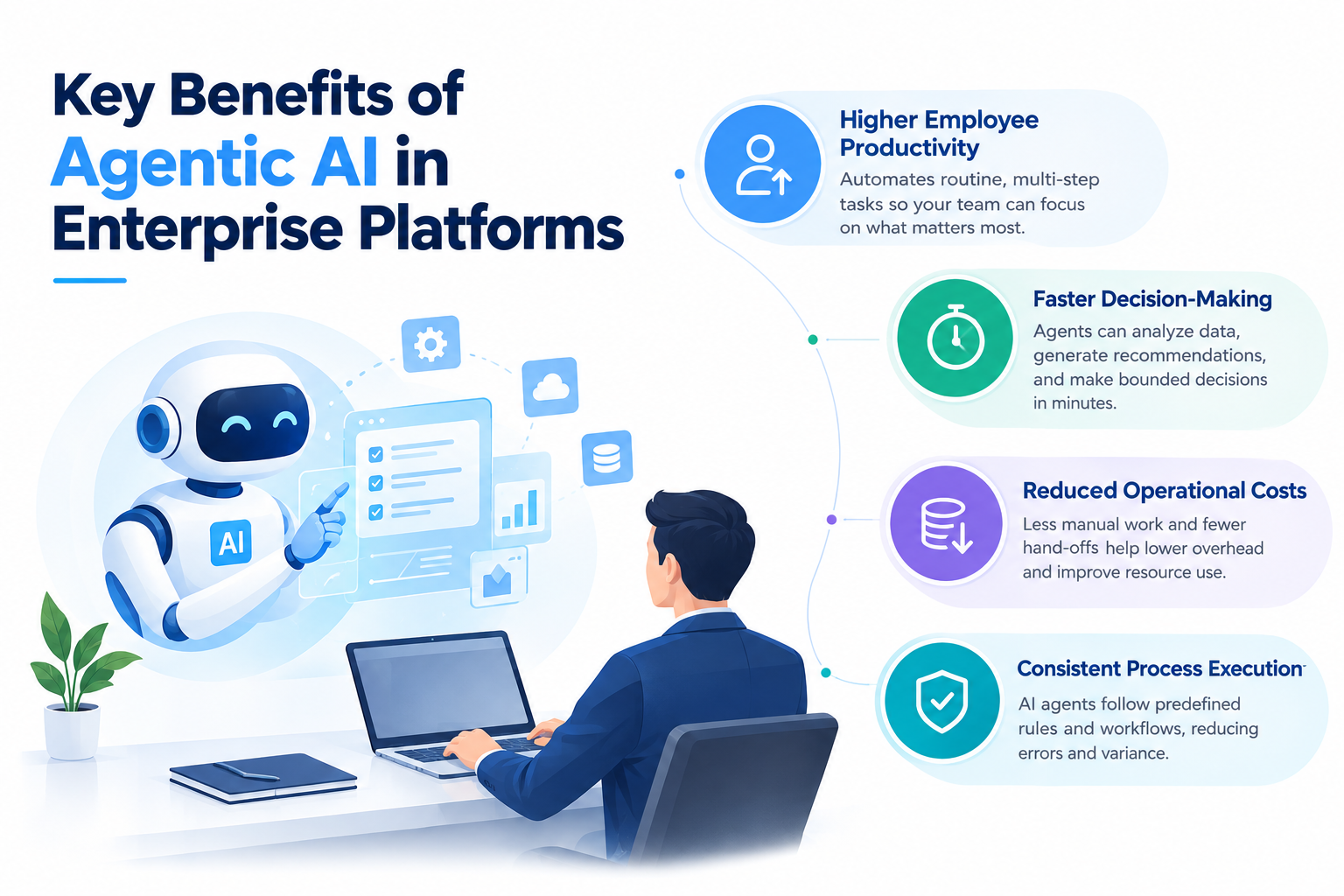
- Higher throughput per employee — routine multi-step work gets handled without a person driving each step
- Faster decision cycles — agents can gather data and propose or make bounded decisions in minutes, not days
- Lower operating costs — fewer manual hand-offs across departments reduces process overhead
- More consistent execution — agents follow the same defined logic every time, reducing variance between how different employees handle the same task
- Better employee experience — shifting repetitive coordination work to agents frees people for judgment-heavy, relationship-heavy work
- Scalability without proportional headcount growth — transaction volume can grow without a matching increase in operational staff
Taken together, these benefits explain why so many enterprise software roadmaps now lead with agentic AI in enterprise platforms rather than treating it as an add-on feature.
 Challenges and Risks of Deploying Agentic AI in Enterprise Platforms
The same autonomy that makes agentic AI in enterprise platforms powerful also makes it riskier than a passive chatbot. Four areas deserve particular attention before rollout.
Governance and Accountability
When software can take real actions — issuing a refund, changing a record, sending a communication — someone has to own the question of who is accountable if it acts incorrectly. Clear approval thresholds and audit trails are not optional extras; they’re the foundation of safe deployment.
Data Security and Privacy
Agents often need broad access to internal systems to be useful, which widens the potential blast radius of a mistake or a compromised credential. Role-based permissions and least-privilege access matter more, not less, once an AI system can act on its own.
Integration Complexity
Most enterprises run a patchwork of legacy systems, custom APIs, and third-party tools. Getting an agent to work reliably across that patchwork — without brittle integrations breaking the workflow — is often harder than building the agent’s reasoning itself.
Change Management and Trust
Employees who are used to owning a process end-to-end may be wary of a system that now does part of it for them. Rolling out agentic AI in enterprise platforms works best when it’s framed, and genuinely used, as removing drudgery rather than removing people.
Best Practices for Implementing Agentic AI in Enterprise Platforms
- Start with a narrow, well-defined workflow. Pick a process with clear rules and measurable outcomes before expanding scope.
- Keep a human in the loop for high-stakes decisions. Let agents handle the routine 80% and route exceptions to a person.
- Invest in observability. You need to see what an agent decided and why, not just what it output.
- Design for security from day one. Scope permissions tightly and log every action an agent takes.
- Set a baseline and measure ROI. Track cycle time, error rate, and cost per transaction before and after deployment so the business case is based on evidence, not assumption.
- Train employees on how to work alongside agents. The goal is a workflow where people and agents each do what they’re better at.
Agentic AI in Enterprise Platforms vs Traditional Enterprise Software
| Dimension | Traditional Enterprise Software | Agentic AI in Enterprise Platforms |
|---|---|---|
| Role of the system | Stores data, enforces workflow steps | Plans, decides, and executes steps |
| User involvement | Human drives every step | Human sets the goal and reviews exceptions |
| Adaptability | Rule changes need manual reconfiguration | Can adjust its plan within set boundaries |
| Speed of execution | Limited by how fast people click through steps | Limited mainly by system access and guardrails |
| Value over time | Value is fixed once configured | It can compound as the agent is given more scope |
The Future of Agentic AI in Enterprise Platforms
Agent Ecosystems and Interoperability Standards
As more vendors ship agents, the next challenge is getting agents from different systems to work together — a sales agent handing off to a finance agent, for instance. Expect continued work on standards that let agents discover and call each other’s capabilities safely across vendor boundaries.
Regulatory and Industry Trends to Watch
Regulators in several regions are starting to ask pointed questions about AI systems that take autonomous actions, particularly in finance, healthcare, and hiring. Enterprises adopting agentic AI in enterprise platforms should expect compliance requirements — audit logs, explainability, human override — to tighten rather than loosen over the next few years.
Key Takeaways
- Agentic AI in enterprise platforms plans, decides, and acts across systems — it goes beyond the drafting and summarizing that generative AI copilots do.
- It differs from traditional automation by adapting its plan as conditions change, instead of following a fixed script.
- The clearest early wins are in support, IT operations, finance, HR, and sales workflows with well-defined rules.
- Governance, security, and change management are the real gating factors for safe, effective adoption.
- Starting narrow, keeping humans in the loop for high-stakes calls, and measuring ROI are the most reliable paths to success.
Conclusion
Agentic AI in enterprise platforms marks a genuine shift in what business software does — from recording and displaying information to actively moving work forward. The organizations getting the most value aren’t the ones chasing the flashiest demo; they’re the ones picking a well-scoped workflow, building in proper oversight, and expanding scope as trust and evidence grow.
If your enterprise platform roadmap doesn’t yet account for agentic AI, now is the time to start piloting it—deliberately, securely, and with clear metrics for success. Aeologic Technologies can help enterprises explore AI-driven solutions that align with their business goals and support smarter, more efficient operations.
FAQ Section
Q1. What does “agentic” mean in agentic AI?
“Agentic” refers to an AI system’s ability to act with a degree of independence toward a goal, rather than only responding to a single prompt. In the context of agentic AI in enterprise platforms, it means the software can plan, decide, and carry out multi-step tasks across connected systems with limited human prompting at each step.
Q2. How does agentic AI in enterprise platforms work?
It’s typically given a goal and access to specific tools and data sources. The system breaks the goal into sub-tasks, decides which tool to use for each one, takes the action, checks the result, and adjusts its next step — continuing until the goal is met or it hits a boundary that requires human approval.
Q3. What’s the difference between an AI copilot and an AI agent?
A copilot assists a human who is actively driving the task, offering suggestions or drafts one step at a time. An agent can be delegated the whole task and complete most of it independently, only surfacing to a human for approval or when it encounters something outside its defined scope.
Q4. Which enterprise platforms already support agentic AI?
Major CRM, ERP, ITSM, and HR software vendors have been rolling out agentic capabilities into their existing platforms. Rather than naming specific vendors, enterprises evaluating options should check whether a platform’s AI features can take real actions across systems, not just generate text or recommendations.
Q5. Does agentic AI replace employees?
In most deployments, it replaces specific repetitive tasks within a role, not the role itself. Employees typically shift toward reviewing exceptions, handling judgment calls, and managing relationships — work that still requires human context and accountability.
Q6. What are the biggest risks of agentic AI in enterprise platforms?
The main risks are over-broad system access, insufficient audit trails, and a lack of clear accountability when an agent takes an incorrect action. These are governance and design risks more than they are risks inherent to the technology itself.
Q7. How do you measure ROI from agentic AI in enterprise platforms?
Common metrics include cycle time per task, error or exception rate, cost per transaction, and employee hours freed up for higher-value work. Measuring a baseline before deployment makes the comparison after rollout meaningful.

Manoj Kumar is a seasoned Digital Marketing Manager and passionate Tech Blogger with deep expertise in SEO, AI trends, and emerging digital technologies. He writes about innovative solutions that drive growth and transformation across industry.
Featured on – YOURSTORY | TECHSLING | ELEARNINGINDUSTRY | DATASCIENCECENTRAL | TIMESOFINDIA | MEDIUM | DATAFLOQ