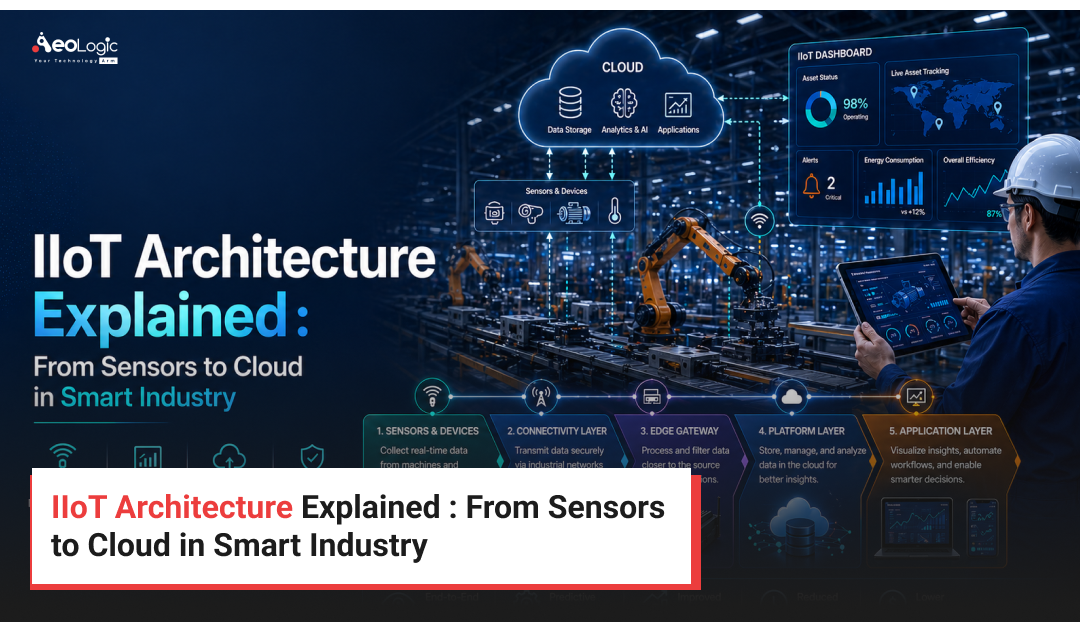
In today’s world of automation, digitalisation and data analytics, industries are rapidly shifting to intelligent and integrated systems. Central to this evolution is IIoT Architecture, which facilitates the interaction between devices, sensors and cloud systems to build smart industrial environments. In the transition towards Industry 4.0, data integration from the factory floor to analytics platforms is essential for enhancing productivity, minimising downtime, and fostering innovation.
In a fast-paced business environment, companies are no longer operating with siloed systems or manual processes. They are now creating a connected ecosystem in which devices, applications and platforms communicate seamlessly. This systematic approach not only improves visibility of the business but also enables real-time decision-making and enables growth of digital programs.
What is IIoT Architecture?
IIoT Architecture is the designed structure that integrates industrial devices, sensors, networks, data processing and cloud services into a cohesive system. This architecture specifies how data is gathered, transferred, processed and used to enhance operational efficiency, decision-making and automation within industrial settings.
Essentially, the architecture seeks to integrate operational technology (OT) with information technology (IT). Rather than isolated machines, this architecture facilitates real-time monitoring, predictive maintenance, and smart automation in industries like manufacturing, supply chain, energy, and healthcare.
Why IIoT Architecture Matters for Modern Enterprises
IIoT Architecture is essential to empower digital transformation in businesses. Lacking it can lead to isolated, vulnerable and inefficient industrial IoT systems.
Real-time data is crucial for today’s enterprises to enhance productivity, minimize downtime, and ensure quality. This approach facilitates the flow of data from sensors to analytics tools, allowing for quicker and more informed decisions.
It’s also scalable, enabling companies to grow their IoT deployments without impacting their current operations. With the integration of emerging technologies such as artificial intelligence (AI), machine learning and edge computing, a strong architecture is more important than ever.
Ultimately, it turns industrial data into a valuable resource for innovation, efficiency and growth.
Core Layers of IIoT Architecture
Device Layer (Sensors and Actuators)
The device layer is the backbone of IIoT Architecture, comprised of sensors, actuators and machines. These are used to gather data from the physical world like temperature, pressure, vibration, and motion.
Sensors measure equipment and environmental parameters, and actuators carry out actions in response to system signals. This is an important layer as data quality is determined by the quality of these devices.
Sensors such as RFID, GPS and smart meters are used to gather data across industries. The combination of these devices allows for real-time monitoring and control of processes.
Connectivity Layer (Network and Communication)
The connectivity layer facilitates the transfer of data from devices to data processing units. This layer comprises communication protocols, gateways and networking technologies like Wi-Fi, Ethernet, 5G and LPWAN.
This layer is crucial for data integrity and low latency. It allows smooth communication between devices and higher-level systems, even in challenging industrial settings.
Gateways may serve as data aggregators, collecting information from various devices and transmitting it to edge computing or cloud platforms. Connectivity is crucial for real-time monitoring and control.
Edge Computing Layer
The edge layer allows data processing in close proximity to devices, instead of transmitting all data to the cloud. This enhances speed and reduces data transfer costs.
Edge devices perform processing and support real-time processing for critical functions. For instance, in manufacturing, edge computing can identify machine performance anomalies and initiate corrective measures.
This improves efficiency and allows real-time operations. It also minimises reliance on cloud connectivity for operations.
Data Processing and Storage Layer
This component collects, stores and processes data from devices and edge platforms. It comprises databases, data lakes and analytics platforms.
Data processing includes filtering, cleaning and transforming data to extract insights. Complex analytics platforms and algorithms are applied to detect patterns, trends and anomalies.
Data management techniques are essential to efficiently manage the vast amount of industrial data. This layer allows businesses to leverage their data and gain insights.
Application Layer
The application layer offers user interfaces and applications to interact with the system. This layer comprises of dashboards, analytics and enterprise applications.
These applications allow users to view processes, reports, and manage processes. This layer converts data into simple and understandable insights.
They can be linked with enterprise resource planning (ERP) and customer relationship management (CRM) systems for efficient business processes.
Cloud Layer
The cloud layer is the core of data, analytics and application hosting. It offers scalability, flexibility and powerful computing resources.
The cloud allows companies to store large volumes of data and perform sophisticated analytics. They also facilitate remote access, enabling users to access and control operations remotely.
This layer is crucial for supporting advanced applications like predictive maintenance, AI analytics and digital twins.
 Step-by-Step Flow: From Sensors to Cloud
Step 1: Data Collection
Sensors installed on machines and equipment collect real-time data. These include temperature, pressure and vibration readings.
Step 2: Data Transmission
The collected data is transmitted through communication networks to gateways or edge devices. High-speed networks prevent data loss.
Step 3: Edge Processing
Edge devices analyze data locally to detect anomalies and trigger immediate actions. This speeds up processing and makes it more efficient.
Step 4: Data Aggregation
Processed data is aggregated and sent to centralized systems for further analysis. This step ensures that data is organized and ready for processing.
Step 5: Cloud Integration
Data is transferred to cloud platforms where advanced analytics and storage take place. This allows for massive data processing and insights generation.
Step 6: Visualization and Action
Insights are presented through dashboards and applications, enabling users to make informed decisions and take appropriate actions.
Key Benefits of IIoT Architecture
A sound IIoT Architecture provides several benefits to businesses, revolutionising industries and their competitive landscape in the digital economy.
It optimises processes through real-time data monitoring and automation. This helps to reduce downtime and boost productivity.
It facilitates predictive maintenance by detecting and predicting potential faults. This reduces maintenance expenses and prolongs the lifespan of equipment.
It enables better decision-making with real-time information. Businesses can adapt and fine-tune their operations.
It’s scalable, with companies able to scale IoT deployments without significant infrastructure modifications.
It improves security by adopting common protocols and monitoring practices, safeguarding industrial data against cyber attacks.
Real-World Use Cases of IIoT Architecture
Smart Manufacturing
In manufacturing, this architecture supports real-time production line monitoring. Real-time monitoring by sensors provides insights into machine efficiency, and analytics systems detect and eliminate bottlenecks.
Predictive Maintenance
IoT is used in industry to track equipment performance and forecast failures. This minimises unplanned maintenance and downtime.
Supply Chain Optimization
IoT solutions provide real-time monitoring of products throughout the supply chain.
Energy Management
IoT technologies help companies track energy use and manage energy efficiency, saving money and resources.
Healthcare and Pharmaceuticals
IoT solutions provide compliance and quality assurance by tracking conditions like temperature and humidity.
Technologies Powering IIoT Architecture
This architecture is facilitated by a number of technologies. IoT sensors and devices, edge and cloud computing, artificial intelligence and machine learning.
Data exchange is facilitated using communication protocols like MQTT, CoAP and HTTP.
Cloud platforms provide scalable infrastructure for data storage and analytics. Edge computing enhances real-time processing capabilities.
Cybersecurity technologies protect data and ensure the integrity of industrial systems.
Common Challenges in IIoT Implementation
However, there are challenges associated with IIoT Architecture implementation. A significant challenge is the integration of existing systems and IoT.
Security is also a significant issue, given the vulnerability of industrial systems to cyber attacks.
Scalability can also be an issue, particularly for large and complex systems.
Handling big data and maintaining data integrity requires sophisticated tools and skills.
Compatibility and interoperability between devices and platforms can also be a challenge and requires standards and protocols.
Best Practices for Successful IIoT Deployment
For successful deployment, companies should adhere to best practices, including identifying specific goals and applications prior to deployment.
They should focus on deploying flexible infrastructure to support future growth.
Cybersecurity is critical to safeguard data and systems.
They should also prioritise data governance and quality to get the most value from the IoT data.
IT-OT integration is important for smooth functioning of IoT systems.
Future Trends in IIoT Architecture
Emerging trends and technologies will drive the future of IIoT Architecture.
We will see greater use of edge computing for quicker and more efficient data processing.
Artificial intelligence and machine learning will enhance predictive analytics and automation capabilities.
Digital twins will allow virtual models of physical systems, facilitating better decision-making and optimisation.
Energy efficiency and sustainability will also be important factors, promoting the use of IoT technologies in industries.
Conclusion
To sum up, IIoT Architecture is the backbone of creating smart, integrated and efficient industrial systems. It facilitates the flow of data from sensors to the cloud, supporting businesses to streamline processes, lower operational expenses, and foster innovation.
With industries rapidly embracing digital transformation, building a scalable architecture is critical. Organizations that effectively embrace these systems will thrive in the data economy.
To harness the power of industrial IoT and create solutions ready for the future, working with a partner like Aeologic Technologies can assist companies to develop customised architectures that support their business objectives.
People Also Ask (FAQs)
Q1. What is IIoT Architecture and how does it work?
IIoT Architecture is a systematic design that links industrial devices, sensors, networks and the cloud to facilitate data-driven processes. It involves data collection from sensors, data transfer via communication networks, data processing (edge or cloud), and data presentation via applications. This facilitates real-time monitoring, predictive maintenance, and automation in industrial settings to enhance efficiency and inform decisions.
Q2. What are the main components of an IIoT system?
A typical IIoT system consists of devices (sensors and actuators), communication networks (gateways), edge processing and data processing units, applications, and cloud infrastructure. These elements are responsible for data collection, communication, processing, and application. Combined, they form an integrated system for real-time data and intelligent decision-making.
Q3. How is IIoT different from IoT?
While IoT focuses on consumer applications such as smart homes and wearable devices, IIoT is specifically designed for industrial environments. It emphasizes reliability, scalability, and security to handle critical operations.
Q4. What are the benefits of implementing IIoT in industries?
IIoT systems provide advantages like increased efficiency, downtime reduction, predictive maintenance, better decision-making and cost savings. It also allows automation and real-time monitoring, enabling companies to streamline their operations and remain competitive in the digital economy.
Q5. What challenges do companies face in IIoT adoption?
The challenges companies encounter include integrating existing systems, data security, managing data, and interoperability of devices and systems. To overcome these challenges, companies need to plan well, invest in technology, and involve both IT and OT personnel.
Q6. What role does cloud computing play in IIoT?
Cloud computing is the platform for storing and analysing the massive amount of data from IoT devices. It facilitates data analytics, remote monitoring and scalability. It also facilitates integration with other enterprise applications, improving efficiency and effectiveness.

Project Lead with 9+ years of experience in Web Technologies and AI. Expert in leading end-to-end development of scalable, AI-driven solutions. Driving innovation through smart architecture, agile execution, and team leadership.