
Many warehouses still rely on manual counts and barcode scans. Inventory numbers on the screen often fail to match the actual stock on the shelves. A pallet may be moved without being logged. A scanner may also miss a barcode hidden behind shrink wrap. A picker grabs the wrong SKU because two boxes look identical from three feet away. Multiply that by thousands of transactions a day, and even a 97% accuracy rate starts to translate into real money lost to stockouts, overstock, and frustrated customers.
This is exactly the gap that RFID in warehouse management is built to close. Radio-frequency identification (RFID) doesn’t require a clear line of sight. It reads tagged items automatically, often dozens at once. The collected data then flows into your systems in real time.
Copy revised text For operations teams tired of chasing discrepancies at month-end, that shift from periodic, manual counting to continuous, automated visibility is the difference between reacting to problems and preventing them.
In this guide, we’ll break down what RFID actually is, how it works inside a warehouse environment, the specific accuracy and efficiency gains it delivers, how it stacks up against barcode scanning, and what a realistic implementation looks like — including the costs and trade-offs nobody skips mentioning in the sales pitch.
What is RFID in Warehouse Management?
RFID in warehouse management uses radio-frequency identification technology to track inventory automatically. Small tags are attached to pallets, cartons, or individual items. Fixed or handheld readers capture their location, movement, and status without manual scanning.
Copy revised text Unlike barcodes, RFID tags don’t need direct line-of-sight contact with a reader, which allows warehouses to capture inventory data continuously and at much higher volume.
Direct Answer (Featured Snippet Target, 48 words): RFID in warehouse management is a tracking method that uses radio-frequency tags and readers to identify and locate inventory automatically, without line-of-sight scanning. It improves accuracy by capturing real-time data on every tagged item’s location and movement, reducing the manual counting errors common with barcode systems.
Each RFID tag carries a unique identifier and, depending on the tag type, additional data such as batch number, expiration date, or serial number. Readers positioned at dock doors, on forklifts, or at pick stations detect tags as items pass by, instantly updating the warehouse management system (WMS) with location and status changes.
 How Does RFID Work in a Warehouse?
An RFID system has three core components working together, and understanding each one helps explain why accuracy improves so much once the system is running.
1. RFID Tags — Passive tags have no internal power source and are activated by the reader’s signal; they’re inexpensive (often under $0.10 each) and ideal for high-volume item-level tagging. Active tags have their own battery, broadcast continuously, and are typically used for high-value assets or large containers that need long-range, real-time tracking.
2. RFID Readers — Fixed readers mounted at doorways, conveyor belts, and dock doors capture tag data as goods move past. Handheld readers let staff do targeted scans — a full pallet in seconds instead of scanning each carton individually.
3. Middleware and WMS Integration — Raw tag reads are filtered, deduplicated, and translated into usable inventory events, then pushed into the warehouse management system so stock levels, locations, and movement history update automatically.
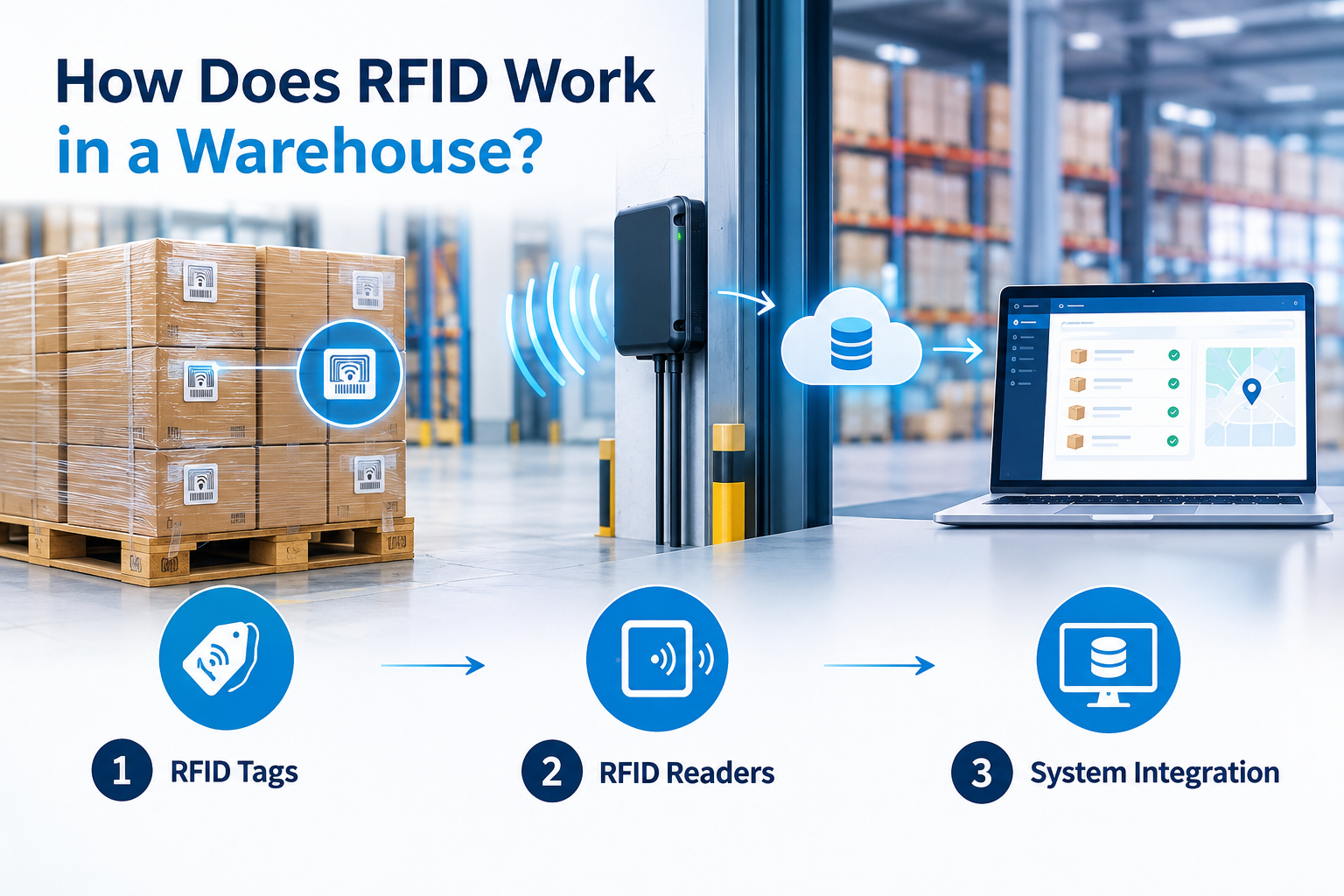
The result is a warehouse where inventory updates happen as a natural side effect of normal operations — goods moving through a dock door, a picker walking past a reader — rather than requiring someone to stop and manually log the transaction.
Top Benefits of RFID in Warehouse Management
The appeal of RFID in warehouse management comes down to six measurable improvements that compound on each other once the system is fully deployed.
1. Higher Inventory Accuracy
This is the headline benefit, and the one most operations leaders care about first. Barcode-based warehouses commonly report inventory accuracy in the 85–95% range, largely because scanning depends on a person catching every single item. RFID systems routinely push that into the high 90s, since tags are read automatically and in bulk rather than one at a time by hand. Fewer missed scans means fewer phantom stockouts, fewer “ghost” inventory records, and far less time spent on cycle counts trying to reconcile the system with reality.
2. Real-Time Visibility and Tracking
Because RFID doesn’t require line-of-sight, readers can capture an item’s location continuously as it moves through receiving, storage, picking, and shipping. Instead of a snapshot updated every few hours, managers see live movement — useful for locating a misplaced pallet, verifying a shipment left the correct dock door, or spotting a bottleneck in near real time.
3. Faster Receiving and Put-Away
A pallet wrapped in dozens of RFID-tagged cartons can be read in a single pass through a dock-door reader, confirming the full shipment contents in seconds rather than scanning each carton by hand. That shaves meaningful time off receiving, one of the most labor-intensive steps in a warehouse’s daily operation.
4. Reduced Labor Costs and Manual Errors
Every scan a worker doesn’t have to perform manually is time saved and a chance for human error removed. Warehouses that shift repetitive counting and scanning tasks to automated RFID reads typically redeploy that labor toward higher-value work like quality control or exception handling.
5. Improved Order Fulfillment and Fewer Shipping Mistakes
RFID verification at the pack and ship stage confirms that the items physically in a box match what the order says should be there — catching mis-picks before they become costly returns or chargebacks from retail partners.
6. Better Loss Prevention and Shrinkage Control
Because every tagged item’s movement is logged, discrepancies between expected and actual inventory are far easier to trace to a specific time, dock, or zone — making it harder for shrinkage, whether from error or theft, to go unnoticed.
RFID vs. Barcode Scanning: What’s the Difference?
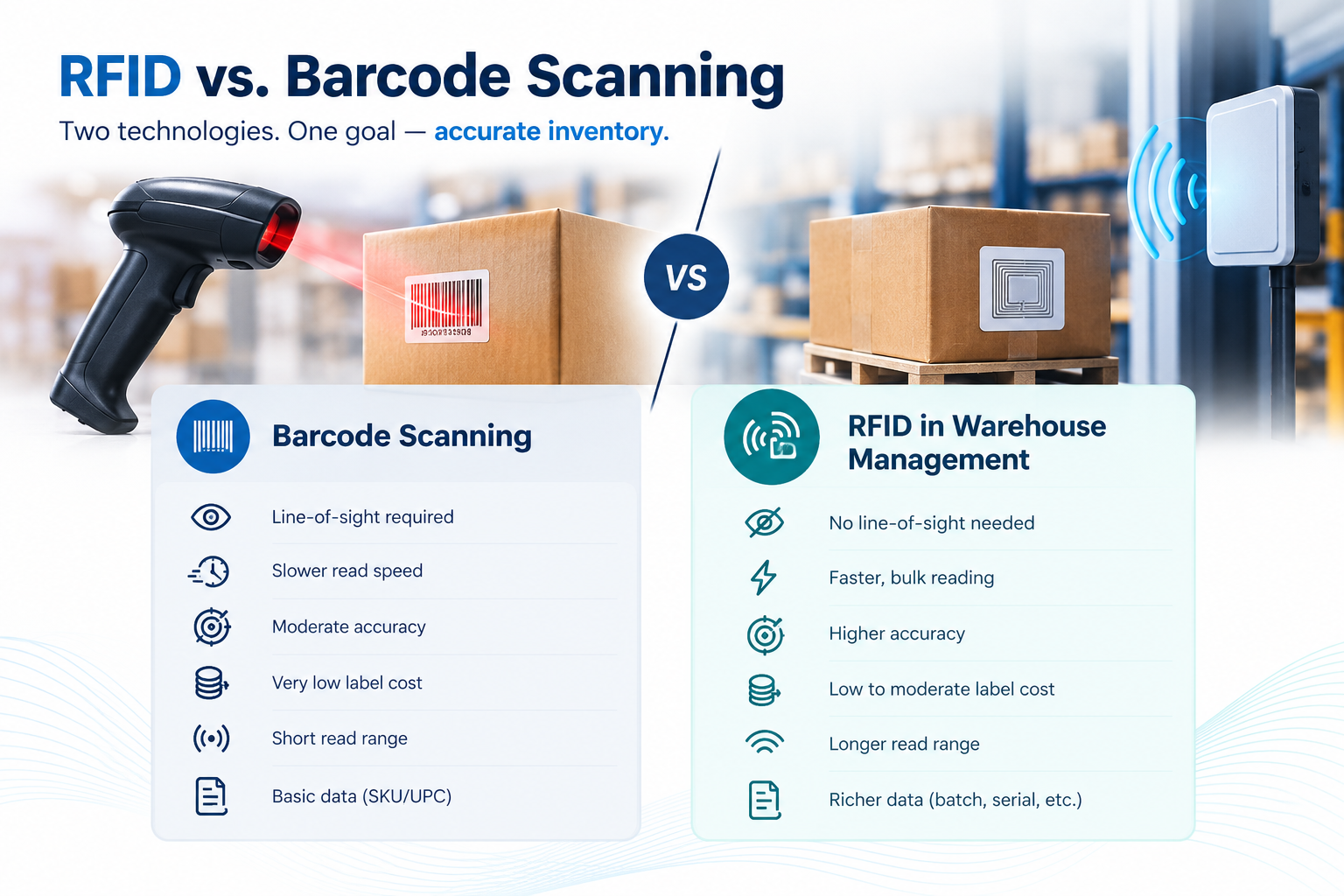
Barcode scanning isn’t obsolete — it’s cheaper to deploy and works fine for lower-volume operations. But when accuracy and speed at scale matter, the gap with RFID becomes clear.
| Factor | Barcode Scanning | RFID in Warehouse Management |
|---|---|---|
| Line-of-sight required | Yes, one item at a time | No, reads multiple tags simultaneously |
| Read speed | Seconds per item | Dozens of items per second |
| Typical accuracy | 85–95% | 95–99%+ |
| Tag/label cost | Very low (cents) | Low to moderate (passive tags often $0.05–$0.15) |
| Read range | Inches (direct contact) | Several feet to tens of feet |
| Data per tag | Limited (SKU/UPC) | Can store batch, serial, expiration data |
| Best fit | Small operations, low SKU count | High-volume, high-SKU, fast-moving environments |
Many mid-size and growing warehouses run a hybrid model — barcodes for low-value, slow-moving SKUs and RFID for high-value or high-velocity items — to balance cost against accuracy gains.
 Challenges and Limitations of RFID Adoption
No accuracy improvement comes free, and it’s worth being upfront about where RFID adoption gets complicated.
- Upfront cost. Readers, tags, middleware, and WMS integration represent a real capital investment, especially for item-level tagging at scale.
- Signal interference. Metal shelving and liquids can absorb or reflect RFID signals, sometimes requiring tag placement adjustments or specialized tag types.
- Integration complexity. Connecting RFID data cleanly into an existing WMS or ERP system takes technical work and testing before go-live.
- Staff training and change management. Workers accustomed to barcode workflows need training on new processes and, often, a shift in daily habits.
- Tag cost at item level. Tagging every individual SKU (versus case or pallet level) adds up quickly in high-SKU-count operations.
None of these are reasons to avoid RFID — but any realistic evaluation of RFID in warehouse management should weigh them against the accuracy and labor gains before committing to a full rollout.
Best Practices for Implementing RFID in Warehouse Management
Warehouses that get the most value from RFID in warehouse management tend to follow a similar implementation path rather than attempting a full facility-wide rollout on day one.
- Start with a pilot zone. Choose one high-value or high-error category — a single product line, or one dock door — and prove out accuracy gains before scaling.
- Match tag type to use case. Passive tags for high-volume item tracking; active tags for high-value assets needing continuous location data.
- Plan for WMS/ERP integration early. Involve IT and your WMS vendor before tag selection, not after — integration requirements often dictate tag and reader choices.
- Test for interference in your actual environment. Metal racking, liquids, and dense stacking all behave differently facility to facility; lab specs don’t guarantee in-warehouse performance.
- Train staff on the new workflow, not just the hardware. The biggest adoption risk is usually process change, not the technology itself.
- Track accuracy and ROI metrics from day one. Baseline your current accuracy rate before go-live so the improvement is measurable, not anecdotal.
Real-World Use Cases and Applications
RFID in warehouse management shows up differently depending on the industry:
- Retail and apparel — Item-level tagging supports accurate omnichannel fulfillment, where online and in-store inventory must stay in sync.
- Third-party logistics (3PL) — High SKU variety across multiple client accounts benefits from RFID’s speed advantage during receiving and cross-docking.
- Food and beverage / cold chain — Batch and expiration data encoded on tags supports FIFO rotation and faster recall response if needed.
- Pharmaceuticals — Serialized tracking supports compliance requirements and tighter chain-of-custody visibility.
- Manufacturing — Work-in-progress tracking across production stages reduces time spent locating components or sub-assemblies.
The Future of RFID in Warehouse Management
The next phase of RFID in warehouse management is less about the tags themselves and more about what they feed into. Integration with IoT sensors, real-time location systems (RTLS), and AI-driven demand forecasting is turning RFID data from a simple “what’s in stock” answer into a predictive input — flagging slow-moving stock, forecasting replenishment needs, and feeding robotics and automated guided vehicles with precise item locations. RAIN RFID standards are also pushing read ranges and tag costs in a direction that makes item-level tagging increasingly viable for operations that previously could only justify case- or pallet-level tracking.
Key Takeaways
- RFID eliminates the line-of-sight requirement that limits barcode scanning accuracy and speed.
- Typical accuracy improves from the 85–95% barcode range to 95–99%+ with RFID.
- The biggest gains show up in receiving speed, inventory accuracy, and order fulfillment correctness.
- Interference, integration work, and tag cost are real constraints worth piloting around before a full rollout.
- A phased pilot-then-scale approach reduces risk and builds a measurable ROI case.
Conclusion
Accuracy problems in a warehouse rarely come from one dramatic failure — they build up from dozens of small missed scans, mislabeled pallets, and manual counting errors every single day. RFID in warehouse management addresses that at the root by removing the dependency on a person catching every scan correctly, replacing it with automatic, continuous data capture at a scale manual processes simply can’t match.
While RFID offers significant benefits, costs, signal interference, and system integration remain important considerations. Aeologic Technologies can help businesses evaluate RFID solutions to improve warehouse accuracy and operational efficiency. Start with a small pilot, measure improvements against your current inventory accuracy, and use the results to guide future expansion.
FAQs
Q1. What is the main benefit of RFID in warehouse management?
The main benefit is accuracy: RFID automatically captures inventory location and movement without manual scanning, reducing the human error that causes stock discrepancies. This typically moves accuracy rates from the 85–95% range common with barcodes into the high 90s.
Q2. How much does RFID cost to implement in a warehouse?
Costs vary widely based on scale and tag type. Passive tags often run $0.05–$0.15 each, while readers, middleware, and WMS integration can range from a few thousand to six figures depending on facility size and whether tagging is applied at the case or item level.
Q3. Does RFID replace barcode scanning entirely?
Not necessarily. Many warehouses run a hybrid approach, using RFID for high-value or high-velocity SKUs and keeping barcodes for lower-priority items where the cost of tagging doesn’t justify the accuracy gain.
Q4. Can RFID work with metal shelving or liquid products?
Metal and liquids can interfere with RFID signals by reflecting or absorbing them. Specialized “on-metal” tags and careful reader placement typically resolve most of these issues, but it’s worth testing in your actual environment before a full rollout.
Q5. How long does an RFID implementation typically take?
A focused pilot in one zone can often launch within a few weeks to a couple of months. A full facility rollout, including WMS integration and staff training, more commonly takes several months depending on scale and system complexity.
Q6. What’s the difference between passive and active RFID tags?
Passive tags have no battery and are activated by the reader’s signal, making them cheap and suited to high-volume item tracking. Active tags carry their own power source, broadcast continuously, and suit long-range tracking of high-value or large assets.
Q7. Does RFID improve order picking accuracy?
Yes. RFID verification at pick and pack stations confirms that the physical contents of an order match what was selected, catching mis-picks before shipment rather than after a customer complaint or return.
Q8. Is RFID worth it for a small warehouse?
It depends on SKU volume and error rates. Smaller operations with low SKU counts and infrequent errors may see barcode scanning as sufficient, while those with high throughput or costly mis-picks often see faster ROI from RFID.

Manoj Kumar is a seasoned Digital Marketing Manager and passionate Tech Blogger with deep expertise in SEO, AI trends, and emerging digital technologies. He writes about innovative solutions that drive growth and transformation across industry.
Featured on – YOURSTORY | TECHSLING | ELEARNINGINDUSTRY | DATASCIENCECENTRAL | TIMESOFINDIA | MEDIUM | DATAFLOQ