
When should Enterprises choose On-Premise ERP? A Complete Guide
 Jubin Mathai
In an era of businesses that are increasingly seeking to transform into digital enterprises, one of the key technology decisions is choosing the right ERP system. ERP software can be used to link departments, help to streamline processes, centralize business information and equip organizations with …
ERP AMC Services : Key Benefits, and Business Value
 Prashant Yadav
In today’s digital era, businesses rely heavily on enterprise resource planning (ERP) systems to facilitate seamless departmental collaboration, streamline processes, and empower decision-making based on real-time data. ERP solutions cut down on business processes and boost the effectiveness of the organization, from finance and procurement …
Government ERP Use Cases : Transforming Digital Governance Across Public Services
 Bhagwan Pratap
Digital transformation has become a defining priority for governments across the world. As public expectations continue to evolve, government agencies are under increasing pressure to deliver faster, more transparent, and citizen-centric services while managing resources efficiently. Traditional administrative systems, often fragmented and heavily dependent on …

How AI Agents will revolutionize ERP Business Operations
 Ankit Sharma
Enterprise Resource Planning (ERP) systems have been a vital part of modern businesses for years. They help organizations manage finance, inventory, procurement, human resources, and customer relationships from a single platform. ERP solutions have evolved significantly over the years. Today, artificial intelligence (AI) is transforming …
Retail ERP : Benefits, Features, and Implementation Guide
Retail is a rapidly changing sector, with businesses trying to keep up with their customers’ ever-changing expectations, supply chain complexities, and the use of multiple sales channels. Whether in retail stores or through online channels, or across a combination of both (omnichannel retail), retailers are …
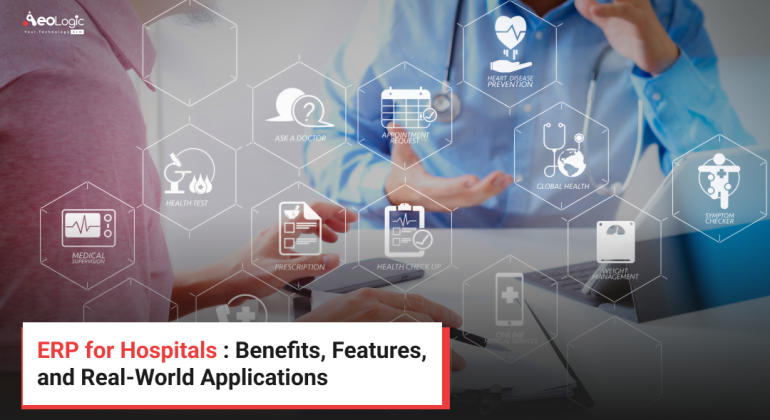
ERP for Hospitals : Benefits, Features, and Real-World Applications
The healthcare industry is undergoing a rapid digital transformation, and ERP for hospitals has become a critical technology for improving operational efficiency, patient care, and resource management. Modern hospitals manage complex processes across departments such as patient administration, finance, pharmacy, inventory, procurement, human resources, and …
ERP in Supply Chain Management : Benefits, Use Cases and Business Impact
Today’s supply chains are more interconnected, data-driven and customer-centric than ever. Companies today must be able to manage services such as procurement, inventory, warehousing, transportation, production and customer fulfillment in an efficient and accurate manner. When operating in such an environment, ERP in Supply Chain …
ERP Consulting Services : Why It’s Critical Before ERP Implementation
In today’s fast-paced and data-driven business landscape, operational efficiency, real-time visibility, and workflow optimization are vital to the continued success of modern business. Enterprise Resource Planning (ERP) is a software that enables an organization to connect various business functions like finance, supply chain, procurement, inventory, …
Why Custom ERP Development Matters for Complex Businesses
In today’s highly dynamic and interconnected business environment, organizations with complex operations often struggle to manage processes efficiently using off-the-shelf software. This is where Custom ERP Development for Complex Businesses becomes a strategic necessity rather than a luxury. Enterprises dealing with multi-layered workflows, diverse departments, …